Guest hospitality budget needed: MOFA
HONORED GUESTS: Countering China’s attempts to hem Taiwan in diplomatically and rising airline costs have caused the budget to increase, the ministry said
By Huang Ching-hsuan / Staff reporter


In a report, the Ministry of Foreign Affairs cited diplomatic pressure from China and deepening ties with the US as major factors for the increase of more than NT$150 million (US$4.57 million) in its budget for hosting foreign visitors this year.
The proposed budget drew scrutiny from lawmakers, who questioned the increase and called for an assessment of its effectiveness. The legislature subsequently froze NT$15 million of the proposed spending.
In its latest report submitted to the legislature, the ministry said that the rise in foreign guest reception budget is primarily for countering Chinese suppression, as well as for meeting growing demand for invitations and exchanges that resulted from deepening Taiwan-US and Taiwan-Canada relations
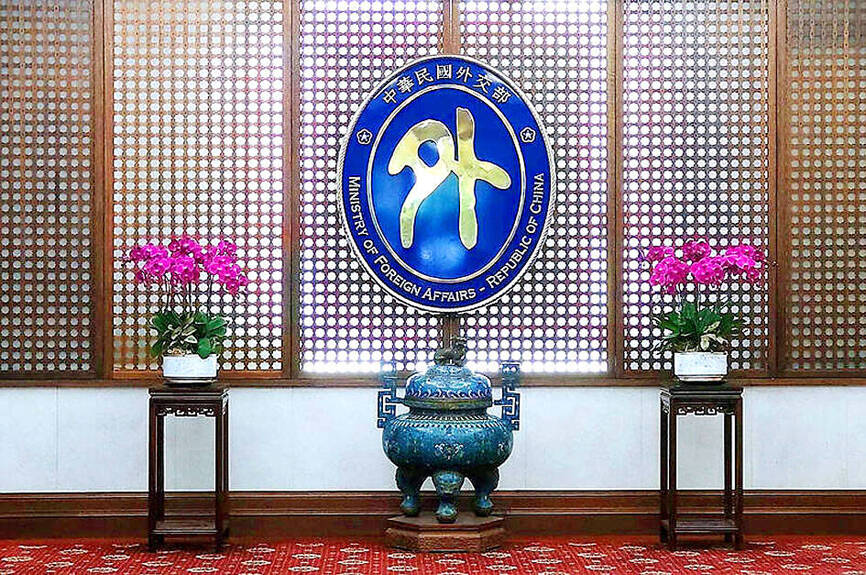
The Ministry of Foreign Affairs’ logo is pictured in an undated photograph.
Photo: Yang Cheng-yu, Taipei Times
Hosting foreign dignitaries is vital for deepening bilateral ties and garnering international support, it said in response to legislators’ questioning on the purpose, execution strategy, mid-to-long-term planning and quantitative evaluation of guest reception spending.
By inviting prominent figures — including politicians, parliamentarians, political staffers, think tank scholars, business leaders and media representatives — to Taiwan, the ministry aims to deepen their understanding of the nation’s democracy, economy, technology and society while fostering mutual trust, cooperation channels and pro-Taiwan support, it said.
The ministry said the expansion of this year’s budget for hosting visiting dignitaries is due to three main reasons: countering China’s diplomatic pressure and staying abreast of developments while expanding cooperation and meeting rising costs.
In response to China’s constant use of financial incentives and targeted infiltrations of Taiwan’s diplomatic allies and friends to narrow Taiwan’s international space, the ministry must strengthen ties with decisionmakers and opinion leaders from different countries, consolidate pro-Taiwan support and expand cooperation at all levels, it said.
The ministry said as US President Donald Trump’s administration strengthens its engagement with Latin American countries, Taiwan must remain abreast of regional developments and cooperative opportunities, using invitations to bolster relations with diplomatic allies and friendly non-diplomatic countries.
As Taiwan-US and Taiwan-Canada cooperation continues to deepen, the demand for invitations and exchanges across various fields has increased accordingly, it added.
The increased spending reflects international situations, inflation and fluctuations in exchange rates and oil prices affecting hosting costs, the ministry said.
Airfare is the primary cost involved in inviting foreign dignitaries, which must be arranged according to flight scheduling and ticket costs, it said.
The budget for inviting visitors in 2024 and last year fell short of the ministry’s needs, it said, adding that this year’s budget has been prudently increased based on planned invitations, execution status and cost fluctuations.
Regarding the outcomes, it said former Paraguayan president Santiago Pena visited Taiwan in May, witnessing the signing of a number of judicial, cybersecurity and artificial intelligence-related memorandums.
A delegation of Panamanian lawmakers visited Taiwan in February and were deeply impressed by Taiwan’s political and economic development, which led to the establishment of the Panama-Taiwan Inter-Parliamentary Friendship Group in the National Assembly of Panama in September, joined by 45 lawmakers so far, the ministry said.
The ministry said it has continued to invite politically influential or promising US and Canadian dignitaries, political staffers, scholars and analysts to visit Taiwan to cultivate friendly relations.
The ministry said that under last year’s Invitation Program, it welcomed 345 visitors across 41 North American delegations with all expenses covered.
It said it provided local reception and support for self-funded delegations and those independently organized by chambers of commerce, to expand networks across various sectors and lay the foundation for long-term cooperation.
KioskNews shows a cleaned-up reading view extracted from the publisher’s page — the original always lives on their site, not ours.