‘Like selling wolves from Yellowstone’: how protected US sharks are being sold off to foreign aquariums
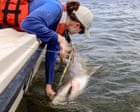
Shortly after 12.45pm, what remains of a 300-metre line goes taut. Somewhere beneath the murky green surface of Delaware Bay, on the eastern US coast, a sand tiger shark has taken the bait of a mackerel chunk. Marine researchers at the University of Delaware haul the line towards a small boat as the shark’s grey-brown outline emerges.
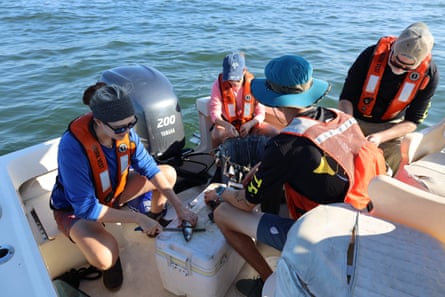
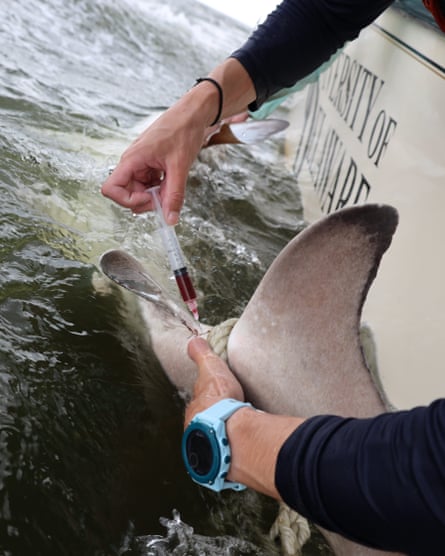
It is a large animal: 225cm (7ft) long with a 90cm girth. Its mouth hangs open, revealing rows of jagged teeth. The researchers work quickly, measuring the shark, recording its sex, and taking blood and muscle samples. A tag is then fastened beneath its dorsal fin, through its thick sandpapery skin.
The mature male seems to watch them as they work. Then it is lowered back into the bay. With a powerful flick of its tail, it disappears almost as quickly as it arrived.
Several thousand miles away, sand tiger sharks collected from these same waters circle tanks in Abu Dhabi, moving among artificial reefs and through blue-lit tunnels in the desert city’s aquariums, where visitors pay up to $100 (£75) for day passes. They will never return to Delaware Bay.
Tagging sand tigers – a species of concern that is prohibited from being caught in US waters – offers clues about the lives of these fish, which are critically endangered globally.
However, in recent years, the bay – a US habitat of particular concern between the states of Delaware and New Jersey – has become a hotspot for private collection of specimens for the global aquarium trade.
A recent study by marine researchers from the University of Delaware, Delaware State University and the University of Rhode Island shows that, since 2018, the number of sand tiger sharks collected from Delaware Bay for public display has risen sharply, from two that year to 40 in 2023. In total, 80 of the sharks were taken from Delaware waters for aquariums between 2018 and 2024.
The study, citing data from Delaware’s Department of Natural Resources and Environmental Control (DNREC) shows that nearly all the sand tiger sharks collected from Delaware Bay were sent overseas: the highest numbers went to China and the United Arab Emirates, while others went to South Korea and Thailand. Some were sent to other countries – including Turkey, Scotland, Israel, Italy, France and Uzbekistan – with a few remaining in the US.
“This [private collecting of sand tiger sharks] is like going into Yellowstone [national park] and catching wolves and then selling them to zoos in France or in the Middle East,” says Brad Wetherbee, a shark researcher at University of Rhode Island who co-wrote the study.
“[These countries] used to have sand tigers. They could just go out in their own waters and catch them and collect them, but their populations are so low they can’t do that any more.”
The US has spent decades restricting the killing of sand tiger sharks, yet in recent years, through a regulatory maze of federal and state permits, private collecting companies can legally remove these protected sharks from the wild for public display. A shark that an angler would be required to release after catching can instead be transported thousands of miles and placed in a foreign aquarium, with private companies profiting from the trade.
“How can we say these people [private collectors] can remove them and functionally harvest them, whereas these ones [recreational anglers] can’t?” says Aaron Carlisle, an associate professor from the University of Delaware’s school of marine science and another of the study’s authors. “If our concern is sustainability, we need to know what is the impact of removal.”

Sand tigers, despite their fearsome appearance, are non-aggressive and docile. They have one of the lowest reproductive rates of any shark species, reaching sexual maturity at about six to 10 years old, depending on sex, and producing just one or two pups every two to three years.
Once widespread across subtropical and temperate coastal waters, the species has declined across much of its range. Populations in parts of south-east Asia, west Africa and the Arabian Sea have fallen to critically low levels, largely because of overfishing, including bycatch, and habitat degradation. In some regions, they are believed to have been wiped out entirely.
The north-west Atlantic is one of the few regions where the species’ populations are not critically endangered, largely due to federal and state protections. Yet the population has never had a formal assessment, and how healthy it actually is remains difficult to determine.
One private company has accounted for most of the recent collection in Delaware Bay. Dynasty Marine, a Florida-based supplier of live marine animals to aquariums and research institutions worldwide that drew bipartisan outrage in Florida in 2025 after legally netting a manta ray for SeaWorld Abu Dhabi, began collecting sand tigers in Delaware in 2021.
A spokesperson for Delaware state’s department of natural resources and environmental control (DNREC) says the company has “ramped up collection in the following years”.
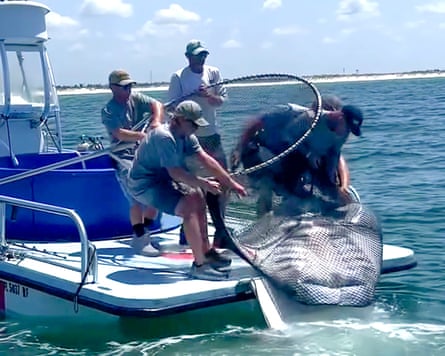
Records reviewed by the Guardian show that Dynasty Marine collected 71 sharks between 2022 and 2024. The study also records 35 sand tiger harvest requests in 2025, with most destined for China.
Recipients of the sharks caught between 2022 and 2024 included SeaWorld Abu Dhabi, Dubai Aquarium and Underwater Zoo, Sea Life Busan in South Korea, Aquaria Phuket in Thailand and Guangzhou Ocean World in China.
Dynasty Marine was asked to comment on the number of sand tigers it collects a year but did not respond. In a statement to the Guardian, it said: “Every collection we conduct is done in full compliance with all applicable federal and state permits and regulations.
“The animals we collect are cared for to the highest standards and go on to live in human care, where they play a vital role in educating millions of people each year about marine life and the importance of ocean conservation.”
The company says it supports “numerous marine conservation, science and education initiatives”, including shark research, manatee rehabilitation and coral restoration efforts.
Private companies seeking to collect sand tigers for public display must first obtain an exempted fishing permit from the US National Marine Fisheries Service (known as Noaa Fisheries). If the collection takes place in Delaware waters, the permit holder must then obtain a scientific collecting permit from DNREC.
Noaa Fisheries says it reviews applications for capture of the sharks on a “case-by-case basis”.
“We have an overall scientifically based annual quota for all shark research and public display,” says John Chu, a Noaa Fisheries spokesperson. “We consider that overall quota when issuing public display permits.”
The state follows the federal lead in granting permits. The DNREC says Noaa Fisheries’ approval is “evidence enough for the state to believe that removal of the permitted number of individual sharks is sustainable”.
However, scientists argue that, without knowing the population’s size or trend, it is difficult to determine what impact removing sharks for display in an aquarium may have.
The concern is heightened by the size of many sand tigers collected in Delaware. Many are large juveniles or near-mature adults that could soon reproduce if left in the wild.
The DNREC says the recent increase in collections is “an emerging concern”, but says it would be up to the federal government to act on that. It says an assessment on the number of sand tiger sharks in the area would “lend context” to a permit request from a private collection company.
This uncertainty extends to what happens to the sharks after they leave Delaware Bay. Neither the DNREC or Noaa Fisheries record the sharks’ final status, including whether those animals become sick or die, though the DNREC says it intends to change this.
Dewayne Fox, an assistant fisheries professor at Delaware State University who also worked on the study, says the issue is not just whether the collections are sustainable, but also who benefits from a population protected in US waters.
“We have protected the habitat and yet we are going to allow some out-of-state company to come in, catch these animals and then ship them all the way around the world and make money,” he says. “Everybody else is benefiting from our conservation success.”
KioskNews shows a cleaned-up reading view extracted from the publisher’s page — the original always lives on their site, not ours.