Ceferin: ‘Political interference’ in Italian football could ‘undermine UEFA trust’ ahead of Euro 2032

DUSSELDORF, GERMANY - JULY 06: Aleksander Ceferin, President of UEFA, looks on in the stands prior to the UEFA EURO 2024 quarter-final match between England and Switzerland at Düsseldorf Arena on July 06, 2024 in Dusseldorf, Germany. (Photo by Clive Mason/Getty Images)
With the FIGC likely to be put under special administration, UEFA President Aleksander Ceferin warns that ‘political interference could undermine the trust of UEFA and other partners’ ahead of Euro 2032.
Giovanni Malagò was elected FIGC President this past June, but Italian football is still far from stable.
Malagò is likely to be dethroned in the coming weeks by CONI, paving the way for the FIGC to be placed under special administration.
Technically, the reason is that Malagò didn’t formally have a FIGC membership, which is required to run for the presidency.

“Without delving into legal interpretations, I want to remind everyone that this is not the first time external interference in the Football Federation’s activities has arisen,” Ceferin told Gazzetta.
“FIFA and UEFA have always unequivocally insisted on the autonomy of federations. I hope the competent bodies will decide in line with the rules of sports law as soon as possible; the worsening institutional crisis benefits no one.
“We do not intend to prejudge the institutions’ decisions, but the independence of federations and respect for the will of their members are fundamental principles of the UEFA and FIFA Statutes, and we expect them to be upheld. We trust that the Italian sports institutions will find a solution in line with these principles, in the interest of both Italian and international football.”
Ceferin was asked whether a FIGC put under special administration would have consequences on Italy’s role as a co-host of Euro 2032.
“I do not intend to comment on hypothetical scenarios. No decision has been made yet,” he replied.

“I will only say that, as a co-organiser, Italy has a particular responsibility. For this very reason, it is important to preserve the independence of sports institutions. Any political interference could undermine the trust of UEFA and other partners, which would not serve either Italian football or the tournament.”
Ceferin has long been vocal that Italy must build new infrastructure and stadiums.
“Italy’s football infrastructure is nowhere near the prestige your football enjoys,” he insisted.
“Nevertheless, progress has been made. In August, 13 cities expressed interest in hosting matches, and the significant investments announced are an encouraging sign that institutions understand the seriousness of the situation. However, time is not on anyone’s side. The willingness shown must be translated into concrete steps as quickly as possible; that is the only thing that counts for success.
“The examples of Juventus, Atalanta, and Udinese demonstrate that when a club takes over a stadium and manages it, results follow relatively quickly. For this reason, I believe Euro 2032 is the right opportunity to improve this model, and that Italy, with the collaboration of public institutions, clubs, and local communities, will seize it.”
Malagò has replaced Gabriele Gravina as the FIGC President, but the latter has retained his role as UEFA vice-president.
Gravina resigned as FIGC President in March 2026 after Italy had failed to qualify for the World Cup for the third time in a row, the second time in his tenure
“Gravina left Italian football, in many respects, in better condition than he found it,” insisted Ceferin.
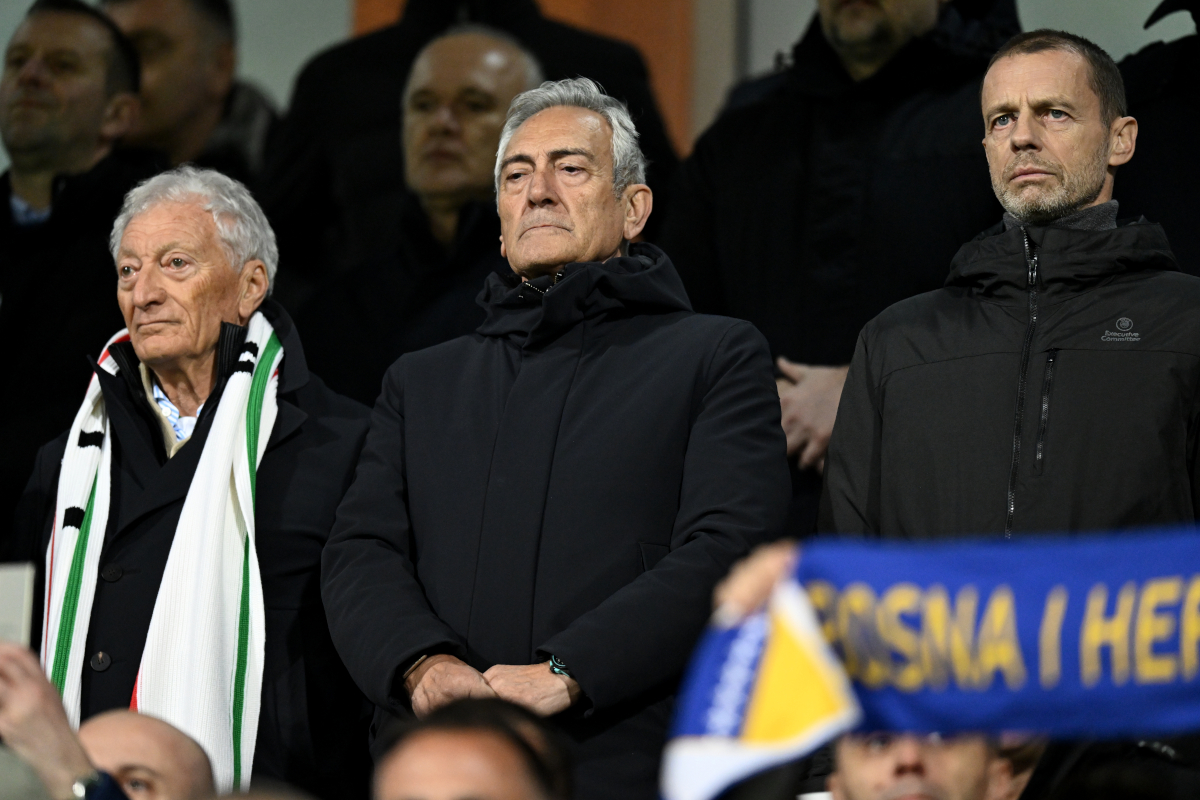
“The FIGC was emerging from special administration, and the national team from the shock of missing the World Cup. In less than three years, Italy became European champions at Wembley and finished third twice in the Nations League.
“But his greatest achievement is less visible: the system, with its successes in youth and women’s football, plus the winning bid to co-host Euro 2032 with Turkey. Football is like that: a single result can determine the fate of a role, but it cannot erase almost eight years of important work. Time will show how much Gravina has done for Italian football.”
Ceferin is on good terms with Malagò as well.
“He is a serious man with a great love for football, which has always been at the heart of our conversations. We have an excellent relationship,” he said.
Malagò and Ceferin also share the same stance on FIFA President Gianni Infantino.
“Trust in our sport rests on three pillars: unity, transparency, and governance that serves the many, not the few,” Ceferin concluded.
“Recently, those who swore to uphold them have trampled all three. The project that shattered the unity of world football may have been shelved, but the trust it compromised has not returned. Rebuilding it is now our common task. I am pleased that Italy and the rest of the European football family, along with some partners from other confederations, are united, as they always have been when it was necessary to defend our game. I repeat: football is not for sale.”
KioskNews shows a cleaned-up reading view extracted from the publisher’s page — the original always lives on their site, not ours.