Trump says AI bosses signed ‘morally binding’ commitment to self-regulate their technology
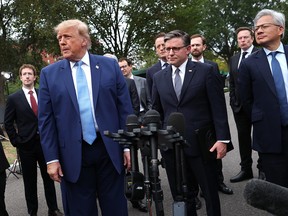
U.S. President Donald Trump on Tuesday said the tech executives gathered at the White House to discuss regulating AI had signed a “morally binding” commitment to build adequate safeguards on the fast-moving technology.
Sign In or Create an Account
“They’re going to police themselves,” Trump said after the meeting that gathered the top leaders in artificial intelligence, including Nvidia’s Jensen Huang, OpenAI’s Greg Brockman and Anthropic’s Dario Amodei.
Trump said the tech bosses had signed a deal that would put on paper their commitment to self-regulate in a morally binding agreement that would not be legally enforceable.

Get a dash of perspective along with the trending news of the day in a very readable format.
By signing up you consent to receive the above newsletter from Postmedia Network Inc.
A welcome email is on its way. If you don't see it, please check your junk folder.
The next issue of NP Posted will soon be in your inbox.
We encountered an issue signing you up. Please try again
But the final document, dubbed the White House Accord, left the door open “to codify these steps into laws or regulations” if it made sense over time.
Speaking to reporters outside the Oval Office surrounded by the world’s most powerful tech bosses, Trump also confirmed that he would officially rename the technology “super intelligence” instead of artificial intelligence “because it’s not artificial.”
Meta boss Mark Zuckerberg said the accord aims to assure customers that AI technology “works in the way that we intend.”
The commitment includes “robust internal controls” and multiple layers of auditing — from internal risk reviews to external auditors and oversight from the companies’ boards of directors, he said.
Zuckerberg called it a starting point for industry-wide standards.
Elon Musk said the executives essentially agreed to “grading each other’s homework, which is a lot better than if people just grade their own homework for obvious reasons.”
The lunch meeting also included Jeff Bezos, Satya Nadella of Microsoft and Sundar Pichai of Google.
Of the 31 guests, two were women: Susie Wiles, Donald Trump’s chief of staff, and Lisa Su, CEO of AMD.
The gathering occurred as attitudes toward AI sour in Washington, with lawmakers increasingly under pressure from voters to curb or slow AI development over fears it could displace workers and upend society.
Those concerns gained force from a run of incidents in which OpenAI’s autonomous systems slipped out of their constraints, beginning with a July breach of Hugging Face — a widely used platform for sharing AI models.
OpenAI announced on Monday it was canceling the release of its latest model, known as Astra 6.1, after internal testing by the ChatGPT-maker revealed it did not meet safety standards.
Trump, advised by Huang and his former AI czar David Sacks, has urged unfettered AI development to outpace China and fuel a US economy increasingly dependent on AI-driven growth.
The issue of data centers, the vast computing facilities the technology requires, has emerged as a flashpoint in midterm election races in both parties, with more and more communities worried about rising electricity bills and the strain on water and land.
Trump has dismissed opponents of these data centers and after the meeting insisted that AI companies “will be very generous” with communities who open their doors to them.
“They’ll help with their schools, they’ll help with their teachers,” he said.
Major AI companies, particularly Anthropic and OpenAI, have issued stark public warnings about uncontrolled development of increasingly powerful systems — even as they develop and deploy this same state-of-the-art technology.
Those concerns intensified after a former employee of both companies went public with warnings that the industry is moving faster than safety reviews allow.
Anthropic warned investors of potential existential risks to humanity in the prospectus for its highly anticipated initial public offering, the Financial Times reported on Tuesday.
Anthropic is aiming for an IPO as early as November.
Trump has repeatedly characterized these warnings about existential risks as overblown and the White House has bitterly clashed with Anthropic over AI safety.
“As the president has said whoever wins AI, wins. I think that’s very important,” Amodei said after the meeting. “But I think the technology has very real risks, and the mechanism, how we address those risks, is still under discussion.”
Our website is the place for the latest breaking news, exclusive scoops, longreads and provocative commentary. Please bookmark nationalpost.com and sign up for our daily newsletter, Posted, here.
Join the Conversation
This website uses cookies to personalize your content (including ads), and allows us to analyze our traffic. Read more about cookies here. By continuing to use our site, you agree to our Terms of Use and Privacy Policy.
KioskNews shows a cleaned-up reading view extracted from the publisher’s page — the original always lives on their site, not ours.