Wildfires - South Kalimantan police test starch-based fire suppressant
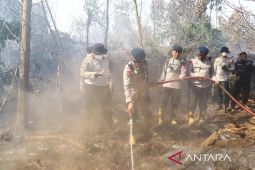
Banjarbaru, S Kalimantan (ANTARA) - South Kalimantan police are testing a starch-based liquid to improve efforts to extinguish forest and peatland fires, particularly around Banjarbaru's airport, to prevent smoke from disrupting flights.
"With the support and direction of the national police chief, we tested this flour-based formula mixed with water, and results showed it effectively slowed the spread of fire," South Kalimantan Police Chief Inspector General Rosyanto Yudha Hermawan said here Friday.
The police chief said the flour-based liquid was supplied directly by the National Police headquarters.
The peatland firefighting formula uses cassava starch mixed with ammonium polyphosphate, water and a wetting agent to slow the spread of fire.
Water in the mixture absorbs heat and lowers the temperature of vegetation and other combustible material, while cassava starch improves adhesion, helping the liquid remain longer on the ground.
The starch also helps distribute moisture more evenly across the land, keeping peat surfaces wet for longer and reducing the risk of fire spreading.
South Kalimantan police, working with the Indonesian Palm Oil Association (GAPKI), have also applied a peatland injection method, pumping water directly into soil to depths of up to two meters.
The injected water is mixed with foam, which acts as a wetting agent to improve moisture penetration into the peat.
Yudha said trials showed a significant drop in soil temperatures, with an area within about a one-meter radius of injection points becoming cooler and underground fire sources being suppressed.
The South Kalimantan police forensic laboratory is currently helping develop and reproduce the wetting-liquid formula for wider use.
"We aim to produce and deploy it more widely starting today, particularly to wet peatland in three priority areas: Guntung Damar, Liang Anggang protected forest and Pengayuan," Yudha said.
Related news: Indonesia deploys extra 1,000 forest rangers for wildfire response
Related news: Gov't sends 200 water pumps to support Kalimantan wildfire response
Translator: Firman, Rahmad Nasution
Editor: Primayanti
Copyright © ANTARA 2026
KioskNews shows a cleaned-up reading view extracted from the publisher’s page — the original always lives on their site, not ours.