Premier refuses to countersign bill on seniors’ NHI premiums
Premier Cho Jung-tai (卓榮泰) will not countersign an amendment requiring the central government to cover National Health Insurance (NHI) premiums for certain seniors, Cabinet spokesperson Michelle Lee (李慧芝) said yesterday.
In a statement, Lee outlined three reasons for Cho’s decision not to countersign the amendment to Article 22 of the Senior Citizens Welfare Act (老人福利法), which would cost the government an estimated NT$40 billion (US$1.22 billion) annually.
Under the amendment, the central government would fully cover NHI premiums for eligible seniors, estimated to account for about 80 percent of people aged 65 and older.
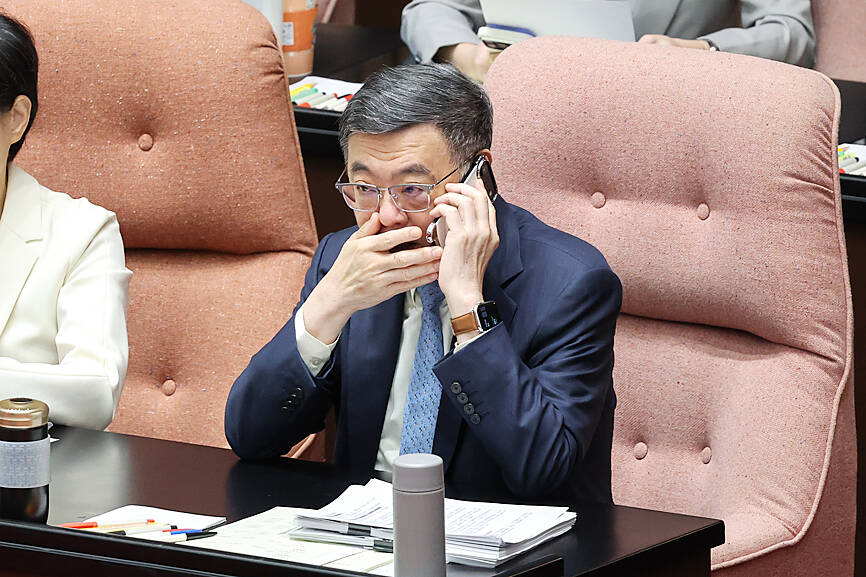
Premier Cho Jung-tai speaks on the phone during a break at the Legislative Yuan in Taipei yesterday.
Photo: CNA
It would also remove local governments’ obligation to help cover medical expenses not reimbursed by NHI for seniors unable to afford them. According to Lee, about 66,000 people currently qualify for such assistance.
The amendment passed the Legislature in a 60-39 vote, with support from the opposition Chinese Nationalist Party (KMT) and Taiwan People’s Party, which together hold a legislative majority.
Lee said the Cabinet’s first concern was that the amendment would infringe on its constitutional authority over policymaking and budgeting by requiring additional government spending.
She said this would violate Article 70 of the Constitution and Article 91 of the Budget Act (預算法) .
The additional NT$40 billion in annual spending could divert funding from elderly care, long-term care and other welfare programs, she added.
The Cabinet’s second concern was that low-income seniors could lose access to medical assistance because no other law requires local governments to cover their medical expenses, Lee said.
Third, she warned that the cost would continue to rise as Taiwan’s population ages, placing a greater financial burden on younger generations and potentially reducing funding for other public programs.
Cho’s decision brings to nine the number of bills passed by the Legislature that have been blocked from taking effect amid a political standoff between the ruling Democratic Progressive Party and opposition parties.
Under Article 37 of the Republic of China Constitution, the president must obtain the premier’s countersignature when promulgating laws or issuing mandates.
However, the use of this power remains controversial. Opposition parties argue that the countersignature requirement is intended to limit presidential authority rather than allow the premier to override the Legislature.
They maintain that the Cabinet should instead ask lawmakers to reconsider legislation it opposes.
KioskNews shows a cleaned-up reading view extracted from the publisher’s page — the original always lives on their site, not ours.