The Mad-ness continues: Jon Hamm suits up again for Winnipeg-shot series American Hostage
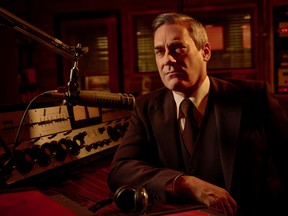
It has been 11 years since the landmark TV series Mad Men finished its seven-season run, from 2007 to 2015.
Sign In or Create an Account
Since that time, actor Jon Hamm has put some distance between himself and the role of smooth-surfaced, internally roiling Madison Avenue ad man Don Draper. Hamm played a vicious bent lawman in the fifth season of Fargo, a bloodthirsty crook in Baby Driver, a stuffy vice-admiral with little patience for Tom Cruise’s shenanigans in Top Gun: Maverick, and assorted roles in an array of series such as Your Friends & Neighbors, Landman and The Morning Show.
Yet with that multitude of characters, it’s hard not to think of Draper as you watch Hamm’s new eight-episode series American Hostage, premièring on Crave on Sept 20.
In an adaptation of a true crime story from 1977, Hamm plays Fred Heckman, a popular, even revered Indianapolis radio host who inadvertently becomes a part of the story he is covering when he agrees to interview Tony Kiritsis (Giovanni Ribisi), an angry would-be entrepreneur who feels cheated by a local mortgage broker and takes a hostage from the firm in a bid to air his grievances publicly.
Though the period is a decade later than Mad Men, Draper and Heckman appear to be brothers under the skin, smart, capable, ambitious alphas, masters of their media fields, coping with dramatically changing times.
One distinction between the men is that Draper spins the truth and Heckman honours it above all.
Hamm, speaking about the show following its première at the Toronto International Film Festival, says the suit-and-tie, cigarettes, barbered similarities are outweighed by that disparity.
“The difference, I think, with Don Draper is that he, as an advertising creative person is driving the narrative and driving the conversation, whereas Fred, being a journalist, is trying to be neutral, is trying to just report the facts.”
“And the problem with the situation as it develops in American Hostage is that he is thrust into being a part of the story, and trying to navigate the difficulty of finding the line. Where is the line? The line keeps moving.”

The show, filmed in Winnipeg, was adapted by a podcast of the same name, which also featured Hamm as Heckman. If the story is near to Hamm’s heart — he also serves as an executive producer — it may be because it resonated with him personally, hearkening to a time when journalism had a clearer purpose and radio was a driving media force in the community.
“I’m from St. Louis, Missouri, which is a very similar city to Indianapolis, especially in the ‘70s,” Hamm says. “There’s a lot of shared DNA. They’re both in the Midwest. They’re both relatively rural.
“The main radio station in St. Louis was KMOX, which was a 50,000-watt clear channel,” Hamm recalls. “It was called the Voice of the Prairie because it broadcast from St. Louis all the way to the Rocky Mountains. You could get Cardinal games in 12 states. And so you could also get the news delivered right there. And so everybody listened to KMOX.”
Hamm says his friend, sportscaster Joe Buck, came from that realm.
“He broadcast the Cardinal games. His father broadcast the Cardinal games,” Hamm recalls. “That family was such a beloved part of the community in St. Louis because of their place on this radio station that was in everybody’s homes all the time. So much so that on Thanksgiving and Christmas, they would do a remote thing from the Bucks’ house.
“He would have people over and he would interview people at his house and ‘Have Merry Christmas everybody’ and ‘Happy Thanksgiving everybody.’ And that was a thing you listened to.
“So the voice of these people was very much part of the community, the voices of these people. And so that was kind of my inspiration for where Fred was in the community for sure, and the place that he held in the community and the place that journalism used to hold.
“We used to trust these voices because we knew they were giving us the facts.,” Hamm says. “They weren’t giving us their opinion on the facts. Or if they did, they would say, ‘This is an opinion. This does not represent the views of the radio station in any way.’
“Now it’s all opinion,” Hamm says. “And you have to kind of determine what’s bull and what isn’t.”
randall.king.arts@gmail.com
Join the Conversation
This website uses cookies to personalize your content (including ads), and allows us to analyze our traffic. Read more about cookies here. By continuing to use our site, you agree to our Terms of Use and Privacy Policy.
KioskNews shows a cleaned-up reading view extracted from the publisher’s page — the original always lives on their site, not ours.