Cabinet approves draft for NT$100bn MSME program
EXTENDED ASSISTANCE: The draft includes expanding tax incentives for equipment investment and R&D as well as additional tax deductions for wage increases
By Chung Li-hua and Jake Chung / Staff reporter, with staff writer and CNA


The Executive Yuan yesterday approved a draft proposal for an eight-year, NT$100 billion (US$3.17 billion) program to support the development of micro, small and medium-sized enterprises (MSMEs) through expanded tax breaks, relaxed investment thresholds and targeted loans.
More than 4,000 MSMEs are expected to benefit from the initiative, generating more than NT$50 billion in investment, the Ministry of Economic Affairs said.
A notice to commence a period of public comments for the proposal was announced yesterday, with public hearings to be held to gather feedback from business owners.
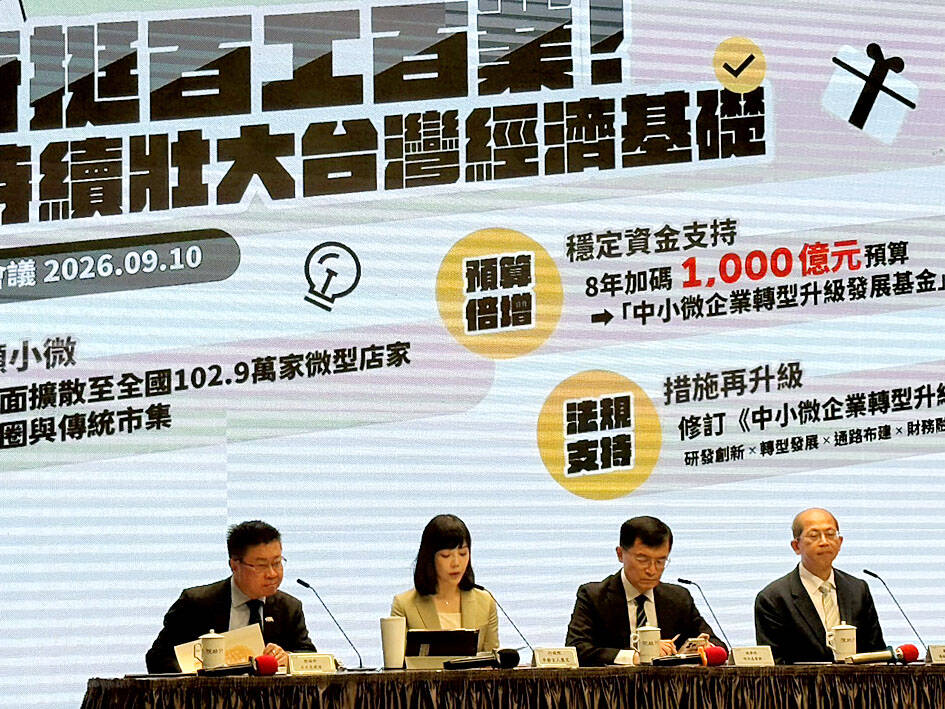
Cabinet officials preside over a post-meeting news conference in Taipei yesterday.
Photo: Chung Li-hua, Taipei Times
It is expected to be submitted to the Executive Yuan for approval next month before being forwarded to the legislature for review.
According to the government’s White Paper on Small and Medium Enterprises last year, Taiwan has 1.716 million MSMEs, accounting for 98.9 percent of all businesses and employing nearly 80 percent of the workforce, or about 9.194 million people.
The draft plans to extend government assistance to 1.029 million microbusinesses, including sole proprietorships and partnerships, which account for about 60 percent of all businesses.
The program would also cover commercial districts, public markets, local specialty industries, agricultural enterprises, tourism businesses and start-ups.
It includes measures to improve the business environment in 353 commercial districts and 1,030 public markets.
A chapter dedicated to start-up development discussed encouraging large corporations and venture capital firms to nurture start-ups, and creating an environment for innovation and experimentation. Larger companies would be encouraged to help MSMEs connect with high-tech supply chains and digital platforms.
For businesses with fewer than 30 employees, the government would provide simplified loan applications, project-based loans and short-term interest subsidies, while expanding credit guarantee coverage.
A Small and Medium Enterprise Credit Guarantee Fund would also increase its risk coverage to help smaller businesses that lack substantial collateral to obtain financing for transformation.
Businesses could obtain additional credit guarantee coverage if funds are used to raise employee wages, the ministry said.
The program would significantly expand tax incentives for equipment investment, and research and development (R&D), and lower the minimum investment required to qualify for tax credits on smart machinery, artificial intelligence, digital transformation and net zero equipment from NT$1 million to NT$250,000, under the Industrial Innovation Act (產業創新條例).
Digital management systems needed by service businesses and outsourced R&D spending would also qualify for the first time, while the R&D tax credit rate would rise to 20 percent.
Tax incentives for hiring would be expanded, with the eligible age range widened from 24 or younger and 65 or older to 29 or younger and 55 or older.
The additional tax deduction for wage increases would rise from 175 to 200 percent.
KioskNews shows a cleaned-up reading view extracted from the publisher’s page — the original always lives on their site, not ours.