From Jensen Huang to India-Pakistan and beyond, the long history of honeytrapping
At the height of World War II, a charming, six-foot-six former British Royal Air Force pilot became the life of America’s cocktail party circuit. He built connections with American politicians, journalists and business tycoons. And he wooed some of the country’s most influential socialites, including oil heiress Millicent Rogers and Congresswoman Clare Boothe Luce.
All this was part of an undercover effort to detect any potential anti-British sentiment circulating in the US government’s corridors of power. We know the man better as the beloved children’s author Roald Dahl. And he was what those in the intelligence community would call a classic case of a “honeypot”.
The tactic, long used in spycraft, has recently been in the news after it emerged that Jensen Huang, CEO of the high-profile US technology firm Nvidia, had an extramarital affair with a woman suspected to be working on behalf of Chinese intelligence agencies. We explain the meaning of the term and its history of deployment in the world of espionage
What is a honeypot or honeytrap?
While the Oxford English Dictionary lists the earliest usage of the term “honeypot” in the English-Latin wordbook Catholicon Anglicum in 1475 CE, it came to describe anything irresistible or something that drew people towards it — as idioms such as “like flies to a honey pot” in mid-19th-century newspapers indicate. On the other hand, “honeytrap” had a literal meaning — as in any type of insect trap that uses honey as bait — before both terms became prevalent in spycraft.
Now, a honeypot or a honeytrap refers to an espionage tactic that involves an attractive person promising or using romantic or sexual relations to lure individuals possessing valuable, classified information into revealing it. A deeply invasive and controversial tactic, it aims to extract sensitive information such as State or military secrets or even gain access to embassies and consulates.
 Poster from World War II, depicting an attractive woman speaking to a Royal Air Force sergeant. (Wikimedia Commons)
Traditionally, this involved physical relationships. But the Internet’s ever-growing reach since the turn of the millennium has led to rising cases of cyber-honeytrapping, where victims are enticed through false social media profiles or even AI deepfakes.
How are honeypots used in spying?
Some claim that the earliest recorded instance of honeytrapping exists in the Bible’s Book of Judges, where a woman named Delilah is bribed by the Philistines to discover the source of the Israelite judge Samson’s superhuman strength. Samson eventually falls in love with Delilah (who might not have reciprocated his feelings) and gives away his secret to her, who then betrays him to his enemies.
Story continues below this ad
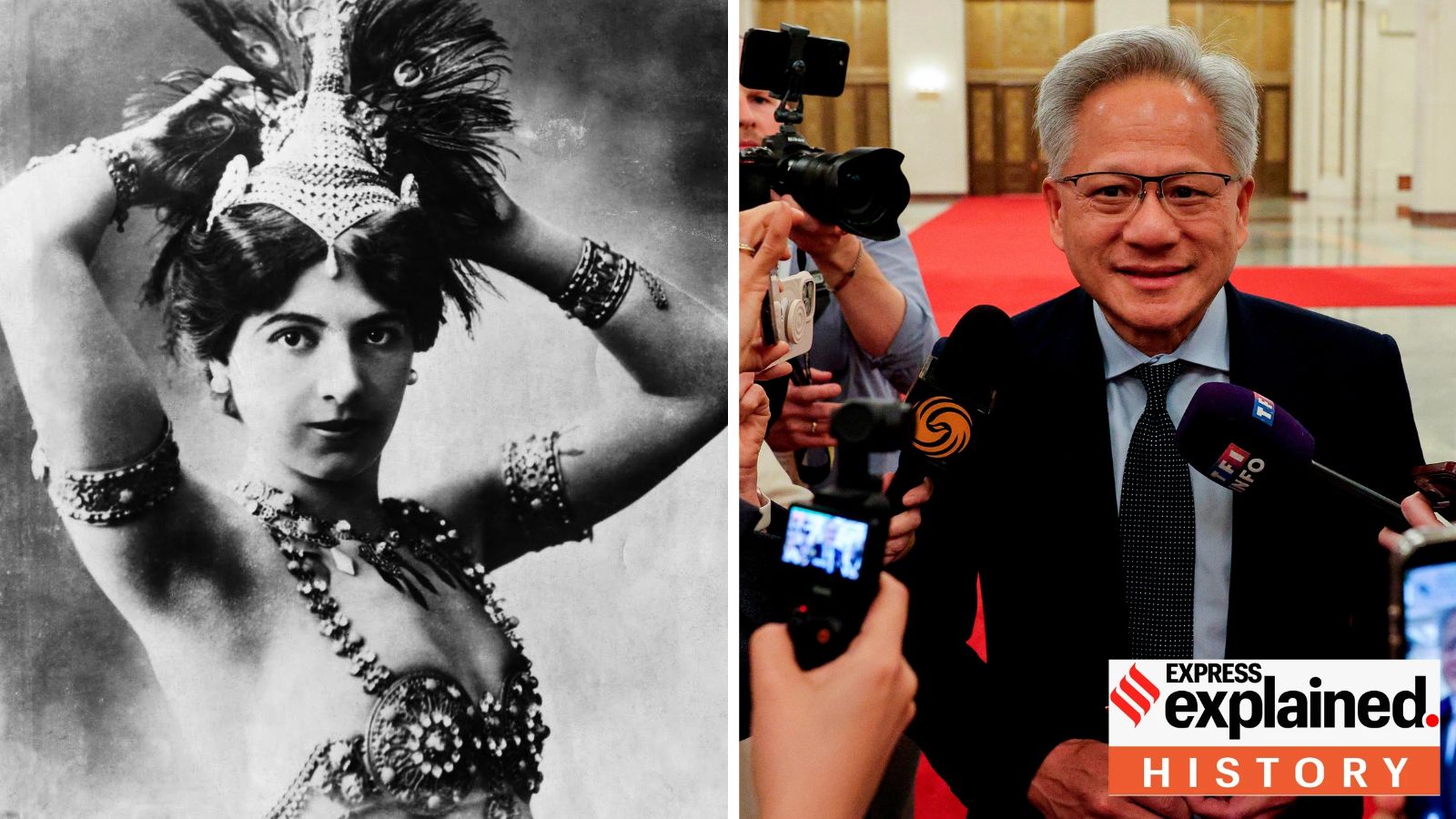
But its deployment as a stratagem in a systematic manner began only in the 20th century. One of the earliest and contentious examples is the Dutchwoman Margaretha Geertruida MacLeod, better known as the exotic dancer Mata Hari. She gained fame in Paris, but she was constantly on the radar of French intelligence during World War I, given her numerous relationships with military officers, some involving money.
After intercepted communications showed her receiving money from a German consul, she was convicted of being a German spy by a French military court and executed by firing squad in 1917. Decades later, many have raised questions about her guilt, while some have suggested that she had either been a scapegoat for officials seeking to blame someone for France’s wartime failures or that her blatant disregard for societal norms led to her conviction.
Another prominent example from the early 20th century was Yakov Agranov, a high-ranking deputy of the Soviet intelligence service NKVD, who was responsible for political repression and the Stalinist show trials during the 1920s and 1930s. He organised sex spy operations (also called “sexpionage”) to target members of the Russian intelligentsia using Bolshoi ballerinas as well as movie and theatre actresses.
Agranov was also responsible for establishing what would serve as a blueprint for Russia’s “sexpionage schools” — Jason Matthews, a former CIA officer-turned-novelist, depicted one such real-world school in the Russian city of Kazan in his award-winning 2013 novel Red Sparrow (later adapted into a 2018 Hollywood film starring Jennifer Lawrence).
Story continues below this ad
During WWII, the Anglo-American spy Betty Pack (whose maiden name was Amy Elizabeth Thorpe) played a key role in extracting naval code ciphers of France’s Nazi collaborator Vichy regime by seducing a French embassy official. Her deception facilitated the successful US invasion of parts of Vichy-held North Africa in late 1942.
As WWII ended and the Cold War began, Germany had already been divided into two: West and East. In the early 1950s, the East German spymaster Markus Wolf established a new department in his country’s security service, the Stasi, and filled it with good-looking, well-mannered male agents called “Romeo spies”.
The department stemmed from Wolf’s realisation that since WWII had cost thousands of German lives (mostly men), many women in West Germany — especially some powerful and influential ones — were seeking company. The Romeo spies exploited this enforced solitude to obtain valuable intelligence and infiltrated West Germany’s government and key industries.
The same Stasi, in the 1960s, would also use women, nicknamed “Mielke’s Maidens” after the Stasi chief Erich Mielke, to carry out sexpionage operations against Western diplomats and businessmen to entrap and compromise them. The Stasi even identified and targeted gays and lesbians perceived as susceptible to blackmail.
Story continues below this ad
A 2002 report in The Scotsman on a 2,500-page declassified Stasi dossier revealed the extent of these operations. “Officially, prostitution was a western bourgeois ailment that had no place in the socialist Utopia of the German Democratic Republic. Unofficially, it was an important tool in the war against the class enemies beyond the Berlin Wall,” the report said.
While some intelligence agencies would use honeypotting to recruit an adversary as a double agent, those at the KGB, the Russian spy agency, were known to use kompromat — that is, the use of incriminating material (such as illicit sexual encounters) to blackmail or pressurise the targeted individual.
That didn’t mean honeytraps were out of the KGB playbook, as it showed in the case of Clayton Lonetree, a Marine guard supervisor at the US Embassy in Moscow during the 1980s. A Russian agent who worked as a translator at the embassy seduced Lonetree, and then put him in touch with a KGB handler. He continued to spy for the Russians even after being transferred to Vienna, though he subsequently surrendered — becoming the first Marine to be convicted of spying against the US.
But even the Americans didn’t shy away from such tactics, as William Sullivan, a former assistant director of the Federal Bureau of Investigation, would testify in front of a US congressional committee in November 1975: “The use of sex is a common practice among intelligence services all over the world. This is a tough, dirty business. We have used that technique against the Soviets. They have used it against us.”
Story continues below this ad
Although there have been cases of honeypots in recent years, the tactic doesn’t appear to have the institutional backing it once enjoyed during the Cold War.
Have Indians been targets of honeypotting?
Closer to home, there have been several cases of Indian officials, military officers, and employees in domestic defence companies whom Pakistani spies have allegedly targeted in honeytrap operations. These cases, however, are notable for being instances of cyber-honeytrapping.
In May 2023, Maharashtra’s anti-terrorism squad arrested Pradeep Kurulkar, an Indian scientist who headed the Defence Research and Development Organisation’s (DRDO) Research and Development Establishment (Engineers) laboratory at the time. He was accused of sharing information about sensitive defence projects with a woman who identified herself as Zara Dasgupta — an alleged Pakistani intelligence agent — in exchange for nude pictures and sexting. His trial finally began in July 2026.
In one case involving military personnel, the Indian Army’s Shantimay Rana was arrested in July 2022 for allegedly leaking classified information after he was honeytrapped by Pakistani spies posing as women through fake social media profiles.
Story continues below this ad
These incidents led the Indian armed forces to issue guidelines to its personnel, warning them against excessive use of social media platforms. The Indian Army, for instance, began setting up a new, dedicated information warfare team at its headquarters — in April 2026, then Army chief General Upendra Dwivedi confirmed that the unit had been operationalised and would play a critical role in countering adversary narratives and managing perceptions.
KioskNews shows a cleaned-up reading view extracted from the publisher’s page — the original always lives on their site, not ours.