NZ election 2026: New Zealand faces weeks of uncertainty with results ‘too close to call’

New Zealand could be facing a weeks-long wait to know the shape of its next government, after its nail-biting election failed to hand a decisive victory to either the incumbent rightwing coalition or opposition left bloc.
On preliminary results, the centre-right National party, led by the prime minister, Christopher Luxon, managed to secure enough seats to govern alongside its traditional coalition partners, the libertarian Act and populist New Zealand First parties.
But with some seats won by very slim margins, and special votes yet to be counted, that success is precarious, resulting in an election too close to call until official results are released on 27 November.
Special votes include overseas votes and ballots cast outside a voter’s electorate. In 2023, 600,000 such votes were made, 21% of the total. These votes tend to favour the left – in 2023, special votes resulted in Te Pāti Māori (the Māori party) and the Greens gaining three seats between them.
With nearly 100% of the regular votes counted on Saturday night, National secured 42 seats, Act 13 and New Zealand First 12. The combined 67-seat majority is wafer thin, with the left bloc just three seats behind.
Speaking to a room full of the party faithful at Auckland’s Viaduct events centre just before midnight, Luxon said the results were “too close to call” and the special votes would need to be counted before negotiations could begin.
National was still the largest party in parliament, he said, and had “a pathway to forming the next government”. National pipped Labour by 0.02% in the party vote.
Labour, led by Chris Hipkins, secured 35 seats, while its traditional coalition partners the Greens won 16 and Te Pāti Māori five. Even with the seven seats from the centrist newcomer party, Opportunity, the left bloc is three seats short of forming a government.
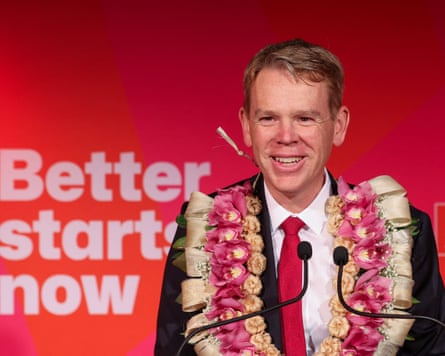
Before a rowdy crowd of supporters at the Cosmopolitan Club in Upper Hutt, north of Wellington, Hipkins joked that New Zealand had spoken but “it may take a bit longer to work out what they’ve said”.
“As things stand tonight, it is clear that we are not going to know the shape of our next government for a little while longer yet,” Hipkins said, promising that Labour would get “straight to work” should the final count land in its favour.
The collapse of the two major parties, amid a sluggish economy and stubbornly high inflation, is feeding record support for the smaller parties, including Act, New Zealand First and the Greens. It is also helped propel Opportunity into parliament for the first time.
Opinion polls in the lead-up to the election had Opportunity placed to become the kingmaker. At this stage, the right bloc does not need the party to govern, but if special votes change the landscape, its predicted role could come to fruition.
Currently at 5.9%, the centrist party has met the threshold needed to enter parliament, a historic first. Since New Zealand adopted the mixed-member proportional (MMP) electoral system in 1996, no new party has been able to meet that threshold – all the other minor parties have been born from MPs or groups splintering from larger parties.
The party’s leader, Qiulae Wong, told her supporters in Auckland she was “stoked”.
“It’s looking very promising for us,” she said. “Let’s just see how the rest of the votes fall.”
In New Zealand, voters cast two votes: one for an electorate MP and one for a party. The system is meant to produce a parliament that reflects each party’s share of the nationwide vote.
However, if New Zealanders vote for more electorate MPs from a particular party than their party vote would entitle them to, they get to keep the extra MPs in what is called an overhang.
National won more seats that its party support allows for, meaning it could gain an extra five seats to make up the balance.
That will be good news for its path to power, but comes with some significant trade-offs for the party. Four of its most senior ministers, including Nicola Willis, Paul Goldsmith, Chris Bishop and Gerry Brownlee, will not return to parliament because they did not win a seat, or the party didn’t win enough votes to bring in list-only MPs.
On the other side of the house, Te Pāti Māori picked up five overhang seats.
With all the extra seats, there could be 130 in the next parliament – a record under MMP – which means 65 seats are needed to form a coalition.
The country faces a two-week wait until special votes are announced, followed by the possibility of weeks of negotiations. Luxon said caretaker government conventions would apply in the meantime.
“For now, I want to tell New Zealanders that well-established caretaker conventions apply … The daily business of government will continue.”
KioskNews shows a cleaned-up reading view extracted from the publisher’s page — the original always lives on their site, not ours.