Tamkang, Sorbonne academics receive Taiwan-France Cultural Award
The 29th Taiwan-France Cultural Award has been presented to Tamkang University’s Wu Hsi- deh (吳錫德) and Victor Louzon, an assistant professor of history at Sorbonne University.
At a prize ceremony in Paris Monday, Wu, a professor emeritus in Tamkang’s Department of French, said that after studying in Paris more than 40 years ago, he returned to Taiwan with the belief that "the homeland needs me."
According to Taiwan’s Ministry of Culture (MOC), which jointly organizes the award with the Academie des Sciences Morales et Politiques of the Institut de France, Wu founded the Taiwan Association of French Teachers in 1996 and the Taiwanese Association of French Translators in 2014. He also initiated Taiwan’s International Francophonie Day events and French translation awards.
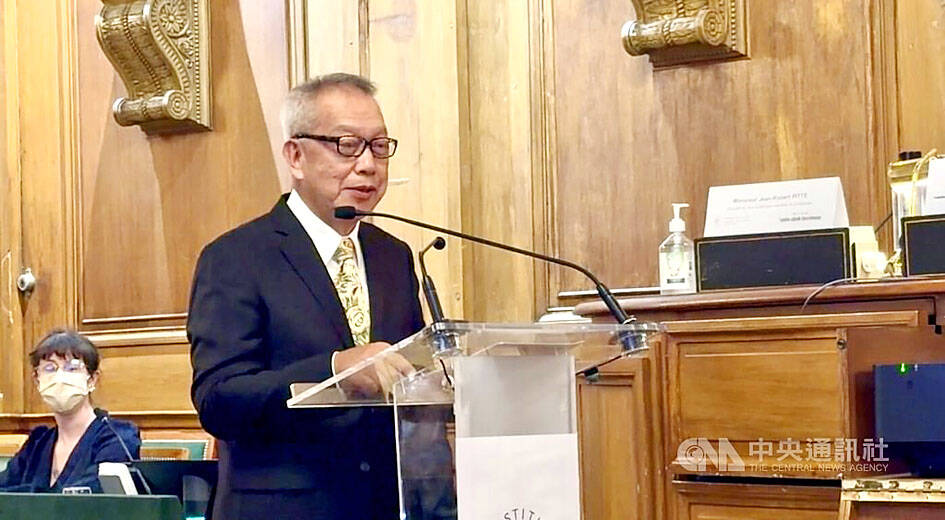
Tamkang University’s Wu Hsi-deh gives his speech upon receiving his Taiwan-France Cultural Award in Paris, France, on Monday.
Photo: CNA
Using the "key of knowledge" given to him by France, Wu said his work in French education, translation and publishing had not ended, but "continued to extend through countless encounters, interactions and the passing down of knowledge between generations."
He also said that through deeper understanding, trust and reciprocity between Taiwan and France, "France will not only find a loyal and dependable partner in Taiwan, but also endless inspiration and innovative power."
Meanwhile, Louzon has focused his research on the transformation of political power in Taiwan in 1945 and published the first French-language monograph examining the 228 Incident, the MOC said.
He has also sought to bring French students to Taiwan for fieldwork, organize academic conferences and launch translation projects centered on Taiwan’s history, according to the MOC.
Receiving the award, Louzon said he had discovered that Taiwan has a complicated history, rich historical materials and an open research environment, making it an "ideal place" for historical research.
He said he devoted himself to researching the 228 Incident after asking a simple question: "Why were there so many sacrifices?"
Louzon said the key to writing Taiwan’s history is to let "Taiwan become the subject of its own history, not a minor part on a bigger stage."
"Taiwan’s history should not be simplified as a bargaining chip between major powers," he said.
Speaking to reporters after the ceremony, Louzon said he had initially wondered whether, as a Frenchman, he was qualified to discuss decentralization with Taiwanese people. However, he said he was grateful to his research partners in Taiwan, who had welcomed him and given him complete academic freedom.
He said this attitude was not only a result of Taiwan’s democracy and academic professionalism, but also its ability to reflect on its own identity.
"This confidence is a more mature nationalism that is especially noteworthy in the current day, when many people are starting to admire the facade of stability in authoritarianism," he said.
Taiwan’s Culture Minister Li Yuan (李遠) and Jean- David Levitte, president of the Academie des Sciences Morales et Politiques of the Institut de France, also attended Monday’s ceremony, which concluded with a Chinese glove puppetry performance by 2006 Taiwan-France Cultural Award winner Jean-Luc Penso, founder of Theatre du Petit Miroir.
Established in 1996 and held annually since then, the Taiwan-France Cultural Award recognizes institutions and individuals who have made significant contributions to promoting Taiwanese culture in France, Europe and Taiwan, according to the MOC.
KioskNews shows a cleaned-up reading view extracted from the publisher’s page — the original always lives on their site, not ours.