Mohamed Fahmy: Iran rains terror on Yemen to cut off Saudi oil shipments
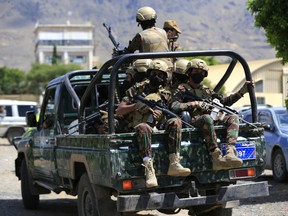
The war in Yemen is no longer simply a domestic conflict. It has become a dangerous proxy war between Iran-backed Houthi rebels and Saudi-backed government forces — and another front in Tehran’s decades-long effort to project its Islamic revolutionary ideology and expand its regional reach, at a devastating human cost.
Sign In or Create an Account
During the months I spent covering the Iran war from Kuwait, the United Arab Emirates, Saudi Arabia and Lebanon, one question kept coming up in my interviews and conversations with people on the street: is the Gulf’s golden age beginning to slip away as escalating wars increasingly intrude on everyday life?
And another question loomed: what happens if Iran fully mobilizes its Houthi allies in Yemen? If Tehran can disrupt traffic through the Strait of Hormuz — which carried roughly 20 per cent of the world’s oil before the war — could the Houthis also threaten the Bab al-Mandab Strait, a vital artery for about 12 per cent of global maritime trade?

Columnist Jesse Kline keeps you up to date with what’s happening in Israel and the effects of antisemitism on life here in Canada. Friday mornings.
By signing up you consent to receive the above newsletter from Postmedia Network Inc.
A welcome email is on its way. If you don't see it, please check your junk folder.
The next issue of Channel Israel will soon be in your inbox.
We encountered an issue signing you up. Please try again
The Iran-backed Houthis have waged an insurgency against Yemen’s internationally recognized government since the early 2000s. The conflict escalated dramatically in 2014 after the Houthis seized Sanaa, prompting a Saudi-led coalition to intervene in 2015.
The Houthis are part of an Iran-led military and ideological network often described as the “Axis of Resistance,” which includes Hezbollah in Lebanon, Hamas in Gaza and militias in Iraq. Canada designated Ansarallah, the Houthi movement, as a terrorist entity in 2024. The United Nations maintains a sanctions regime targeting Houthi leaders and activities.
The latest escalation, which began in July, shattered the period of relative calm that followed the UN-brokered truce of 2022. The immediate trigger came on July 13, when a U.S.-sanctioned Mahan Air flight reportedly carried Islamic Revolutionary Guard Corps (IRGC) personnel and military equipment to Yemen.
While the flight was originally bound for Sanaa, its airport was attacked by government forces, forcing the plane to divert to Hodeidah International Airport in western Yemen. The Houthis regarded the airport strike as an act of war and retaliated with strikes on major Saudi targets, reigniting the conflict.
From there, the cycle of violence intensified, with the Houthis launching missiles and drones toward Saudi Arabia and targeting energy infrastructure and military sites. The most serious escalation came on Sept. 8, when Houthi attacks injured at least 73 people, according to Saudi authorities.
The battle for the Bab el-Mandeb Strait — which connects the Red Sea to the Gulf of Aden and links Asia, the Middle East and Europe via the Suez Canal — was among the war’s most dramatic episodes. An eyewitness I spoke with remotely described it as almost “apocalyptic.”
In early September, Houthi fighters launched a week-long offensive, seizing the port city of Mokha and advancing along the coast. They captured strategic positions including Perim Island, at the entrance to the strait, forcing Saudi-backed government forces to withdraw from parts of the coast.
The advance gave the Houthis greater leverage over a vital maritime choke point. The speed and co-ordination of the offensive also raised questions about the extent of support the group is receiving from the IRGC.
The offensive killed at least 494 combatants and 29 civilians, according to an AFP tally, while more than 46,000 people were displaced during its first week, according to the UN’s International Organization for Migration.
I asked Edmund Walter Fitton-Brown, a former British ambassador to Yemen and senior fellow at the Foundation for Defense of Democracies, about Iran’s on-the-ground presence in Yemen.
“Iran certainly has IRGC personnel on the ground inside Yemen, providing advice and operational support to the Houthis. It denies it for cosmetic reasons, to avoid antagonizing Arab opinion and to give the Houthis maximum credit as an independent actor. The point is to bolster their claim to be an Arab government,” he said.
“Iranian support has been constrained by losses in its own wars and blockades on both Iran and Houthi-controlled Yemen. Even so, it has probably increased as the Houthis have emerged as Iran’s key proxy, even above Lebanese Hezbollah.”
For Tehran, the timing appears unusually pragmatic. U.S. President Donald Trump has so far declined Saudi Arabia’s request for direct U.S. strikes against the Houthis, while offering intelligence and targeting support instead. Trump has also said that the Houthis contacted Washington and did not want a fight with the United States. For now, the Houthis say their blockade targets Saudi vessels and that they are allowing other ships to pass.
But sustained pressure on energy supplies could still mean higher fuel prices and greater economic pain in the United States. U.S. diesel prices have reached a record $6.53 a gallon, with supply disruptions linked to the Iran conflict contributing to the surge.
For Iran, that creates an opportunity to impose economic costs on Washington through regional proxies without confronting the United States directly on every front — potentially adding to the political pressure surrounding the U.S. midterm elections in November.
In the Middle East, where I am now, alarm spread rapidly on Sept. 16, after Saudi officials accused the Houthis of launching a drone toward Mecca, Islam’s holiest city and a destination for millions of pilgrims each year. The drone was reportedly intercepted before reaching its destination.
The allegation triggered fear across the region, reviving memories of the bitter confrontation between Iran and Saudi Arabia over the security and sanctity of Islam’s holiest sites.
The region was thrown into another frenzy on Thursday, after Saudi authorities announced that the Houthis had targeted a power facility supplying the Prophet Muhammad’s mosque in Medina.
Since Iran’s 1979 Islamic revolution, the Hajj has been a flash-point between predominantly Sunni Saudi Arabia and predominantly Shiite Iran. Ayatollah Ruhollah Khomeini called for exporting the revolution and challenged Saudi custodianship of Mecca and Medina.
Starting in 1981, Iranian pilgrims staged political demonstrations under the banner of “disavowal of polytheists,” with demonstrators chanting slogans such as, “Death to America! Death to the Soviet Union! Death to Israel!”
Tensions escalated throughout the 1980s. In 1986, Saudi authorities said they seized 150 kilograms of explosives from Iranian pilgrims. The following year, clashes between Iranian demonstrators and Saudi security forces during the Hajj killed 402 people.
Saudi Arabia and its allies have repeatedly bombarded the mountainous region of Saada, the Houthis’ birthplace and traditional stronghold, since the war began in 2015. Yet years of airstrikes have failed to eliminate the group’s core capabilities, suggesting that airpower alone may not fundamentally shift the balance of power.
So what options does Saudi Arabia have, and how will Riyadh confront the enemy on its southern border?
“The Saudis have limited options, partly because of their own imprudence. They have needlessly fallen out with the U.A.E., their key ally in Yemen. The Houthi advance would not have succeeded if it had been attempted this time last year,” said Brown.
“The Saudis know that the Houthis have territorial claims on southern Saudi, including the assertion that the Saudis are not fit guardians of the holy places. And yet they have been trying to buy them off. They also showed weakness in the face of Iranian attacks.
“They left Trump unimpressed with their commitment. Their alliance with Turkey and Pakistan has yielded no useful support. And their feeble nervousness about the Abraham Accords has left them with only limited U.S. and Israeli support.
“Even so, their best option is to revisit these alliances. Saudi Arabia is too important to fail — which is precisely why Iran and its Axis are targeting it. The U.S. should — and can probably be prevailed upon to — lead the reconstruction of an anti-Houthi alliance, based on the sound legal principles of defending Saudi Arabia and the internationally recognized government of Yemen, and on enforcing the law of the sea.
“It will be important to include in this coalition as many as possible of U.A.E., Turkey, Pakistan, Egypt and relevant European powers.”
Yemen remains one of the world’s worst humanitarian crises. More than 22-million people are in need of aid, according to the United Nations, and 18.3 million face acute food insecurity. The latest escalation has displaced more than 130,000.
For Yemenis, the geopolitical struggle over regional power and strategic waterways is ultimately measured in homes lost, families displaced and lives destroyed.
National Post
Mohamed Fahmy is an award-winning journalist who has covered the Middle East for numerous outlets, including CNN, Al-Jazeera, the Los Angeles Times and Foreign Policy.
Join the Conversation
This website uses cookies to personalize your content (including ads), and allows us to analyze our traffic. Read more about cookies here. By continuing to use our site, you agree to our Terms of Use and Privacy Policy.
KioskNews shows a cleaned-up reading view extracted from the publisher’s page — the original always lives on their site, not ours.