History is calling Europe on Ukraine. Can it answer?
The window for Europe to weigh in on Ukraine’s fate is closing fast
By Marc Champion / Bloomberg Opinion


There are reasons to believe an opportunity exists to reach a peace deal on Ukraine. There is the fact that Russia agreed to attend a new round of trilateral talks in Abu Dhabi this week, the approach of a new, less Moscow-friendly US Congress, the soaring casualty rates among Vladimir Putin’s troops and the unbearable toll on Ukraine’s cities and economy. A rational takeaway from all this, that we are on the threshold of a pact to end the war, is unfortunately misleading.
Something has indeed changed, and as Ukrainian President Volodymyr Zelenskyy said in Dublin Wednesday, ahead of the European Political Community summit of about 50 world leaders, the continent needs to decide “in November” who would speak for it in this new phase of the conflict. US President Donald Trump and his team seem at last to have realized that the continent must be involved because any deal, and any security guarantees that Putin would accept, must grapple with the larger ambitions and concerns for which he went to war. This was never just about Ukraine, but also Russia’s ambitions for control and influence in Europe. As Jared Kushner, one of Trump’s envoys to the talks has recognized, this is going to be a long process — and that suits the Kremlin well.
Putin has a plan for victory and he is sticking with it, because it appears to be working better than anything he has tried since the first hours of the war. Only the tactics for his invasion have altered, a shift that can be traced back to the moment the US went to war with Iran in February and began burning through its stocks of the scarce, multimillion-dollar Patriot air-defense interceptors on which Kyiv relies to shoot down ballistic missiles. Russia’s production capacity for ballistic missiles is estimated to be a record 200 per month, creating a lethal advantage.
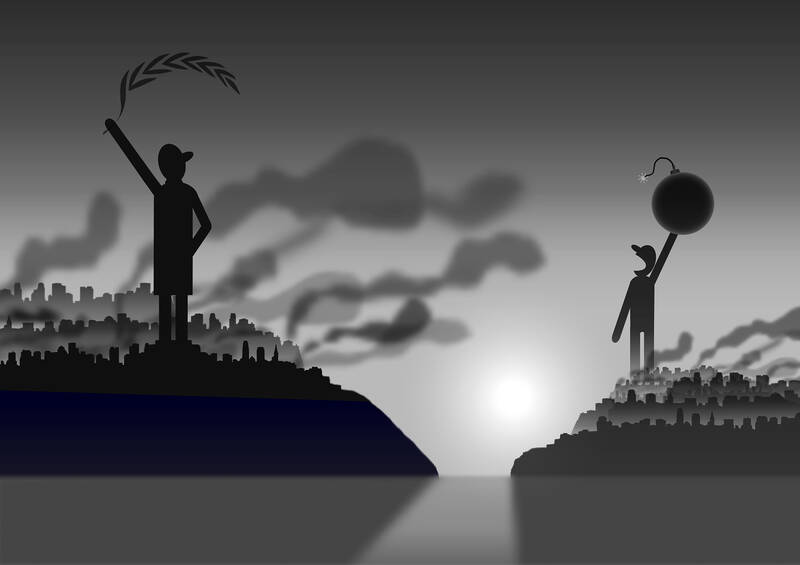
Illustration: Yusha
Kyiv’s inability to defend itself against these powerful weapons means that Russia’s strategy no longer has to rely on the success of its troops on the ground. Putin’s goal, as he has publicly spelled out, is to reduce Ukraine’s infrastructure and economy to rubble. Not unreasonably, he calculates, a deal on his terms would follow.
From Moscow’s point of view, the Abu Dhabi negotiations — which involved simultaneous talks about prisoner swaps, de-escalation measures and security structures — are helpful in allowing it to pursue its war of destruction without incurring further international pressure and penalties.
Ukraine is doing what it must in these circumstances, but its fate at this point is in Europe’s hands. So far, the continent has shown more spine than expected by Putin or pretty much anyone else back in February 2022. However, the unity of purpose this achieved is not enough. It needs to act, and lead, in ways it never has before.
Money first: Ukraine has a budget shortfall next year of 70 billion euros (US$77.2 billion), according to European Commission President Ursula von der Leyen, and most of the funds to cover that would have to come from Europe. EU leaders are looking at a further 45 billion euro loan to cover a majority of the gap, but the domestic politics around this are only getting harder — another reason Putin believes time is on his side. German Chancellor Friedrich Merz’s threat to block the EUs budget (and with it the tens of billions of euros in funding on which the likes of Slovakia’s pro-Russian President Robert Fico rely) cuts up rough. However, that is what is required.
Second, Germany and others need to band together to move frozen Russian assets out of Belgium, which has blocked their use for fear of retribution from Moscow. These must be leveraged to create further loans for Ukraine. It is morally and politically the right move, especially when the alternative is to ask European taxpayers to foot the bill for Putin’s destruction.
Next, air defenses. Europe and Kyiv are trying to develop their own capabilities, and there are promises of more Patriot ammunition down the line. Until then, the only way to save Ukraine’s cities is to destroy missile launchers and factories in Russia. Ukraine is reaching what it can with long-range drone swarms but it needs help — covert and overt — to overcome the elaborate defenses around these installations. This is not tit-for-tat over Russia’s bombing of civilians and their means to live. It is not Europe going to war with Russia. It is aiding Ukraine in its self-defense.
Finally, Europe needs a consistent, credible voice. Several leaders, including Italian Prime Minister Giorgia Meloni, have pointed out that the melee of competing, rotating leaders claiming to speak for Europe on Ukraine is unserious. The temptation could be to create a troika or some such collective European face, which is the EU’s wont. However, this all but guarantees failure when dealing with the likes of Putin and Trump, who treat it as weakness.
Likewise, the idea of using the EU institutions that were designed for this job but have very rarely been allowed or able to execute it. With no insult intended to von der Leyen and European Council President Antonio Costa, this should not be done by them or their institutions. For one thing, neither the US nor the Russian leader respect them. For another, they speak for the EU but not for some vital security contributors, including the UK.
This is an important role that should be taken on by a current European leader. It cannot be any of the big three: France could soon be led by Marine Le Pen, whose party once took millions of euros in funding from Russia. It cannot be Merz, who could be good in the role but is too weak at home. British Prime Minister Andy Burnham has insufficient foreign policy experience.
Fortunately, there are good candidates, including Meloni, who has proved herself in office and has the steel. Then there is the equally tough and pragmatic prime minister of Denmark, Mette Frederiksen, who has led in finding creative solutions for Ukraine, from wartime reconstruction in the port city of Mykolayiv to setting up the Danish Ukraine Fund to procure weapons from Ukrainian manufacturers and send them directly to the front — a mechanism that other donor nations have joined. Finland’s Alexander Stubb could be the frontrunner, given his country’s long history of dealing with Russia, a shared border and the military heft to defend it. Nor does it hurt that he is Trump’s golfing buddy.
It matters less which of these competent candidates gets the role than that they are chosen quickly. All of these decisions need to be made in the coming weeks because Ukraine’s situation is dire, and with it the prospects for European security.
Marc Champion is a Bloomberg Opinion columnist covering Europe, Russia and the Middle East. He was previously Istanbul bureau chief for the Wall Street Journal. This column reflects the personal views of the author and does not necessarily reflect the opinion of the editorial board or Bloomberg LP and its owners.
KioskNews shows a cleaned-up reading view extracted from the publisher’s page — the original always lives on their site, not ours.