Buckle in – this eight-seat Korean fine diner wants you to relinquish all control to the chef
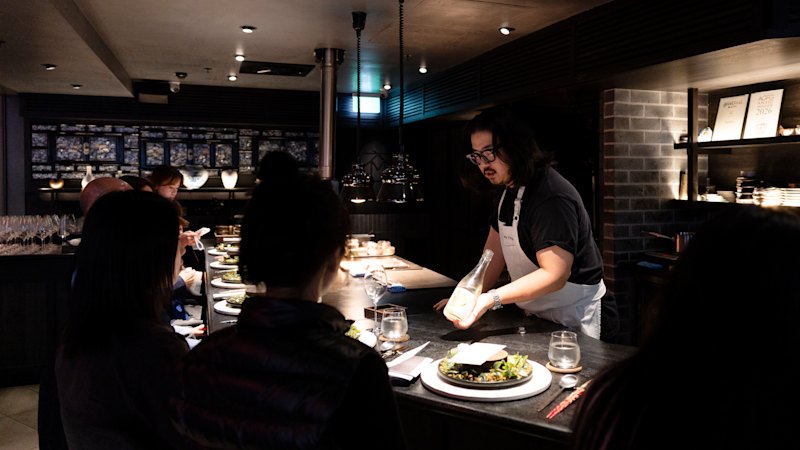
In the Korean language, “mat-kim” means “entrust” or “leave it up to you”, a style of dining you might know as omakase in Japan. For Matkim owner-chef Jacob Lee, it’s an invitation for a surprise evening of lesser-known Korean dishes.
Only eight spots are available each evening at this restaurant beneath Salesforce Tower in the CBD, and you’ll be seated along a black granite counter that gives everyone a view of Lee in action. The menu changes each season, but even when you arrive, there’s no written detail of the dishes in store – only drawn pictures of key ingredients. Buckle in. It’s trust all the way from here.
Bite-sized snacks pave a delicious start from creamy, soothing chestnut tarakjuk rice porridge to glistening slices of raw otoro and akami tuna bathed in a tangy jangajji (pickled vegetables) vinaigrette. What looks like a tiny sushi roll is a Korean seaweed cylinder wrapped around amaebi prawn. It’s a surprise mouthful, the crunchy snap of seaweed giving way to the clean sweetness of raw prawn, sourced from waters around Dokdo in the far east of Korea.
This is the second iteration of Matkim, which Lee originally opened in collaboration with a larger company in early 2024. He later stepped away from hospitality until Matkim’s owner made an offer for Lee to acquire the business outright, and the chef relaunched the restaurant in tune with his own point of view and history in September last year.
Restaurant reviews, news and the hottest openings served to your inbox.
Dishes arrive steadily as Lee and his head chef (YG Lee) work seamlessly and wordlessly together. Before each course is served, Lee takes care to explain the story behind the dish, its origin and why it was made a certain way. The sujebi noodles in our clam broth, he says, are steeped in nostalgia for many Koreans. In the 1960s and ’70s, when food was scarce, sujebi – hand-torn pieces of wheat dough cooked in broth – were a humble food designed to fill the stomach. In tonight’s version, the noodles are made softer and bouncier by using potato and glutinous rice flours. It’s but one texture in our bowl of fragrant and deeply savoury clam and anchovy broth. Each spoon yields a different component: in one mouthful it’s sweet, gently cooked prawn; then it’s whelk with its tender but resistant chew.
A sharp palate cleanser of fermented apple sorbet with Jeju green mandarin and shiso granita gives way to pork loin, rump and belly. (Lee uses Bangalow pork because of Australian quarantine restrictions around importing Jeju’s famous black pig.) He purchases whole rib sections to break them down in-house then dry ages for over a week to develop their flavour. The three cuts are cooked at different temperatures, finished on a binchotan grill in the dining room, and served with myeolchi-jeot (fermented anchovy) sauce, plus onion and perilla leaf puree.
The rice served alongside is equally important. After extensive research, Lee settled on Haenaru rice from Dangjin in Chungcheongnam-do on Korea’s west coast, chosen for its supreme gloss, flavour and texture. It’s cooked in an iron pot, as per tradition. “I sometimes feel we have forgotten how much pleasure can come simply from really good rice,” says Lee.
He isn’t afraid to let loose on desserts, either. Who knew black garlic sponge cake worked so well with ice-cream made from jigemi (the leftover lees of makgeolli rice wine) and sweet potato ganache? Busan street-food favourite ssiat hotteok (pancakes filled with molten brown sugar and nuts) is transformed into a tarte tatin doused with Korean ginseng and whisky-barrel-aged maple syrup.
I dined in September, just as the mid-year menu concluded. Marinated crab and abalone both feature on the new carte, the abalone starring in a classic naengchae (cold summer salad). Lee’s snack version of bibimbap will incorporate trevally, mumallaengi (dried radish) and perilla oil. For dessert, expect mugwort and white chocolate ice-cream paired with roasted buckwheat cream and perilla leaf.
The new menu is called “muje” (or “untitled”). Lee says he didn’t want to force a specific fixed theme or idea. “I would rather allow the food, the season, our memories and the ingredients we discover along the way to shape the story naturally. In some ways, I think the name also reflects where I would like Matkim to go next.”
The low-down
Atmosphere: A thoughtful and immersive evening interwoven with personal stories from the chef.
Go-to dishes: There are no choices here. Prepare to relinquish all control to the chef tonight.
Drinks: Comprehensive selection of Japanese sakes plus Korean makgeolli cloudy, cheongju clear and soju distilled rice wines.
Cost: Tasting menu $279 per person, excluding drinks
Good Food reviews are booked anonymously and paid independently. A restaurant can’t pay for a review or inclusion in the Good Food Guide.
KioskNews shows a cleaned-up reading view extracted from the publisher’s page — the original always lives on their site, not ours.