6 Quentin Tarantino Movies That Are 10/10, No Notes

Anja Djuricic was born in Belgrade, Serbia, in 1992. Her first interest in film started very early, as she learned to speak English by watching Disney animated movies (and many, many reruns). Anja soon became inspired to learn more foreign languages to understand more movies, so she entered the Japanese language and literature Bachelor Studies at the University of Belgrade.
Anja is also one of the founders of the DJ duo Vazda Garant, specializing in underground electronic music influenced by various electronic genres.
Anja loves to do puzzles in her spare time, pet cats wherever she meets them, and play The Sims. Anja's Letterboxd four includes Memories of Murder, Parasite, Nope, and The Road to El Dorado.
Sign in to your Collider account
Quentin Tarantino is a unique filmmaker, and his films are greatly lauded and applauded. He's often considered influential, especially to newer generations of directors, and he himself has been claiming influence from global cinema. Another interesting thing about Tarantino is that he promised to retire after making his tenth film—that film was Once Upon a Time in Hollywood, and truly, since then, Tarantino hasn't directed anything except a short film related to his hit movie Kill Bill.
Ranking all ten of Tarantino's films can often feel like a sport, but there are no wrong answers, only endless arguments, which is what makes it so fun. At least half of his films are legitimate candidates for the best film of whatever decade they landed in. And while we won't try to settle anything here today, we will be making the case that only six symbolize a time when Tarantino was operating at a level where no individual element, line of dialogue, shot, casting choice, or needle drop needs improvement. Here are six Quentin Tarantino movies that are 10/10, no notes.
'Reservoir Dogs' (1992)

Reservoir Dogs is Tarantino's feature film debut; when it premiered at the Sundance Film Festival, over a dozen people walked out, citing excessive realistic violence. This is fun since, knowing where Tarantino's films have gone from there, Reservoir Dogs seems tame in comparison today. This film has everything a modern masterpiece needs—pop-culture-infused dialog, a non-linear structure, and excellent needle drops ("Stuck in the Middle with You," we're looking at you)—and it immediately established that a new voice had emerged in American cinema. Harvey Keitel, Michael Madsen, Steve Buscemi, and Tim Roth have fantastic chemistry, making the ensemble work feel effortless.
Reservoir Dogs follows six unnamed professional criminals (nicknamed for different colors) who are recruited by mob boss Joe Cabot (Lawrence Tierney) to carry out a diamond heist. However, the heist immediately goes horribly wrong, and the film begins with the bloody, fractured aftermath, with the survivors regrouping at a warehouse and attempting to figure out which of them is working undercover for the police. Tarantino shot almost all of Reservoir Dogs in one location, which feels like a stylistic choice rather than a budget constraint—demonstrating how to work with what you have. He claims inspiration for it from various crime films, including Stanley Kubrick's The Killing and Jean Pierre Melville's Le Samourai; many critics have also noted similarities between it and the Hong Kong action film City on Fire, starring Chow Yun-fat.
'Kill Bill: Volume 2' (2004)

There was some thought about combining Kill Bill: Volume 1 and Volume 2 into a single entry (or The Whole Bloody Affair), but Tarantino himself stated that Vols 1 and 2 should be treated as separate films, which they are, with the exception of the cast and main storyline. Because, whereas Vol. 1 was a pure action film, Vol. 2 is a Western and a character study, following the Bride (Uma Thurman) through the last few names on her revenge list in a style that has more in common with Sergio Leone than Bruce Lee. Vol. 2 rewards the patience that Vol. 1 requires, so the two form something larger and more complex than either could be alone but still stand on their own separately.
Vol. 2 takes The Bride straight to Bill (David Carradine), her ultimate target, who emerges from the story's edges to take center stage. Carradine, who was 67 at the time and hadn't been a major Hollywood presence in years, delivers a performance of such magnetic, unhurried menace that the film essentially revolves around him. The Pai Mei training sequence is as funny as anything Tarantino has ever written, the Budd chapter is a thrilling sequence of slow-burn dread, and the final confrontation between the Bride and Bill, resolved with some truth serum and a deadly move known as the Five Point Palm Exploding Heart Technique, is one of the most emotionally satisfying endings in Tarantino's filmography.
'Kill Bill: Volume 1' (2003)
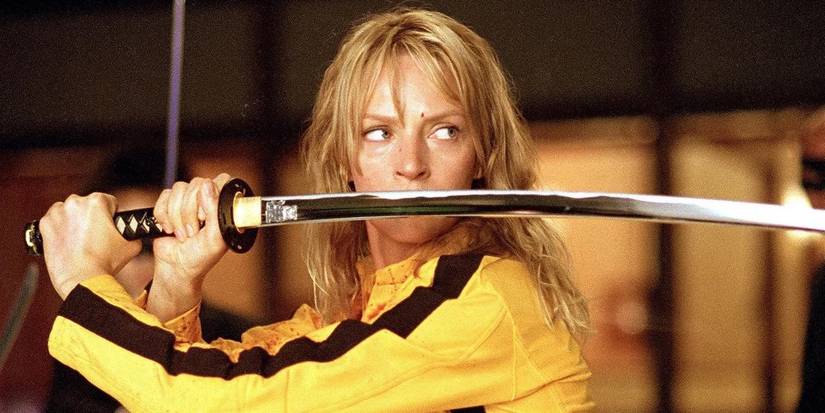
Vol. 1 outperforms Vol. 2 in that Tarantino is working in full cinephile mode here, with stylistic nods to spaghetti westerns, Japanese samurai films, anime, and 1970s exploitation cinema, all filtered through a sensibility so specific and personal that the resulting film could only have been made by this director. Sonny Chiba, Chiaki Kuriyama, and Lucy Liu round out an excellent supporting cast, and the anime sequence depicting O-Ren Ishii's (Liu) backstory is one of the most daring formal swings in any mainstream American release of the time. Tarantino is operating on pure imagination, and it works so brilliantly that we still watch Vol. 1 and gasp in awe of his enthusiasm.
Vol. 1 introduces us to The Bride, who awakens from a four-year coma to discover that her wedding party has been massacred, and her unborn daughter is presumed dead. She has a list of five names—and those names belong to members of the Deadly Viper Assassination Squad; they are the ones who put her in that hospital bed, and the first volume covers The Bride, crossing off the first two names on her list: O-Ren Ishii (Liu) and Vernita Green (Vivica A. Fox). Vol. 1 features the iconic showdown at the House of Blue Leaves against O-Ren's deadly squad known as the Crazy 88, which is still one of the most purely, joyfully choreographed action sequences in American cinema of the 2000s.
Collider Exclusive · Oscar Best Picture Quiz
Which Oscar Best Picture
Is Your Perfect Movie?
Parasite · Everything Everywhere · Oppenheimer · Birdman · No Country
Five Oscar Best Picture winners. Five completely different visions of what cinema can be — and what it can do to you. One of them is the film that was made for the way your mind works. Ten questions will figure out which one.
🪜Parasite
🌀Everything Everywhere
☢️Oppenheimer
🐦Birdman
🪙No Country for Old Men
01
What kind of film experience do you actually want? The best movies don't just entertain — they leave something behind.
02
Which idea grabs you most in a film? Great films are driven by a central obsession. What's yours?
03
How do you like your story told? Form is content. The way a story is shaped changes what it means.
04
What makes a truly great antagonist? The opposition defines the protagonist. What kind of opposition fascinates you?
05
What do you want from a film's ending? The final note is the one that lingers. What do you want it to sound like?
06
Which setting pulls you in most? Where a film takes place shapes everything — mood, stakes, what's even possible.
07
What cinematic craft impresses you most? Every great film has a signature — a technical or artistic element that makes it unmistakable.
08
What kind of main character do you root for? The protagonist is the lens. Who you choose to follow says something about you.
09
How do you feel about a film that takes its time? Pace is a choice. Some films sprint; others let tension accumulate slowly, deliberately.
10
What do you want to feel walking out of the cinema? The best films leave a mark. What kind of mark do you want?
The Academy Has Decided Your Perfect Film Is…
Your answers have pointed to one Oscar Best Picture winner above all others. This is the film that was made for the way your mind works.
Parasite
You are drawn to films that operate on multiple levels simultaneously — that begin in one genre and quietly, brilliantly migrate into another. Bong Joon-ho's Parasite is a film about class, desire, and the architecture of inequality that manages to be darkly funny, deeply suspenseful, and genuinely shocking across a single extraordinary running time. Your instinct is for cinema that hides its true intentions until the moment it's ready to reveal them. Parasite is exactly that — a film that rewards close attention and punishes assumptions, right up to its devastating final image.
Everything Everywhere All at Once
You want it all — and this film gives you all of it. The Daniels' Everything Everywhere All at Once is one of the most maximalist films ever made: action comedy, multiverse sci-fi, family drama, existential crisis, and a genuinely earned emotional core that sneaks up on you amid the chaos. You are someone who responds to ambition, who doesn't want cinema to choose between being entertaining and being meaningful. This film refuses that choice entirely. It is overwhelming by design, and its overwhelming nature is precisely the point — because the feeling of being crushed by infinite possibility is exactly what it's about.
Oppenheimer
You are drawn to cinema on a grand scale — films that understand history not as a backdrop but as a force, and that place their characters inside that force and watch what happens. Christopher Nolan's Oppenheimer is a film about the terrifying gap between what we can do and what we should do, told with the full weight of one of the most consequential moments in human history behind it. You want your films to feel important without feeling self-important — to earn their ambition through sheer craft and the gravity of their subject. Oppenheimer does exactly that. It is enormous, complicated, and refuses easy comfort.
Birdman
You are drawn to films that foreground their own construction — that make the how of the filmmaking part of the what it's about. Alejandro González Iñárritu's Birdman, shot to appear as a single continuous take, is cinema examining itself through the cracked mirror of a fading actor's ego. You respond to formal daring, to the feeling that a film is doing something that probably shouldn't be possible. Michael Keaton's performance and Emmanuel Lubezki's restless camera create something genuinely unlike anything else — a film that is simultaneously about creativity, relevance, self-destruction, and the impossibility of ever truly knowing if your work means anything at all.
No Country for Old Men
You are drawn to cinema that trusts silence, that refuses to explain itself, and that treats dread as a form of meaning. The Coen Brothers' No Country for Old Men is a film about the arrival of a new kind of evil — implacable, arbitrary, and utterly indifferent to the moral frameworks we use to make sense of the world. It is one of the most formally controlled films ever made, and its controlled restraint is what makes it so terrifying. You want your films to haunt you, not comfort you. You are not interested in resolution if resolution would be dishonest. No Country for Old Men is honest in a way that most cinema never dares to be.
'Jackie Brown' (1997)
It seems like Jackie Brown is the most overlooked film in Tarantino's filmography, but it's a movie that is a complete 10/10. It's unsure if the film went under the radar a bit because it followed Pulp Fiction and audiences expected another maximalist explosion, or because its pleasures and payoffs are much slower and more patient than anything else he's made. Jackie Brown really is a tribute to 1970s blaxploitation cinema and a love letter to Pam Grier, who was largely absent from mainstream Hollywood at the time; by hiring her as the titular character, Tarantino handed Grier her best role in twenty years (and this is one of his trademarks). Robert Forster, similarly, gives the performance of his career as the bail bondsman Max Cherry, and the unspoken romantic tension between the two is genuinely moving, giving us little by little with each new scene. Joining them is Robert De Niro in one of his "most chill" roles ever, stepping away from the kinds of stuff he made during the 1990s.
Jackie Brown (Grier) is a middle-aged flight attendant who supplements her income by smuggling cash for arms dealer Ordell Robbie (Samuel L. Jackson). When the ATF apprehends her in the middle of her run, she becomes the pivot point in a three-way con involving federal agents, a bail bondsman (Forster), and Ordell himself, all of whom believe they are in charge. Jackie Brown, like Reservoir Dogs, has a fractured structure that bears the hallmarks of a modern masterpiece; this is most evident in the central money-switch sequence, which is shown three times from three perspectives and remains one of Tarantino's most brilliant pieces of editing.
'Pulp Fiction' (1994)

Pulp Fiction is so good that it still inspires all other anthology films with interconnected characters. It's even used to describe films with similar structures as a compliment and a point of comparison. But Pulp Fiction is more than just a film; it has a number of recognizable elements that make it iconic, ranging from the resurrection of John Travolta's career (the previously mentioned trademark), Samuel L. Jackson's monologue, and the Royale with Cheese conversation to the adrenaline shot to the heart and the diner dance. The film is so full of iconic moments that it's easy to forget how well-executed it truly is.
Pulp Fiction is made up of a few interlocking crime stories set in Los Angeles, told in reverse chronological order; it follows a pair of philosophical hitmen (Travolta and Jackson), a mob boss's wife (Uma Thurman), a fading boxer (Bruce Willis), and a pair of diner robbers (Amanda Plummer and Tim Roth), whose lives continue to intersect during a single, and eventually uncovered to be a very bad day. Pulp Fiction followed Reservoir Dogs, but it was the film that proved Tarantino would be remembered for decades. The non-linear structure and intertwining nature bear the film's weight, with even the characters getting unexpected endings, breaking conventions once again. Pulp Fiction won the Palme d'Or at Cannes and changed the course of American cinema, and three decades later, people still quote it.
'Inglourious Basterds' (2009)

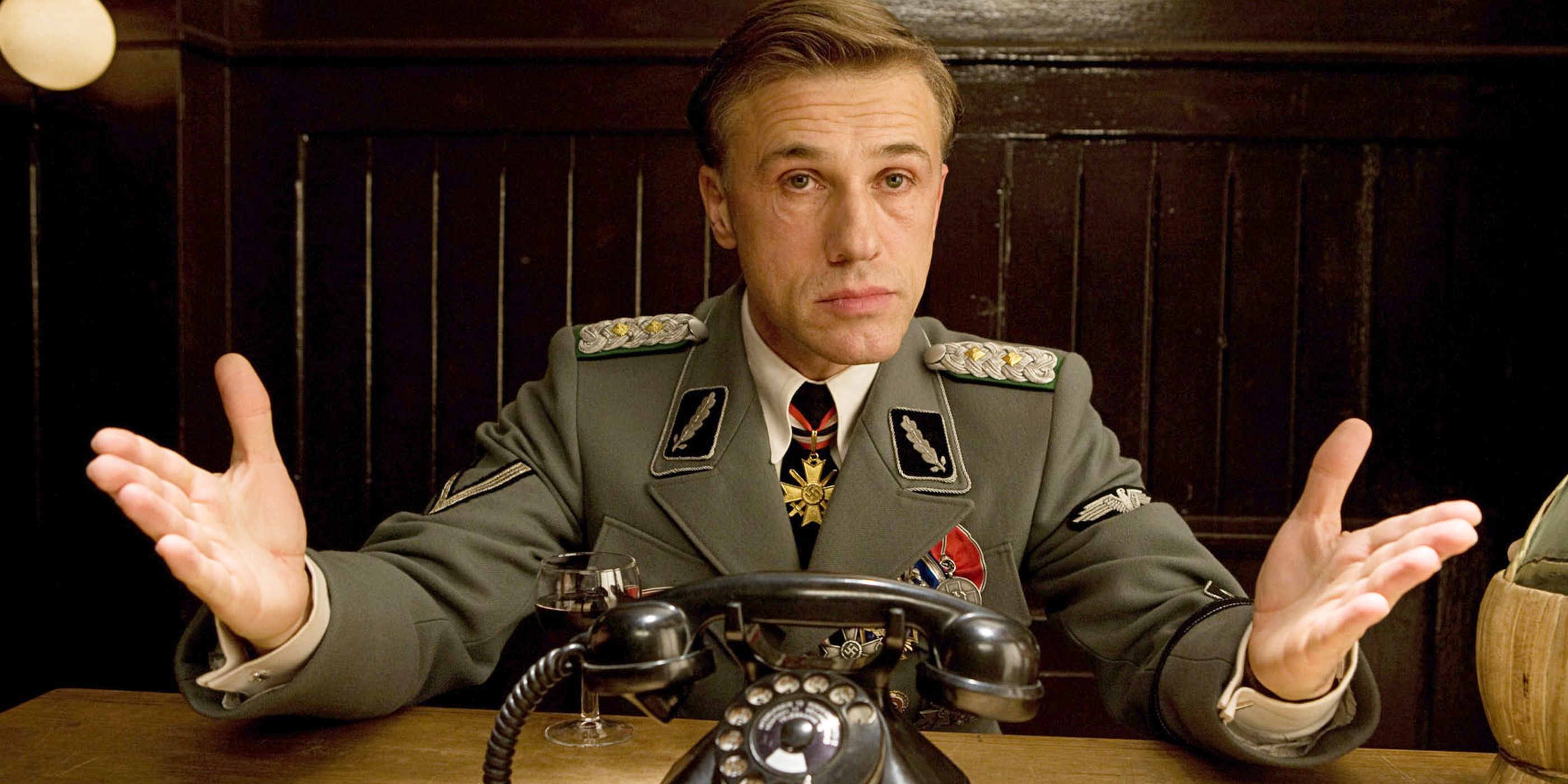
In terms of non-linear, intertwining narratives that lead to a single cohesive conclusion, many consider Tarantino's Pulp Fiction to be the pinnacle, but Inglourious Basterds has a little more spice, zest, and bite than its predecessor. Everything in Inglourious Basterds is so perfect, from the dialogue to the performances, which range from thriller to comic relief, that all the characters' talking goes by quickly. There is a lot of dialogue here, but the delivery and tension make it extremely entertaining. Christoph Waltz takes on the role of a lifetime as SS Colonel Hans Landa, winning every single award for it, and Brad Pitt has never been better than as Lt. Aldo Raine, leading a contingent of vengeful, Nazi scalp-hunting soldiers across Germany during WWII.
In 1944, two parallel plots to assassinate the Nazi high command converge on a Paris cinema: one led by Lt. Aldo Raine and his squad of Jewish American soldiers who scalp their kills, and one by Shosanna Dreyfus (Mélanie Laurent), a young French-Jewish woman whose family was murdered by SS Colonel Hans Landa years earlier and who has spent every day since plotting revenge. Tarantino had been working on the script since 1998 and had set it aside several times when he couldn't figure out the ending, but the ending he eventually discovered is one of cinema's greatest acts of cathartic alternate history. It's the film in which every aspect—performance, script, cinematography, score, and pacing—comes together flawlessly. It's easy to argue that it's the best film of the 2000s and Tarantino's magnum opus, coming in bolder, braver, and smarter since crafting his beloved sophomore feature.
KioskNews shows a cleaned-up reading view extracted from the publisher’s page — the original always lives on their site, not ours.