Trade, gold and culture: Russian envoy pushes for closer ties with Hong Kong

Russian businesses in Hong Kong are finding ways to overcome hurdles brought about by Western-led sanctions, the country’s top diplomat in the city has said, noting that the issue is part of an “ongoing dialogue” with authorities and he hopes more Russian cultural events will take centre stage in the financial hub.
Anatoly Kargapolov, Russia’s consul general in Hong Kong, said that the country’s firms showed growing interest in Hong Kong despite what he described as “obstacles”, with opportunities in areas such as food exports, gold trading and arbitration.
Kargapolov said that annual bilateral trade turnover of US$4 billion between the two markets showed that Russians could do business with Hong Kong despite the “unprecedented sanctions pressure”.
“But, of course, these obstacles exist,” he said. “Without these obstacles, more Russian companies would be interested in coming to Hong Kong.
“Difficulties with banking access are real, and they are understandably a concern for Russian businesses. We do not underestimate the effect that uncertainty over payments and account access can have on day-to-day operations.”
Kargapolov was speaking exclusively to the South China Morning Post in the days following the Apec leaders summit in Shenzhen, which included a historic trilateral meeting between President Xi Jinping and his US and Russian counterparts, Donald Trump and Vladimir Putin.
Since Russia’s full-scale war with Ukraine began in 2022, Russia has faced a slew of sanctions from the United States, the European Union and other countries. It was also cut off from Swift, the main international payment messaging network.
Although Hong Kong does not enforce unilateral sanctions, the global financial institutions operating in the city tend to abide by such measures to preserve their presence in major Western markets and access to Swift.
Asked whether those Russian firms operating in the city had already found a workaround, such as using China’s alternative to Swift, the Cross-Border Interbank Payment System, or settling payments in yuan, Kargapolov said: “I’ll tell you the truth – I don’t know the details.
“For the time being, businesses are very smart and they are finding ways to do the payments, how to do day-to-day business, and I think they are OK. They found ways to deal with it.”
He added that the consulate maintained an “ongoing dialogue” with the city’s authorities on the matter.
“We want to make the environment for Russian business more comfortable here, and we try to find solutions which could be beneficial and safe for both sides,” he said.
Hong Kong’s ties to Russia have also drawn intense scrutiny from the West, particularly of the city’s alleged role in enabling sanctions evasion and the transshipment of “dual-use goods” for use in the war, all of which the Hong Kong government has strongly rebutted on numerous occasions.
Dozens of Hong Kong companies have been sanctioned in recent years, and earlier this month the US-China Economic and Security Review Commission singled out the city’s ties with Russia, alongside Iran and North Korea, in a report the local government rejected as “biased slanders and smears”.
But Kargapolov said he did not see “any pressure” on Hong Kong as ties between the two sides grew, adding that Russia was “very open and cautious” with its local partners.
“If they are ready to do business, we are more than glad to deal with them. If they feel cautious, we understand,” he added.
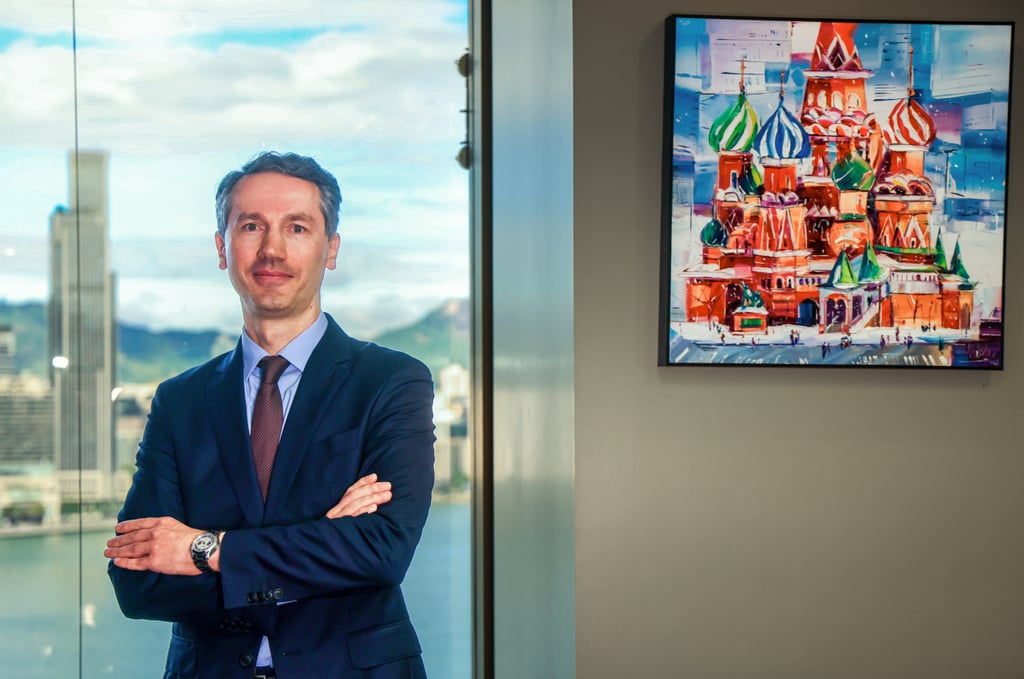
Kargopolov noted that there was growing Russian business interest in Hong Kong, driven by Moscow’s strengthening ties with Beijing and a desire to tap into the Asian market.
Unlike other countries, which often use Hong Kong as a launch pad for entering the mainland market, Kargopolov said Russian firms already had a strong presence there and were comparatively “at an early stage of developing” their presence in the city.
A market profile by the Trade Development Council showed there were just 10 Russian firms with regional headquarters, regional offices or local offices in Hong Kong in 2025. At least two Russian grocery stores operate in the city and a restaurant specialising in the country’s cuisine opened earlier this year.
Kargapolov said he saw particular potential in agricultural and food products. The Northern Metropolis could attract Russian metals and construction materials, he said, adding that joint educational projects were also possible in the 30,000-hectare (74,132-acre) megaproject’s planned university town.
Gold shipments from Russia have reportedly surged to around 100 tonnes in the first seven months of the year, up threefold from the same period in 2025.
Since 2022, Russian gold has faced import bans in some markets and a de facto ban by the London Bullion Market Association.
Kargapolov said Hong Kong was becoming an “important gold hub” and highlighted the city’s planned expansion of storage for the precious metal.
Hong Kong could serve as an arbitration centre for Russian companies, and Russian law firms were looking to open offices in the city, he added.
Apart from trade, Russia has also introduced more of its cultural offerings to the city. November saw the 10th anniversary of the Russian Cultural Festival and Discovery Moscow Fashion Show, and the country featured in the fourth Asia+ Festival.
Kargapolov said he also saw opportunities to bring Russian opera and ballet to the city and for Russian performers to hold concerts at Kai Tak Stadium.
He said Russia also hoped to participate in events organised by the Tourism Board, including the International Dragon Boat Festival, the International Chinese New Year Night Parade and the Hong Kong Wine and Dine Festival.
Tourism from Russia to Hong Kong has also seen a notable surge in recent years. In the first nine months of 2026, the city welcomed over 179,000 visitors from Russia, up 71.9 per cent year on year.
There has been new interest from Russians in Chinese culture, and Hong Kong had long appealed to visitors from the country because of the city’s events calendar and “distinctive cultural identity”, Kargopolov said.
Russia was also ready to expand visa-free travel with Hong Kong, he noted. Russians and Hongkongers are currently allowed 14 days of visa-free travel between the two places.
“We are ready to expand it to 30 days as we have with mainland China and with Macau,” he said.
KioskNews shows a cleaned-up reading view extracted from the publisher’s page — the original always lives on their site, not ours.