FIRST READING: Why drug-addled cities keep voting for drugs
First Reading is a Canadian politics newsletter curated by the National Post’s own Tristin Hopper. To get an early version sent directly to your inbox, sign up here.
Sign In or Create an Account
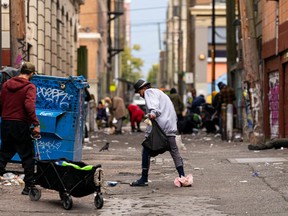
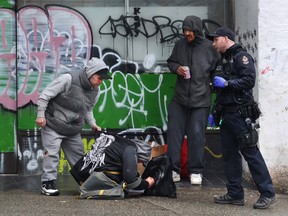
Over the weekend, Vancouverites turned hard left in picking a new mayor and council. The B.C. city is the longstanding hub of visible tent cities and open-air drug use — to the point where it’s becoming one of the only things that tourists are noticing about the city.
And yet, mayor-designate Pete Fry’s drug policy mostly consists of demarcating new “safe, dignified places” to do drugs and pulling back even further on police non-enforcement of drug crimes. In the words of National Post columnist Amy Hamm, Vancouver voted for “more drug chaos and street disorder.”

Columnist Jesse Kline keeps you up to date with what’s happening in Israel and the effects of antisemitism on life here in Canada. Friday mornings.
By signing up you consent to receive the above newsletter from Postmedia Network Inc.
A welcome email is on its way. If you don't see it, please check your junk folder.
The next issue of Channel Israel will soon be in your inbox.
We encountered an issue signing you up. Please try again
Something similar happened in the B.C. capital of Victoria. Despite a worsening drug problem that has branded Victoria the “epicentre for the nationwide opioid crisis,” incumbent mayor Marianne Alto won easy re-election.
And it’s a phenomenon that’s become a familiar part of the Canadian political landscape: The jurisdictions that are getting hit hardest by rising crime and street disorder are often some of the most enthusiastic supporters of the political status quo under which those policies thrived.
B.C.’s incumbent NDP government has acknowledged in recent months that it endorsed drug decriminalization policies that made civic life more chaotic in the province’s urban cores. Regardless, two of the hardest-hit urban cores — Victoria and Vancouver — neatly fit within ridings that are both projected to be landslides for the NDP in this week’s provincial election.
Back in April, the upscale Toronto neighbourhood of Rosedale was experiencing such a spike in home invasions and carjackings that locals were hiring street patrols of K9-equipped private security. That same month, when Rosedalers went to the polls in a federal byelection, they delivered a record-high result for the Liberals, the very federal government whose justice policies helped accelerate the unchecked crime they were experiencing.
Below, a few explanations as to why this keeps happening.
Moderate voters are leaving
It’s a well-documented phenomenon in the United States that cities and states are becoming politically bifurcated due to internal migration. Centrists and right-wingers are fleeing leftist strongholds like Portland or San Francisco, with the result that the electorate left behind becomes even more radical.
And something to that effect may indeed be happening in Canada, particularly in B.C.
According to an analysis by the Business Council of British Columbia, outmigration from B.C. has surged to all-time highs. An Angus Reid Institute poll from 2024, meanwhile, found an incredible 36 per cent of B.C. respondents saying they were “seriously considering” leaving the province.
Those leaving are generally young and in the middle class: the precise cohorts of voters who are most reactive to issues like failing public transit or rising street crime.
It might also explain why many of the cities most likely to attract resettled Vancouverites pushed out by high prices experienced very different election results on Saturday. Jurisdictions such as Penticton, Langford, Surrey and New Westminster all elected mayors and councils with explicitly hard lines on public safety and street disorder.
Electorates shut out of home ownership are more radical
Large Canadian cities such as Vancouver and Toronto happen to be some of the most unaffordable real estate markets on earth. The aggregate impact of this is that whole cohorts of people who would have been homeowner parents in an earlier (and more affordable) era are now eternal renters delaying childbirth.
And, in general, eternal renters without children are much more inclined towards leftist ideals than conservative ones.
This is another phenomenon for which there is growing evidence in the United States. Younger American cohorts have trended strongly toward overt socialism in recent years, resulting in the ascension of several far-left “Democratic Socialist” candidates in the upcoming U.S. midterm elections.
A 2025 paper by the Pacific Research Institute framed this as a reaction to a real estate market young people saw as “rigged” against them.
“Rent control and similar policies have proven time and again to be ineffective solutions to housing problems, and yet they will continue to gain traction if housing affordability remains an issue,” it read.
The alternatives are awful
In Ontario, Premier Doug Ford has pulled off the rare feat of winning three consecutive majority governments. This is despite the fact that he is consistently one of the least popular premiers in the country. As of the last ranking by the Angus Reid Institute, he was dead last in popularity, with just 31 per cent of Ontarians thinking he was doing a good job.

And yet, if an election were called tomorrow, Ford would almost certainly be assured a fourth majority. The reason? Nobody likes his NDP and Liberal opposition.
In Vancouver, the defending incumbent was Mayor Ken Sim, whose 2022 landslide victory was largely won on Sim’s promise to pull the city out of its acute “public safety crisis.” That almost nothing changed on that front made the message less compelling this time around.
Most voters are low-information voters
It’s been a major source of controversy in B.C. that the provincial election is occurring just one week after the municipal elections.
The duelling campaigns have been left scrabbling for scarce media coverage and lawn sign real estate. But perhaps more importantly, many officials have openly worried that voters are not capable of telling the difference between voting for a city councillor and voting for an MLA.
Earlier this month, a former head of the Union of B.C. Municipalities, Cori Ramsay, complained that a not-insubstantial number of voters did not seem to understand that the two were different elections. “I’m hearing candidates going door-to-door for the municipal election being told that ‘I can’t vote for you because I’m voting for our MLA,'” she told CBC.
Perhaps the greatest evidence for the low-information phenomenon was that a meme candidate won an election in Kelowna. Brady Rogers’ entire campaign consisted of humourous lawn signs declaring how unqualified he was for city council, and how little he wanted the job. Rogers not only won, but he got the fourth-highest vote share of any other candidate.

Ontario’s Independent Electricity System Operator just struck a deal with U.S.-based Alpha Generation to import electricity over the winter.
This is a pretty standard arrangement, but got a fair amount of news coverage due to the embarrassing fact that it’s coming just six weeks after Ontario Premier Doug Ford threatened to cut off electricity exports to the U.S. in retaliation for tariffs.
If Ford were a subscriber to this newsletter, he would have known that, despite Canada’s long history of exporting electricity to the U.S., in recent years it has been a net importer. As such, any severing of power connections between the U.S. and Canada could have potentially deadly consequences for Ontario in any kind of cold snap while imposing no noticeable change on the American side.

First Reading is a Canadian politics newsletter curated by the National Post’s own Tristin Hopper. To get an early version sent directly to your inbox, sign up here.
Join the Conversation
This website uses cookies to personalize your content (including ads), and allows us to analyze our traffic. Read more about cookies here. By continuing to use our site, you agree to our Terms of Use and Privacy Policy.
KioskNews shows a cleaned-up reading view extracted from the publisher’s page — the original always lives on their site, not ours.