REFLECTION: e.ID: A Fugue stages our digital identity crisis through vigorous choreography
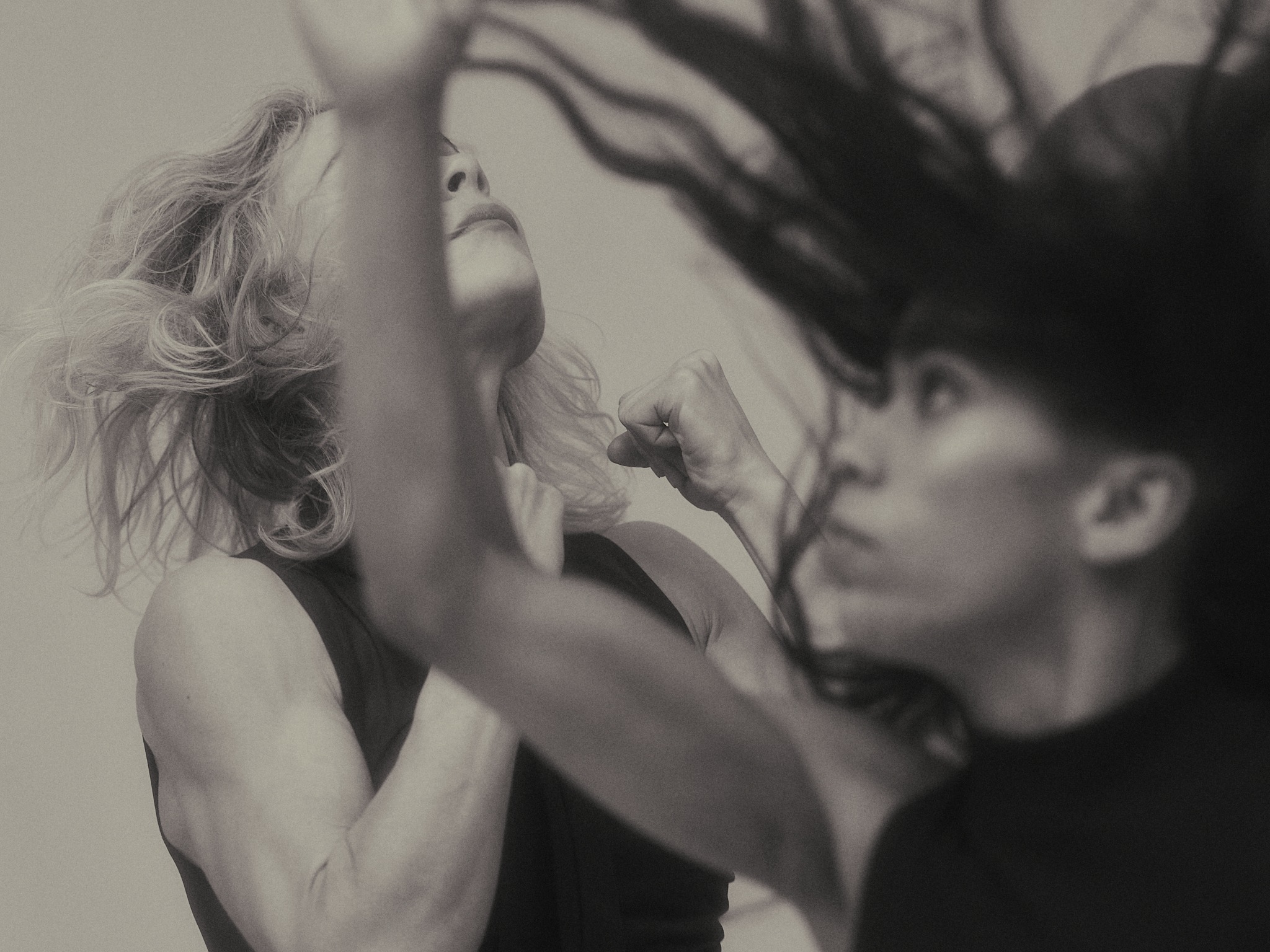
It begins with wild wind, churned up by half a dozen mobile, industrial-strength fans that furiously blast air across the performance space, where the dancers – svelte, taut, athletic, statuesque – stand poised on the tips of their toes for what feels like a cruel period of time.
Not only balancing on their toes, but, as though engaged in some torturous yoga punishment, also moving, in tiny increments, delicately pulsing up and down to a soundtrack that’s a convulsion of metallic snaps and cracks and pings.
Complicating this expression of physical concentration, each of the dancers is also holding in some way a large water-filled plastic bag, like the ones used to convey goldfish from the pet store to your home aquarium.
It goes on long enough that, in the audience, I feel my own calves and feet begin to ache, a sensation of physical empathy, knowing what the body experiences, how pain starts and then builds into something unendurable. And all this time, the cool-headed dancers in rapt concentration, their focus unwavering, the metallic grind of the music creeping under the skin.
There’s a lot going on in e.ID: A Fugue.
A hell of a lot, in fact.
/file/attachments/orphans/GemmaTrehearnRianJansenandTamsynLucyPretoriusinDarkroomContemporaryseIDAFugue_DarkroomContemporary_692592.jpg "Gemma Trehearn, Rian Jansen and Tamsyn Lucy Pretorius in Darkroom Contemporary's e.ID A Fugue. (Photo: Darkroom Contemporary)")
/file/attachments/orphans/RianJanseninDarkroomContemporaryseIDAFugue_DarkroomContemporary_636284.jpg "Rian Jansen in Darkroom Contemporary's e.ID A Fugue. (Photo: Darkroom Contemporary)")
The new production from Darkroom Contemporary Dance Theatre takes you on journey that feels epic, and is inundated with physical and psychic curiosities, brutal existential questions and deeply affecting dancing.
And yet, should you find yourself grappling for meaning, attempting to get answers from each of its successive episodes, or if you try to piece together a coherent narrative, you might be fighting a losing battle. Perhaps even a self-defeating one, since the meaning is the dancing itself, the dancers’ bodies and what they put themselves through – a kind of physical manifestation of these strange times in which meaning seems to always be slipping through our fingers.
I watched this new work in a near-complete form at the dance company’s new rehearsal studio in Gardens, Cape Town, just a few days before they travelled to Gauteng where the show will start a three-city tour – first Pretoria, then Berlin, and finally Arnhem in the Netherlands. It was, to say the least, a masterful integration of edgy music, compelling choreography and frankly phenomenal performances from its dancers.
These five hard-working, skilled athlete-artists – Gemma Trehearn, Rian Jansen, Tamsyn Pretorius, Gala Winkler and Aphiwe Sodlamba – came to the piece already bruised, sore and presumably exhausted from what I could only imagine to be hundreds of hours of rehearsal. None of what they did was easy, and what was demanded of them was, as already mentioned, a lot.
And yet there was barely a hint of strain or struggle. They danced like absolute machines. The irony being that they’re required to accomplish on stage things machines cannot: not only are their movements beyond the scope of robots, artificial intelligences and algorithms, but the act of “thinking through” critical ideas using their flesh-and-bones bodies is precisely the hard work of being human that choreographer Louise Coetzer and her team are interested in expressing.
According to Coetzer, who is no stranger to creating works that grapple with big, worrisome, confounding questions, e.ID is a reflection on “the shifting nature of human identity” as we navigate this contemporary condition.
“We are living between worlds,” Coetzer says, “between the physical and the digital, the inherited and the constructed, the embodied and the represented.”
/file/attachments/orphans/TamsynLucyPretoriusinDarkroomContemporaryseIDAFugue_DarkroomContemporary_622039.jpg "Tamsyn Lucy Pretorius in Darkroom Contemporary's e.ID A Fugue. (Photo: Darkroom Contemporary)")
/file/attachments/orphans/AphiweSodlambainDarkroomContemporaryseIDAFugue_DarkroomContemporary_482062.jpg "Aphiwe Sodlamba in Darkroom Contemporary's e.ID A Fugue. (Photo: Darkroom Contemporary)")
e.ID is about the crisis of identity that has set in as a result of being increasingly plugged-in yet ever more disconnected from ourselves and one another.
The work is an examination of what it means to be human at a time when we are evolving into hybrid beings, increasingly deferring autonomy to digital agents while becoming increasingly dependent on and integrated with various kinds of technology.
In e.ID, these ideas are captured in fascinating images. For one, there are those flimsy bags of water held aloft by dancers on the tips of their toes, subjected to a kind of cruel agony presumably creeping up their calves making the tricky balancing act ever more precarious. And, for each of those imaginary goldfish, an entire universe represented by a fragile ecosystem entirely dependent on those precariously balancing dancers.
In this opening scene alone was a kind of world on the precipice, about to give way to some unknowable, potentially unspeakable reality, perhaps a bleak and frightening apocalyptic future defined by furious weather systems, endless winds blasting across vast, empty landscapes.
Not that e.ID: A Fugue expresses any such ideas explicitly; but this is the feeling that came over me as I watched and witnessed and was made to feel what the five moving bodies seemed to be saying.
That we are, in our willingness to hand ourselves over to technology in exchange for an increasingly frictionless existence, giving up some fundamental part of who and what we are. In pursuit of the thrills and pleasures promised by the digital realm, we might in fact be relinquishing much of what makes being alive so pleasurable.
Many of those pleasures are encoded in Coetzer’s choreography, which – after the opening moments of torturous toe-tip-balancing – evolves into something complex, multivalent and, for the dancers, quite taxing.
Thrilling, even disturbing, as it sometimes is, the choreography’s gestural language is also quite quirky, some of it rather deliberately abject, transforming the dancers into things animalistic, insect-like, creaturesque, I thought. They were, in all kinds of ways, becoming something not quite human – grotesque, even, albeit in playful, fascinating abstractions.
At one point, they became inchworms armlessly inching across the stage. The next moment, as the fans started up again, they had evolved into unearthly hybridised creatures composed of human components put together in ungainly ways. I had William S Burroughs flickering into consciousness, zany chimeras mutating in and out of existence as people became all kinds of mongrels and monstrosities.
Time and again, the dancing evoked a kind madness, raising the spectre of a fugue in the other, psychiatric, sense of the word: that dissociative condition involving the sudden inability to recall one’s own identity.
Though exhilarating to witness, it is not dancing that is necessarily pretty.
Though much of it quite sublime, beautiful in the most seductive way, aesthetic nicety is not the point of Coetzer’s work, and there’s plenty of darkness that’s expressed, for sure.
/file/attachments/orphans/GemmaTrehearninDarkroomContemporaryseIDAFugue_DarkroomContemporary_636696.jpg "Gemma Trehearn in Darkroom Contemporary's e.ID A Fugue. (Photo: Darkroom Contemporary)")
/file/attachments/orphans/GalaJWinklerinDarkroomContemporaryseIDAFugue_DarkroomContemporary_375637.jpg "Gala J. Winkler in Darkroom Contemporary's e.ID A Fugue. (Photo: Darkroom Contemporary)")
It is dancing that is hard on the bodies, that demands something beyond the mere technical execution of neatly executed ballet. There’s an intellectual curiosity, too, expressed through the body, without words and occasionally in the presence of various forms of physical restraint or menace.
There are moments when, in the audience, you feel the corporeal impositions placed on the dancers: claustrophobia; pain in the calves; their skin wet and cold; two adults squeezed into an exquisitely tight space compelled to continue moving.
And Coetzer is unafraid to have the dancers contort, spasm, convulse and distend themselves in order to achieve some previously unseen visual composition, human bodies transfigured into something obscure, becoming momentarily some unusual, curious, outlandish thing.
There is, for example, a bonkers sequence in which a kind of fishing pole is used to manipulate one of the dancers whose hair is hoisted high above her head, a mechanism of control transforming this human being into a surreal puppet, an image that is simultaneously comical and quite frightening.
Also sometimes frightening, in the sense that it gets under your skin, is the music.
Multidimensional, propulsive, sometimes nightmarish, the score keeps you on your toes as you surrender to its blend of guttural breaths, recorded mechanical detritus and an industrial beat that is compulsively danceable.
The soundtrack throbs and aches and torments, and it achieves its task of getting the audience into the headspace of the dancers. Directed by Brydon Bolton, it is a thing of transcendent beauty, the result of an extraordinary collaboration between South African composers Njabulo Phungula and Inge Beckmann, and German composers Heidrun Schramm and Nicolas Wiese.
A thrilling, bewildering, confounding piece of dance, it will be interesting to see how e.ID evolves as it is set loose upon the world, performed in front of audiences who are in very real ways grappling with precisely the issues that underscore the work.
If you want a tidy, easily explained plot, there’s Netflix, but in this 75-minute choreographic mind-blitz, the reward is something much deeper and more profound than a tastefully tied-together story with a beginning, middle and a cathartic twist at the end.
The only thing to do with e.ID: A Fugue is to accept the discomfort of not knowing, give in to the rather liberating sensation of watching and witnessing without the need to stitch into the experience some notion of what it all means.
What you will discover, though, is that there is something urgent in it. And that the uncanny terror it evokes is one that desperately needs to be expressed. DM
e.ID: A Fugue can be seen at the State Theatre in Pretoria on 19 August at 7pm, 20 August at 11am, 21 August at 7pm, 22 August at 3pm and 7pm and 23 August at 3pm. Then the show travels to Europe for performance at Berlin’s DOCK 11 from 2 to 5 September and at ArtEZ in Arnhem on 8 and 9 September.
KioskNews shows a cleaned-up reading view extracted from the publisher’s page — the original always lives on their site, not ours.