Ukraine’s new frontier: how space has become critical to balance of the war

For people in the Russian industrial city of Samara on the banks of the Volga, the first they knew of the Ukrainian attack were detonations that sent a column of smoke into the air.
If the Kremlin was vague about the target, video footage on social media soon made it clear what had been hit in the early hours of 15 August: the Progress Rocket and Space Centre, manufacturer of Russia’s Soyuz-2 rockets.
Two Flamingo missiles had slammed into a pair of buildings, including a facility known as 106A, a “clean room” where motherboards for the Soyuz launch systems were assembled.

In the midst of other Ukrainian strikes against Russian refineries and industry, the Samara attack stood out, providing evidence of a spreading war, the geographical impact of which – already felt across Europe via hybrid attacks, and assaults on civilian shipping in the Black Sea – has crept into the domain of space.
In a conflict that is redefining warfare through the heavy use of drones and battlefield sensors, access to space and the satellites that power those systems – as well as the ability to disrupt enemy operations there – has become ever more critical.
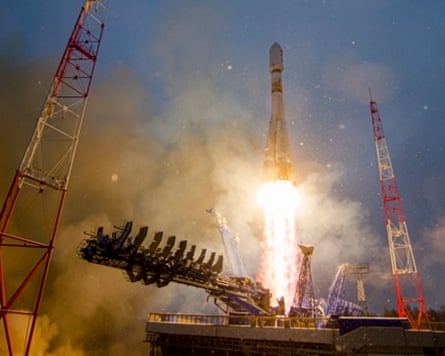
The attack on Samara was a case in point, hitting the rockets that deliver Russia’s new Rassvet satellite system, which is being rapidly deployed as a replacement for Elon Musk’s Starlink, from which Russia was shut out earlier this year.
In addition, Ukraine has attacked other sites belonging to Roscosmos this year, including Korolyov, a large complex north of Moscow, and a Ukrainian-built radio telescope captured by Russia in Crimea.
Russia’s attempts to rapidly deploy its Rassvet network are not the only challenge from space that Ukraine faces. Moscow has also used Oreshnik ballistic missiles on at least three occasions – a system that launches into near space, then deploys multiple independently targetable warheads initially designed for nuclear weapons.
All of this has prompted Kyiv to intensify efforts to diversify its own access to space-based systems away from the US and Starlink, which was controversially choked in recent weeks, and to develop new space countermeasures against threats such as the Oreshnik.
Ukraine has conducted at least three tests of near-space interceptions as it has sought to launch its own sovereign satellites, joining a rapidly expanding number of countries working towards a foothold in space.
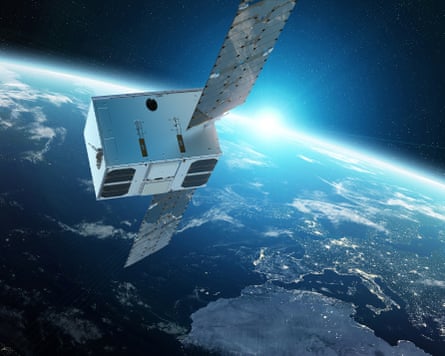
That became a reality last month when Ukraine and Denmark’s GomSpace announced they had successfully launched the Obria Nano, the first test satellite for a future independent Ukrainian communications network, reportedly envisaging about 245 satellites.
‘Everyone wants their own version of Starlink’
The increasing incursion of the Ukraine conflict into space, say experts, is only the latest evidence of the rapid militarisation of a domain the treaties for which remain ill defined, outdated and difficult to enforce.
In September the US air force secretary, Troy Meink, admitted for the first time that Washington had deployed “on-orbit space control weapons” amid reports that Russia had regularly flown its satellites close to US and other countries’ assets in space.
As if to underline that point, a few weeks later a Russian satellite, Kosmos 2612, was observed aggressively manoeuvring towards a commercial radar satellite operated by the Finnish group Iceye that provides three-dimensional terrain imaging to the Ukrainian military, in what experts described as an act of deliberate harassment.
“[Space warfare] has been talked about as the future,” says Dr Elena Grossfeld, an expert on space and security at the Swedish Defence University. “But we’re already in that future.”
For Russia, Grossfeld argues, space has become essential to military success, with Moscow treating offensive operations there as a precursor to broader conflict in a new reality where war is inseparable from satellite-based intelligence and targeting.
“This started before the war in Ukraine,” Grossfield said. “The US Space Force [then second in command, Gen David Thompson] said in 2021 that the US was seeing daily attacks [by Russia and China] on US satellites.
“They are not necessarily kinetic [attacks], but now with the war and with everyone’s dependency on space for intelligence and communications, it has become front and centre.”
While Grossfield said Russia’s intention in the recent “bullying” of the Iceye satellite was not clear, one possibility was to force it to use fuel to change course and in doing so shorten its lifespan.
That is not the only tactic that has been seen. Russia has also used signal jamming, laser-dazzling of satellites, and placed “inspector” spy satellites near foreign space assets.
Complicating what is happening in space, experts say, is that treaties on governance in space, and deployment of weapons, have in recent years been overtaken.
Victoria Samson, the head of the space security and stability programme at the Secure World Foundation, which advocates for space safety and sustainability, noted a rapid increase in the number of countries operating in space, in tandem with the expansion of commercial activities by companies such as Elon Musk’s SpaceX and Jeff Bezos’s Blue Origin.
But while many countries have opted to use SpaceX for its satellite launches, Musk’s recent actions towards Ukraine, cutting Starlink data speeds, have forced a rapid rethink of whether to rely on unreliable and sometimes ideologically led commercial ventures.
“The big shift in the past decade,” said Samson, “has been towards commercial space operations and that has been an issue in the current conflict [in Ukraine].”
Like Grossfeld, Samson sees frictions in space becoming more overt. “It’s all part of strategic competition,” she said, describing the recent Russian satellite-bullying incident. She added that with more escalation, there had been “more openness on the US side to talk about what they are doing [in relation to weapons in space] while Russia and China are working on a lot of the same stuff.
“Then there is the issue of space being used in an active military conflict. We have already seen Russia jamming GPS, which has resulted in aviation being disrupted over the Baltics. But it has been particularly visible in the issue of Starlink and in pauses by the US to sharing satellite intelligence with Ukraine [that warns] of incoming ballistic missiles.”
If there has been a consequence of Musk’s and the Trump administration’s unreliability, Samson believes, it has been to push countries to seek alternatives. “Like the Russians with [the] Rassvet network, everyone now wants their own versions of Starlink, including the Europeans.”
For Ukraine, said Fedir Venislavskyi, the head of the state security subcommittee of its parliamentary defence committee, that meant a “sovereign” Ukrainian presence in space, now achieved via the Obria Nano satellite.
“Since the war the space domain has been crucial for Ukrainian forces and that has been underlined by recent events – whether at the instigation of the US government or from SpaceX – where we saw communications drop and jeopardise our military’s command-and-control systems.
“Now we need to raise it to another level, not least because the enemy is already threatening Ukrainian territory from international space via Oreshnik missiles. It’s essential we’re not shortsighted about this risk.”
With Russian launch sites now beyond the range of Ukraine’s longest-range missiles, Ukraine has instead conducted three tests on exo-atmospheric kill systems to intercept launches in near space, including launches of weapons piggybacked on very high-flying aircraft.
“It is a priority,” said Venislavskyi. “We’ve already demonstrated launches of exo-atmospheric systems and we are working to see if we can get that in production.” However, he admitted, given the huge demands of the war, funding would be a significant issue.
KioskNews shows a cleaned-up reading view extracted from the publisher’s page — the original always lives on their site, not ours.