Chinese deep-ocean drilling ship brings home ‘precious’ South China Sea samples
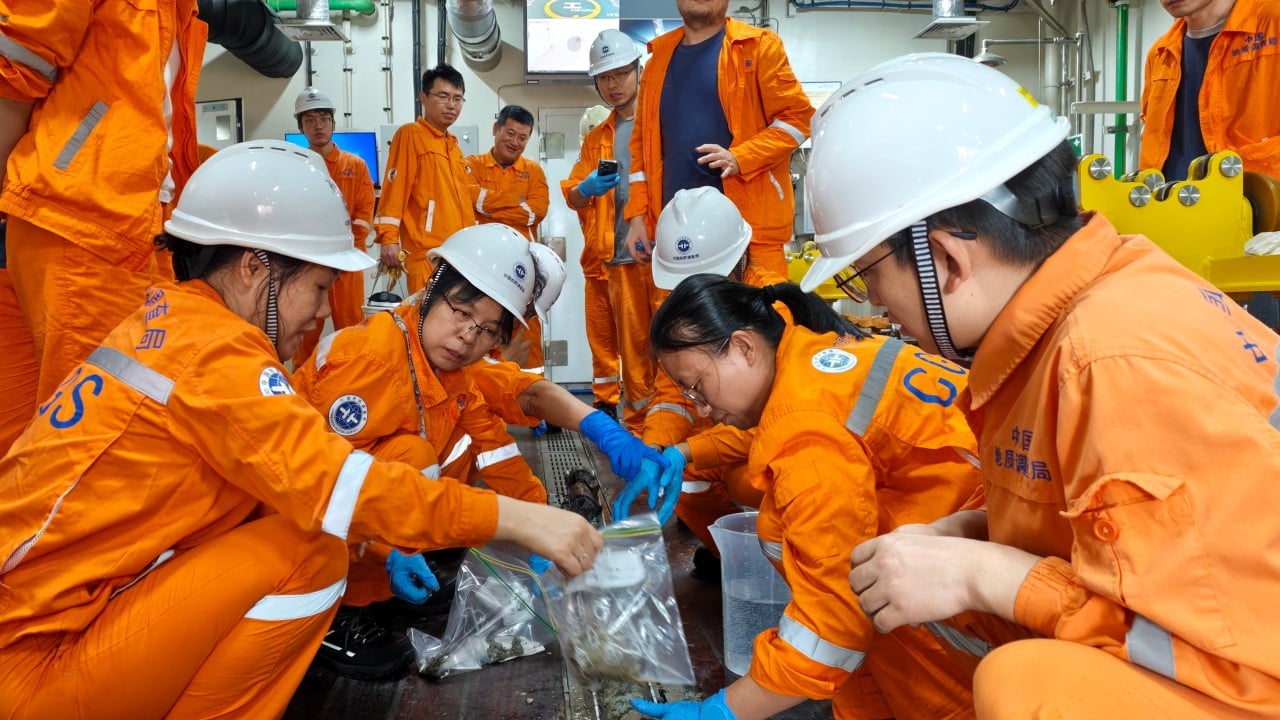
The ocean drilling ship Mengxiang has returned from its first expedition in the South China Sea, where it set a national depth record and obtained basalt core samples that could help to unravel the region’s tectonic history.
The 30-day expedition organised by the China Geological Survey tested the operational capabilities of the world’s most powerful deep-ocean drilling ship, according to a report published on Monday by the official ministry newspaper Science and Technology Daily.
During the voyage operated by the Guangzhou Marine Geological Survey, the ship conducted drilling and sampling at two sites and obtained “a large number of precious core samples and data”, it said.
At one site, the ship’s maximum drill depth reached 4,929 metres (16,000 feet) below the ocean’s surface – penetrating 865 metres below the sea floor – setting a national record for scientific drilling, according to the report.
The samples, which included a 4.27-metre core of basalt rock, will help researchers understand the formation and spread of the South China Sea, as well as the role that a spreading ridge jump and volcanic eruptions played in restructuring the seabed.
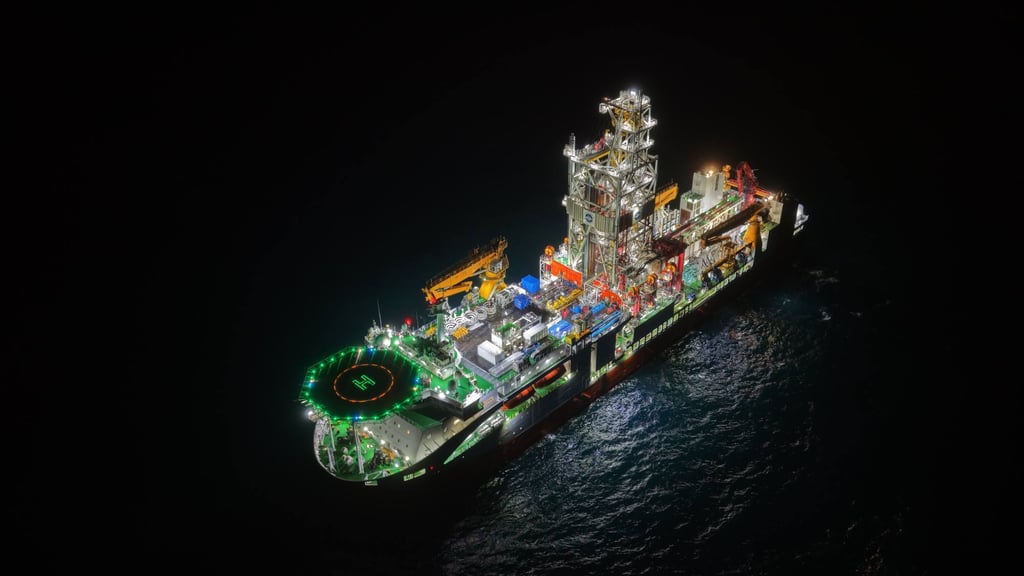
The Mengxiang, which means “dream”, was commissioned in November 2024 as China’s first domestically designed deep-ocean drilling vessel.
China is the third country, after Japan and the US, to use a drilling ship to obtain hard rock samples from a deep ocean basin. The US research drilling vessel JOIDES Resolution was retired last year.
The Mengxiang can drill to a depth of 11km (seven miles, or 36,000 feet) below the ocean’s surface and one kilometre more than the maximum capacity of the current world record holder for deepest scientific ocean drilling, the Japanese vessel Chikyu.
For decades, scientists have been working to drill down into the sea floor to reach the Mohorovicic discontinuity – also known as the Moho – which marks the boundary between the Earth’s crust and mantle.
While the Moho lies about 35km to 40km below dry land, it is only between 5km and 7km below the sea floor – after getting past a few kilometres of water – making oceanic drilling the most feasible path to reach it.
Scientists hope that the samples recovered from this zone could yield critical insights into our planet, including crust formation, plate tectonics and its evolutionary history.
The Mengxiang missions to drill to the Moho beneath the Indian or Pacific seafloors – where the crust is thinner – are expected to start by 2030, according to a letter from researchers at the China Geological Survey published last year in Nature Geoscience.
According to the Science and Technology Daily report, preliminary studies on the samples from its first expedition suggest that large-scale volcanic eruptions occurred after a geological event called a spreading ridge jump in the South China Sea.
In a ridge jump, an underwater spreading centre – a place on the ocean floor where tectonic plates pull apart and magma forms new crust – abandons its position to reopen at a new one.
09:23
History, money and military: why the South China Sea is so important to Beijing
The findings provide crucial evidence that could resolve long-standing questions about how the ocean basin formed and evolved.
Drilling at depths of around 800 metres below the seabed also uncovered rare structural features, such as alternating layers of red and green sediment, which could offer insight into ancient marine environments, the report said.
The vessel’s coring system was tested and proved to meet the standards of the long-running International Ocean Discovery Programme of marine research that uses deep-ocean vessels and platforms to study sediment and rocks.
Passionate about science? Dive deeper with the Dark Matters newsletter, a weekly in-depth analysis on China’s rise in science, technology and military that goes beneath the surface. Sign up for free now.
KioskNews shows a cleaned-up reading view extracted from the publisher’s page — the original always lives on their site, not ours.