Forget ‘A Quiet Place,’ Jake Gyllenhaal’s No. 1 Netflix Thriller 'The Day After Tomorrow' is Even Better


Post-apocalyptic movies usually have a villain, a force or a presence that the heroes can fight back against. 28 Years Later had The Infected, A Quiet Place had Death Angels … but what if the thing destroying Earth could not be battled? What if it was nature itself? That’s the disquieting premise behind the 2004 blockbuster The Day After Tomorrow, which currently sits at number one on the Netflix charts. With an all-star cast led by a young Jake Gyllenhaal, it remains one of the most thrilling disaster movies of the 21st century, with a terror grounded in an all-too-real threat.
‘The Day After Tomorrow’ Sees Humanity Run from World-Ending Disaster
Directed by Independence Day filmmaker Roland Emmerich, the movie imagines a series of climate disasters predicted by scientist Jack Hall (Dennis Quaid), which are not acted on by governments until it is too late. The film then becomes a race against time, as Jack travels from Washington D.C. to New York, where his teenage son Sam (Gyllenhaal) is trapped in a sudden ice storm that has consumed Manhattan.
As with most disaster movies, the film features spectacular special effects that create stark visuals of the carnage. Perhaps the most unsettling image from the movie is the island of Manhattan covered in deep layers of snow following a tsunami, with the Statue of Liberty half-buried to illustrate the scale of the disaster. As with Emmerich’s alien invasion blockbuster, where he blew up the White House, familiar landmarks are used to show the sheer scale of the action scenes which, even two decades on, are startling to watch.
Jake Gyllenhaal Impresses in His First Action Role
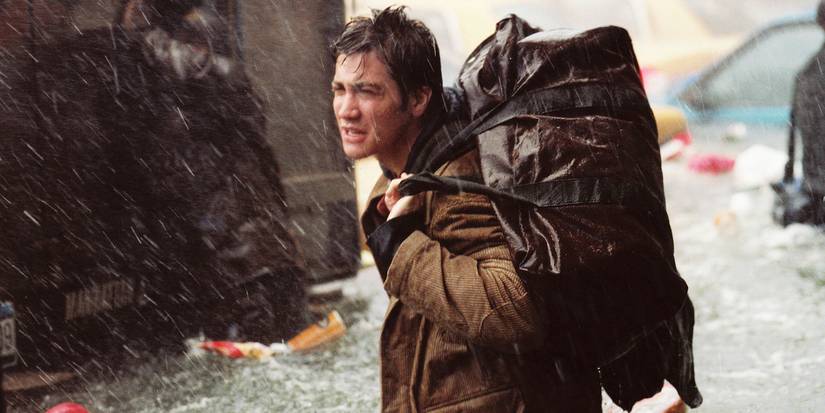
Despite being just 24, Gyllenhaal had already enjoyed global success with his breakthrough hit Donnie Darko in 2001. Having mostly focused on independent dramas, The Day After Tomorrow was his audition for the big time. In a role that could have disappeared in an ensemble of established actors like Quaid and Ian Holm, he has the right mix of courage and emotional vulnerability to stand out. Sam is introduced as more academic than an action hero; however, he becomes the latter when forced to traverse dangerous landscapes in order to survive.
The film is, in essence, the actor’s A-list audition. He would go on to be known for mixing big-budget extravaganzas like Spider-Man: Far From Home and Road House with smaller, more thoughtful independent stories such as Brokeback Mountain and Jarhead. He also became known for bringing personality to the roles he plays, no matter the genre, and in Sam, we saw someone who was much more than a prop for the computer effects – he was a human you cared for deeply.
‘The Day After Tomorrow’ Plays On a Very Real Fear


For a 22-year-old movie, Roland Emmerich’s film is unfortunately becoming increasingly relevant as the years go on. In the real world, catastrophic weather events have occurred with increasing regularity across the world, leaving communities working to find out a way to defend themselves against disasters of an epic scale. Increasingly, movies such as Digger, Don’t Look Up, and Furiosa all imagine worlds devastated by climate change, striking a chord with audiences precisely because they seem more tangible than ever.
The Day After Tomorrow’s title even hints at that real-world parallel, implying that the events of the film are not that far away from the reality we live in. While it's a chilling thought to ponder, it’s also a great technique for drawing in the viewer to the film’s plot. Everyone has their “zombie survival plan,” and in the same vein, we are forced to question what we would do if the oceans rose and an ice age came. While that may seem a bit gloomy, the film’s uplifting message is that, despite the disasters they face, humanity’s spirit prevails. Characters like Sam find hidden reserves to keep going, and protect the people that matter to them. While the predictions of the film may seem foreboding, its message of hope is welcome.
Taking a subject that is a matter of global discourse and making it a big-budget spectacle, The Day After Tomorrow remains popular with streaming audiences because of its mix of entertainment with real-world stakes. It showed what Jake Gyllenhaal could do on the biggest of stages, and became a byword for a future we should work to prevent.

- Release Date
- May 28, 2004
- Runtime
- 124 Minutes
- Director
- Roland Emmerich
- Writers
- Roland Emmerich, Jeffrey Nachmanoff
KioskNews shows a cleaned-up reading view extracted from the publisher’s page — the original always lives on their site, not ours.