John Howard witnessed the 9/11 attacks as PM. It changed his leadership forever
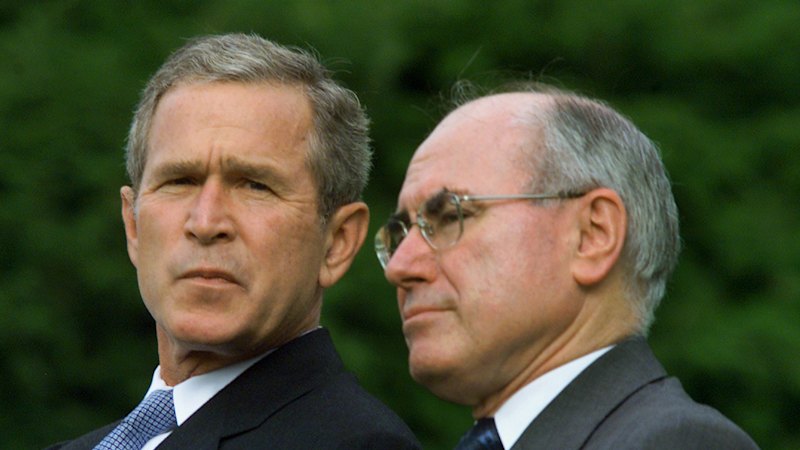
John Howard served as Australia’s prime minister for 4284 days. None were more consequential than September 11, 2001.
As the nation’s second-longest serving prime minister describes it: “Psychologically, the world has never been the same.”
Twenty-five years since terrorist attacks shook the US, and the world, the specifics bear repeating. Terrorists hijacked four passenger planes. Two were deliberately crashed into the World Trade Centre towers in New York, another into the Pentagon building in Virginia. The final plane exploded in a field in Pennsylvania after passengers intervened, stopping the aircraft from hitting its intended target of the US Capitol building in Washington. The death toll from that day was 2977, including 10 Australians.
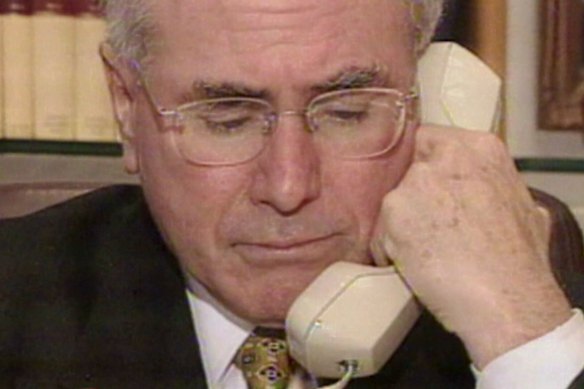
Howard was in Washington and supposed to be at the Pentagon the morning of the attacks, but a meeting was rescheduled for the day before.
“It’s one of those things: ‘were you there?’,” Howard says, on the 25th anniversary of the attacks.
“And very clearly, it was one of the most momentous events, because it transformed world politics. Terrorism would thereafter forever be part of our future planning.
“When you think of security now, you think of terrorism.”
Howard, now 87, still remembers the US visit like it was yesterday. It was a momentous visit, but not in a way the former prime minister had imagined.
The trip that changed Australia’s place in the world
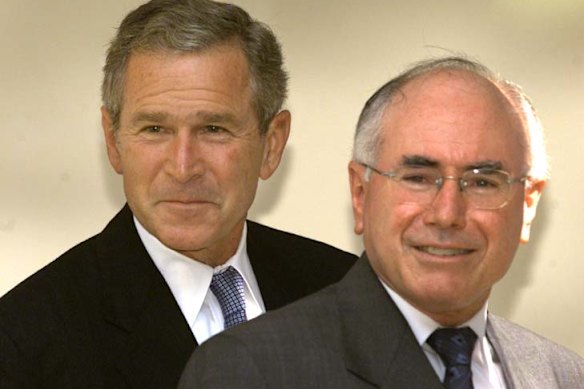
Before it took place, Howard’s US trip was seen as an incredibly important one for the prime minister. He was there to meet then-president George W. Bush in person for the first time.
Howard, along with key advisers and a travelling media pack, had arrived in Washington DC on September 8 – three days before the attacks. Meeting Bush was just one part of the itinerary, Howard was also to address a joint sitting of the US Congress, and hold a series of meetings with the most senior members of the US government.
“Although I had spoken to Bush on the phone several times, I hadn’t met him until then,” Howard says.
In extraordinary timing, Howard had been due to meet then secretary of defence Donald Rumsfeld at the Pentagon on Tuesday morning of the attacks, but the meeting was moved to Monday afternoon.
And on the Monday evening before the attacks that changed the world, Howard sat down for dinner with media mogul Rupert Murdoch.
“We had dinner at a restaurant next to the Willard [InterContinental] Hotel, at which my party was staying. We talked about all sorts of things. He didn’t just ear-bash you – I enjoyed talking to him about his ideas about how to make the world better,” Howard recalls.
As the pair left the restaurant, they were stopped by journalists and Murdoch was questioned about whether his newspapers would endorse Howard at the Australian election, due to be held in the coming months.
“I remember clearly... [Murdoch] said, ‘no, that is a matter for my editors’,” Howard recalls.
“And I said, ‘I think that’ll get a bit of a run in the papers tomorrow’. Little did we know that other things would replace it in the papers. That was the night before.”
The next morning, after powering past the Lincoln and Vietnam and Korean war memorials in Washington on his morning walk, Howard was joined by media chief Tony O’Leary in his hotel room for a discussion about a forthcoming press conference with the Australian media. Ansett Airlines was on the verge of collapse, and that was expected to be the topic of the day.
As the meeting wrapped up, O’Leary mentioned there had been a terrible accident in New York.
Fifteen minutes later, he was banging on Howard’s hotel door and telling him to turn the television on.
“Another plane had hit the other tower and we then knew this was no accident. And we turned it on, and the full horror was being played out on television,” Howard recalls.
It was the most consequential moment of Howard’s career. Instead of addressing a joint sitting of Congress, Howard was the only guest in the House chamber that day.
Howard remembers wanting to get back to Australia but US airspace had been closed, so Powell arranged for Air Force Two to fly Howard and his travelling party to Hawaii (including Scheiffer).
In the grounds of the Australian consulate in Honolulu, Howard offered public expressions of support and solidarity before boarding a Qantas flight.
“On the plane, I rang [foreign minister] Alexander Downer. I had a long discussion with him, and he said ‘John, why don’t we invoke ANZUS?’ And I said, that’s a terrific idea, yeah.”
Cabinet would approve the invocation of the ANZUS treaty for the first time, the formal alliance between the US, Australia and New Zealand, that Friday.
In practical terms, invoking ANZUS meant Howard was committing Australian to join the United States in whatever military response to the attacks was to come in the months and years ahead, come what may.
“I went back to where Tom [Scheiffer] was sitting [on the plane] and told him, and he was visibly moved. He said, ‘John, that that is fantastic’ ... he knew what it would mean to Bush.”
Ten Australians were among the 2977 people murdered in the September 11 attacks – eight in the towers and two in the planes that came down – and just over a year later, on October 12, 2002, another 88 Australians were murdered when Islamic extremists Jemaah Islamiyah, a group linked to Al-Qaeda, undertook the Bali bombing.
Howard notes that the September 11 attacks changed the world, but the Bali bombing brought terrorism right to Australia’s doorstep.
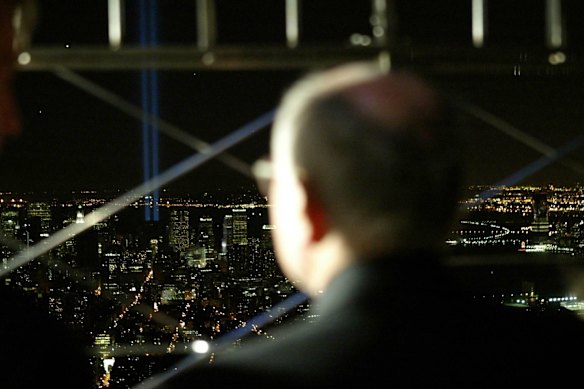
September 11, 2001, Howard says, “raised the spectre of whether there were any homegrown terrorism [in Australia], and of course it turned out that within a little over a year we had the terrible attack in Bali, and in many respects, Bali was an extension of Australia”.
Asked why Australia had needed to send troops into Afghanistan in 2001 after the September 11 attacks, and then into Iraq a year and a half later, Howard pauses for a moment.
Bush, he says, was very appreciative of Australia standing shoulder to shoulder with the US, even if it wasn’t strictly necessary.
“For all its power and might and everything, America is prone to vulnerability at times and therefore they appreciate close friends and immediate expressions of support and understanding,” he says.
“He [Bush] was obviously appreciative. And he said, ‘Look, John, we could do all this. I mean, in effect, said it in a polite way ... we don’t need it physically, but gee, if we’re going to have any help, we’d like to have some from you’.”
Cut through the noise of federal politics with news, views and expert analysis. Subscribers can sign up to our weekly Inside Politics newsletter.
KioskNews shows a cleaned-up reading view extracted from the publisher’s page — the original always lives on their site, not ours.