How the navy’s Haifa fleet is transforming war at sea: New details of attacks revealed - exclusive

From blocking a mammoth Turkish flotilla to new explanations about how the navy's secret Shayetet 13 has radically changed how it operates, to a sword of Damocles that the Navy holds over Lebanon and Syria, to new details of naval attacks and intelligence versus Gaza, Iran, and Yemen, The Jerusalem Post has recently heard a host of revelations.
How did the navy manage to block the mammoth Turkish flotilla of around 80 ships which tried in May of this year to break Israel's blockade of Hamas in Gaza?
With around 600 soldiers in tow, the Israeli navy, with heavy complements of the Shayetet 3 missile boat fleet and the Shayetet 13 navy seals, captured these ships at a stunning distance of around 800 kilometers from the country's coast.
Hearing about the operation in much greater depth than previously discussed, the Post understands that the first goal of the mission was simply to find the vessels and diagnose their formation.
In top navy officers' view, this was critical to best plan the takeover of the ships, since as soon as they took over one ship, they knew the others would try to run and spread out, making them much harder to catch.

Ultimately, the Post learned that senior naval officials decided to carry out two rounds of takeovers. After the first round, the Shayetet 3 fleet withdrew to reform a blocking formation. Later, they went back in and restarted the takeover of the remaining flotilla ships once those flotilla vessels had come back together again.
The flotilla had significantly more ships, so managing to take over all of them was more an art than a science.
It meant, according to senior naval officials, having multiple flexible forward-at-sea command centers and giving sub-commanders on the scene a sizable amount of discretion.
Some ships and commanders were at sea for 42 days, while others for at least two-and-a-half weeks.
Using two different naval convoys, Shayetet 3 could issue orders for their forces to act in unison at times and split off into multiple disparate missions at others.
Shayetet 3, the Post has learned, had two amphibious transport landing craft ships that were converted into large mobile detention centers for holding 600-700 arrestees.
There was a large group of Israel Prisons Service (IPS) personnel on the ships who had taken special training for guarding the detainees while at sea.
These amphibious transport ships gave the navy the capability to intercept the flotilla ships farther from Israel, with more room to maneuver and capture them even if they tried to evade, the Post understands.
After the operation, it took four to five days for all the vessels to return, but the landing craft were loaded with vast amounts of food and other needed items, so the additional travel time with the detainees was not a problem.
Shayetet 3 viewed the flotilla as one big trap to try to delegitimize Israel. The navy has said that there was nothing humanitarian being transported – only small yachts with very little belongings, even very few personal items.
Senior naval officials have said the Shayetet 13 Navy SEALs were very careful, showing significant restraint, and the takeover plan was designed to avoid "another Mavi Marmara situation" for the safety of the soldiers and the flotilla members.
New Shayetet 13 technologies have a stopper cable, which six commandos can slide down on from a helicopter at a time onto a ship. Also, the commandos can pause the sliding-down action in the middle if they see hostile elements entering the drop zone area, the Post has learned.
Some of the flotilla members threw a firecracker at the boats. This kind of firecracker can burn and damage the ships, and a lethal IDF response could have been justified.
The commanders of the Shayetet 13 rigid inflatable fast boats were granted the authority to decide how to respond, the Post understands. In the end, the firecracker did not endanger the ships, and given that the larger mission orders were not to undermine Israeli legitimacy, Shayetet 13 showed restraint.

What are the different ways Shayetet 13 fights with ground forces?
Though Shayetet 13 fighting with IDF ground forces in Gaza has been widely publicized, the Post has learned the comprehensive picture of the three distinct ways that Shayetet 13 naval commandos were used during the Gaza War.
First, special forces were used under the command of the navy for quicker targeted special missions, like striking Hamas in Rafah, starting the northern invasion, and being used to trick Hamas into moving its forces to a southern position to open the northern position more for the larger thrust of IDF forces.
Second, Shayetet 13 were integrated into the separate infantry southern and northern commands, where specific soldiers became part of a ground forces brigade for a medium but extended period, as in the Shifa Hospital mission, but were limited to receiving special, time-limited missions.
Third, some naval commandos were fully integrated into a multi-military-arm attack group, including land, sea, and air forces, meaning 30-50 fighters were part of a full IDF division (four to five times the size of a brigade) for a number of months. This third strategy was the longest period naval commandos were "loaned" to other parts of the military.
During the Second Lebanon War, higher-up officials had not let the Shayetet 13 fight directly with the ground forces, so they were underused, the Post has learned.
The handling of Shayetet 13 during this Gaza War was a corrective measure after various soldiers who were junior officers in 2006 had become top officials by 2023.
Lebanon and Syria in a potential maritime 'chokehold'?
All of Israel's enemies and potential adversaries have maritime areas.
The Shayetet 3 missile boat fleet brings Israel's full naval forces to any and all of these places, whether Syria, Lebanon, or even Libya.
Anywhere Israel's enemies give it a problem, they should expect that the navy can act decisively to stop them, the Post has learned.
Some senior naval officers feel that adversarial forces in both Lebanon and Syria could be broken if Israel placed a full naval blockade on them.
This is not currently being actively considered, but holding it as a back-pocket option always gives Israel some additional strategic leverage between the sides.
Mostly, the reason it has not been carried out against Hezbollah has been because there is no clear way to distinguish choking off Hezbollah's maritime economic support from the Lebanese government's maritime trade.
A move against Syria seems even less likely. But it was probably discussed in some circles as a potential future response when Syria was trying to bring Turkish radars and other elements into its territory.
If relations between the sides might deteriorate significantly from the current relative stability, senior naval officers believe Syria could not stay intact economically if the IDF ever executed a blockade.
New details for sea-to-land attacks
On March 24, 2025, the IDF and Shin Bet (Israel Security Agency) put out a statement that they had killed Ismail Barhoum, head of Hamas's finances and institutions with the terrorist group's political bureau, during a strike in Khan Yunis in southern Gaza.
The senior Hamas official was the successor of Issam al-Da'alis, the former Hamas Prime Minister who was killed only around 72 hours earlier.
Barhoum was a central figure in Hamas's political bureau and played a major role in Hamas's decision-making for their Gaza terror activities against the IDF.
Left out of that press release, but which the Post can now publicize, is that the strike was carried out by the navy, partially to be precise, given that Barhoum was operating at the highly sensitive Nasser Hospital site.
In the operation, the Post learned that the navy and Shayetet 3 began planning the attack on Barhoum while the ship was still on defense.
The missile ships can carry out multiple missions at the same time. For example, they could go on offense, striking Hamas in Gaza, while also remaining on defense to defend Israel's maritime natural gas fields.
However, because of the multiple and varied intelligence systems on the ship, even while nominally on defense, the missile ships could begin certain processes to be ready to carry out the attack when the order was later given.
More broadly, certain Shayetet 3 vessels have far-off surveillance and sensor capabilities as well as a 76-millimeter gun and have also coordinated their firing directly with battalion-level field commanders as they maneuvered and fought with Hamas in Gaza.
In contrast, in the past, coordination between naval and ground forces either rarely happened or required coordination at the Southern Command chief level, three levels above the battalion level, delaying action extensively.
Israeli naval officials said that foreign navy officials visiting have been shocked that Israel's navy can work directly with invading battalion-level IDF ground forces in real-time, something they have not dreamed of attempting.
The Post has new revelations for naval operations in Lebanon as well.
The navy on March 5, killed Hamas commander Wasim Atallah Ali in a highly precise strike on Lebanon’s Beddawi Palestinian camp in the northern coastal city of Tripoli. This was a non-Shiite area that had not yet been attacked during the first week of the Israel-Iran-Hezbollah conflict, which had started on February 28.
Ali was responsible for all training and military exercises in Lebanon within Hamas’s military wing, according to the military.
“The terrorist focused on advancing terror attacks which could harm the citizens of the State of Israel and IDF forces,” the IDF said at the time.
The Post has learned that the navy was brought in for its unique precision capabilities so as to avoid even small amounts of collateral damage to the Christians, foreign diplomats, and other highly sensitive civilians who Hezbollah had embedded itself among.
If the air force can bring down buildings, this attack had to avoid such large-scale destruction.
In addition, if drones must constantly refuel and be replaced, which is logistically difficult and expensive and can lead to missing a sudden opening to strike, ships can more easily remain at sea, even waiting a month for the right moment to strike.
Accordingly, the Post understands that the naval ship in question was in place for five days before the attack, waiting at the ready for the exact time to open fire.
And once the order was given, the navy was able to carry it out in a very short period of time, much more rapidly than the air force can usually act, given its need to take off and fly closer to a given location that it is attacking.
Iran
On March 26, the IDF said that naval intelligence had assisted with assassinating Iranian Naval Chief Alireza Tangsiri in the port city of Bandar Abbas, with eliminating key Iranian naval cruise missile production sites, and Iranian sites related to submarines and other underwater threats.
The process started with the Israeli naval intelligence and operations directorates carrying out specialized research to understand who Iran's naval officials were and when and how they generally operated.
Next, the navy operations directorate placed the specific individuals, including Tangsiri, in the target bank for IDF intelligence and the air force.
After that, IDF intelligence used the initial leads it received from the navy to acquire raw, real-time intelligence for carrying out the assassination, which it eventually passed on to the air force.
Naval intelligence also assisted with targeting key naval cruise missile production sites in Tehran.
The targeted sites operated under the command of the Iranian Ministry of Defense and were used by the Iranian regime to develop and manufacture long-range naval cruise missiles, which are capable of rapidly destroying targets at sea and on land.
Such weapons could be used against the US and other allies seeking to open the Strait of Hormuz.
Aspects of the intelligence in many of the above operations were gathered by Shayetet 3 as well as other classified means, the Post understands.
Shayetet 3 was also critical in defending against aerial threats over the homeland and supporting ground forces in Lebanon, so the overwhelming majority of the air force could focus on offense against Iran.
As noted, unlike aircraft and drones which regularly need to land and refuel, naval ships can remain at sea 24/7 for a much longer period.
The naval fleet provided key defensive actions in dozens of instances.
Freeing up the aircraft to attack Iran was one level performed by the navy, but freeing up even some of Israel's drones to shift to Iran was an entirely additional benefit of the navy's comprehensive defense coverage.
Yemen
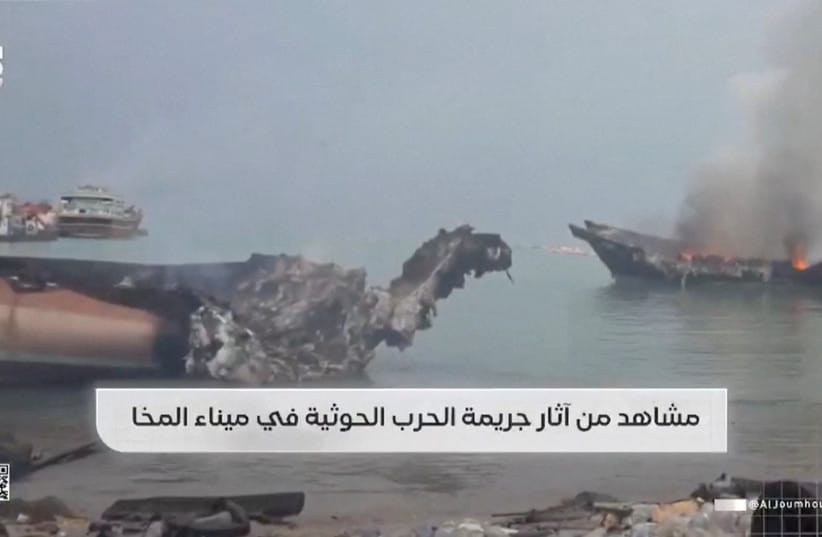
A potential Yemen Houthi blockade of Bab el Mandeb would harm the freedom of sea travel and maritime trade regarding the Port of Eilat. However, it is a much more major issue for other countries.
More trade from the US, EU, Middle Eastern, and Asian countries than Israeli trade goes through Bab el Mandeb. Israel definitely hopes to restore the Port of Eilat to full functionality as soon as possible; since October 7, it has mainly carried maritime trade through its Haifa and Ashdod ports.
Much of the solution regarding the Houthis relates to the Saudis and others providing air power and other support to anti-Houthi forces on the ground in Yemen.
Prior to being stopped by the Biden administration in 2017, many observers thought that the Saudis had the Houthis to a large extent on the run. Not that even in the best case the Houthis will be easy to finish off, as they are a ragtag terror group, not a country, which does not care about how many of their fighters get killed, the Post understands.
Sources also say that Israel needs to further build up its naval capabilities to be ready to engage the Houthis more intensely and consistently should the Yemen terror group choose to engage in conflict with Israel again, as it did from 2023-2025.
Interestingly, the IDF also needs to increase its physical naval capabilities versus Iran. While few observers realize it, Iran is farther away by sea than Yemen.
This inverts the usual balance readers here are used to: Iran is 1,000-1,500 kilometers away by air, and Yemen is 1,800 to more than 2,000 kilometers away, the Post has learned.
But because of the shape of the waterways, reaching Iran by sea is farther, takes longer, and requires additional specific force-buildup moves, according to naval sources.
In any event, naval commanders are prepared to take forceful action against the Houthis via forces based in Eilat and the Red Sea area to make them think twice about meddling in Israel's affairs.
KioskNews shows a cleaned-up reading view extracted from the publisher’s page — the original always lives on their site, not ours.