Ange Postecoglou has moved to Saudi Arabia. How should we feel about that?
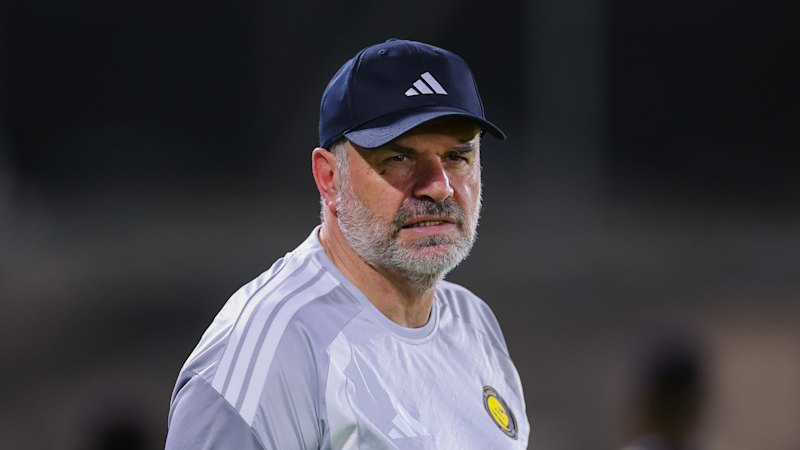
Ange Postecoglou has made a career out of taking the road less travelled; of eschewing the easy, obvious thing in favour of the biggest available challenge.
Not for the first time, he’s outdone himself.
It’s been just over a year since he was unceremoniously dumped by Tottenham Hotspur after delivering the club’s first trophy in 17 years, and just under a year since his brutal sacking by Nottingham Forest after 39 disastrous days in charge. Popular wisdom was that, to overcome the perception that he was damaged managerial goods, Postecoglou, now 60, would have to leave the Premier League and rebuild his reputation elsewhere: perhaps a big club in Germany or the Netherlands, where he could re-establish his credibility and set up a swift return to England.
But nobody thought he would go this far off Broadway.
Postecoglou’s next chapter began over the weekend, without any of the fanfare that came with the last couple. You may not have even known it happened: in the early hours of Sunday morning (AEST), Al-Nassr opened the new Saudi Professional League (SPL) season with a 3-0 win over Al-Fateh.
Cristiano Ronaldo, 41, who increasingly resembles a wax likeness of Cristiano Ronaldo, sported a notable new haircut as he watched on from the stands, not yet ready to play after his recent wedding, having told Vogue (as you do) that this would “probably” be his final season. It will revolve around his pursuit of the 24 more goals he needs to become the first player in history to score 1000 career goals in official competitions. Postecoglou could be the coach who gets him there. He welcomed Ronaldo to his first team meeting of the season by calling him “Cris” and congratulating him on his nuptials. He is now attached to the perpetual CR7 content machine. This is his new world.
Postecoglou’s two-year contract with the reigning Saudi champions reportedly gives him a salary of almost $20 million per year. Pretty good work, if you can get it; the road less travelled, in this instance, is also paved with riyals.
Is this really where we envisaged him taking his managerial talents? And where are we, exactly: does this mark the beginning of the end of the great Angeball odyssey, or is this just a brief interlude before his triumphant resurgence at the highest level?
At this point, we should take a deep breath.
Australians, in particular, should be very careful about turning their noses up at Postecoglou’s decision to work in Saudi Arabia, lest we engage in exactly the same sort of Eurocentric snobbery that Ange has always railed against.
You can’t, on one hand, accuse English pundits of underestimating Postecoglou’s previous achievements in Australia, Japan and Scotland because of where they took place, and then on the other hand dismiss Saudi Arabia as some sort of barren footballing wasteland. It’s not: Saudi Arabia was a legitimate football country before the Public Investment Fund decided to start spending big a few years ago, and it still is.
The cynical view is he’s only gone there for the cash, which doesn’t quite square with the relentlessly ambitious Postecoglou we know. The generous view is that he has taken arguably the most high-profile job in club football outside of Europe, and is now in charge of a squad with more quality than many top clubs in Europe: beyond Ronaldo, there’s Samu Costa, Sadio Mane, Joao Felix, Inigo Martinez and Kingsley Coman, plus a host of tidy Saudi internationals.
This is entirely consistent with Postecoglou’s general worldview: that worthy football exists beyond the borders of Europe, and that coaches should go wherever they feel they can make the biggest impact.
It is, though, possible to be respectful of Saudi football and also acknowledge the undeniable truth that, for Postecoglou enthusiasts, watching the Riyadh derby just isn’t going to hit the same as a North London derby, or an Old Firm clash. Nothing against the Saudi Pro League; that’s just how it is.
But it’s his career, not ours; he has more than earned the right to do whatever he wants, and owes an explanation to nobody.
In pure football terms, this is a cracking challenge. Al-Nassr are the reigning champions of Saudi Arabia; this is the first time Postecoglou, who normally specialises in fixer-uppers, has taken charge of a team defending a league title. That’s new. They’ve never won the AFC Champions League, so there’s his big target to aim for, along with winning the league again. He’s also got to adapt his brand of football to new conditions, in a place where it’s never not hot. He has to somehow manage the gigantic ego of a player who is within sight of an unprecedented individual milestone, and who famously doesn’t press – which would be a lot easier to deal with if this player didn’t run the entire show at Al-Nassr. And he’ll do all this in the knowledge that whatever success he has will be downplayed in Europe, because it’s only Saudi Arabia, and his failures will be magnified, because it’s Saudi Arabia.
This is not a pragmatic career choice.
There are, of course, some uncomfortable ethical considerations. Any player or coach who goes to Saudi Arabia is participating in that country’s efforts to build its public image in a certain way. Does that make this sportswashing? Is every coaching appointment in Saudi really an elaborate act of propaganda? Does sportswashing even actually work if human rights issues are brought up every time someone signs for a Saudi club? Should Postecoglou not get the Tim Cahill treatment, then? Is Socceroo Aziz Behich also guilty, having spent six months on loan at Al-Nassr in 2024? Do we consider Kevin Muscat as doing the bidding of the Chinese government because the club he coaches is owned by a state-owned company?
Or is there another way to view this: that the Saudi football “project” is also a case of a football-mad country which happens to have the means to invest at a staggering scale into the thing that it loves? Are they not engaging in exactly the kind of “nationalistic approach” Postecoglou once said was required to climb the ladder in world football, having given up hope it would ever happen in Australia? Or is any investment from the Saudi government inherently tainted? Where is the line? You can wrestle with these questions at your leisure, but there are no especially satisfying answers.
Success there may not win over Postecoglou’s biggest critics, but it can be a road back to the top. We have proof: Matthias Jassle, who has replaced Eddie Howe as Newcastle United manager, went straight to the Premier League from Al-Ahli. After also being sacked by Spurs, Nuno Espirito Santo spent a year at Al-Ittihad before returning to England with Nottingham Forest – so it can be done. And if he can get Ronaldo swooning in public about how good a coach he is, all sorts of doors could open for Postecoglou one day. Who knows? For him, the road less travelled is often bumpy, but it rarely leads to a dead end.
News, results and expert analysis from the weekend of sport are sent every Monday. Sign up for our Sport newsletter.
More:
KioskNews shows a cleaned-up reading view extracted from the publisher’s page — the original always lives on their site, not ours.