Conrad Black: Quebec’s Gilbert and Sullivan election
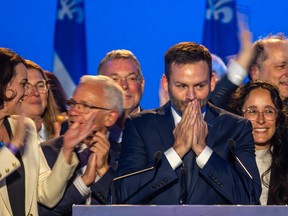
Monday’s election in Quebec produced the most fragmented result in the province’s history, where three parties had between 20 and 28 per cent of the vote, and two others between 12 and 14 per cent. The previously governing Coalition Avenir Québec (CAQ), after eight years in office, though led by the well-liked new premier Christine Fréchette, emerged with no members in the national assembly but approximately 14 per cent of the vote. The complete elimination from the legislature of the governing party is a rare event that surpassed even Kim Campbell when she replaced Brian Mulroney in 1993 and led the Progressive Conservative party from a caucus in the 150s to two. Richard B. Hatfield succumbed to this fate in New Brunswick at the hands of Frank McKenna in 1987, but nothing like it has occurred before in Quebec.
Sign In or Create an Account
The fifth of the parties in electoral strength was Québec solidaire (QS), led by Ruba Ghazal, a Lebanese-Palestinian and foaming-at-the-mouth anti-Israelite leading a party that advocates immediate secession with a minimal interest in any continuing relationship with Canada. This unambiguously rejectionist movement received about 12 per cent off the vote and nine members in the national assembly. The Conservatives elected candidates for the first time in 91 years, since Maurice Duplessis was their leader and joined forces in the 1935 election campaign with reformed Liberals to form what became the Union Nationale, which he led to victory for an unequalled five terms.

Columnist Jesse Kline keeps you up to date with what’s happening in Israel and the effects of antisemitism on life here in Canada. Friday mornings.
By signing up you consent to receive the above newsletter from Postmedia Network Inc.
A welcome email is on its way. If you don't see it, please check your junk folder.
The next issue of Channel Israel will soon be in your inbox.
We encountered an issue signing you up. Please try again
The Conservatives garnered approximately 20 per cent of the total vote and elected 19 members in the 127-seat provincial legislature, a remarkable feat for a federalist free-enterprise party. The shopworn but more or less imperishable Quebec Liberal Party, which governed for 39 years prior to the first election of Duplessis in 1936, and for about half of the time since the Union Nationale was replaced by the Parti Québecois in 1970, came in second with 24 per cent of the vote and nearly 40 legislators. The Parti Québecois managed to elect 59 members (46 percent of the total) with only 28 per cent of the popular vote.
For many years, the Quebec electorate was divided approximately into five roughly equal blocks: around 20 per cent non-French, who were almost entirely Liberal as they were federalists; approximately 20 per cent French Liberal federalists, giving the Quebec Liberals almost 40 per cent of the vote out of the gate; about 20 per cent of Quebecers were conservatives, who were generally also federalist; around 20 per cent were nationalists; and there was a floating vote of about 20 per cent.
The genius of Duplessis was to get the nationalists and the conservatives to vote together, which required great dexterity to avoid becoming so nationalistic that the conservatives were frightened, as happened in Duplessis’s one significant electoral defeat in 1939, an election he called abruptly to try to get a mandate to fight any attempt to reimpose conscription, as the federal government had done in 1917. Prime Minister Mackenzie King’s Quebec ministers — Ernest Lapointe, Arthur Cardin, Charles Power and Raoul Dandurand — all threatened to resign if conscription were imposed, while King solemnly announced that there would be no conscription for overseas service in an attempt to disarm and defeat Duplessis.
Duplessis returned for 15 years and one week and then died in office. The party leadership would pass to Paul Sauvé and, after him, to Daniel Johnson. Both had the finesse to maintain Duplessis’s conservative and nationalist coalition but they too also died in office but in their early ’50s and the nationalist torch, which had been held by the Conservatives in Quebec since Confederation, passed to the left and Rene Levesque and the Parti Québécois.
My guess for many years has been that the Quebec electorate is now composed of a nationalist bloc of around 40 per cent, of whom approximately half are outright separatists, with the other four blocs — the French-speaking Liberals, French-speaking conservatives, non-French and a floating vote — at about 15 per cent each. My best guess is that on Monday, the nationalist vote went 12 per cent to Québec solidaire, 28 per cent to Paul St-Pierre Plamondon’s Parti Québécois, accounting for all of the support those two parties received. About two-thirds of the traditional French-Canadian Liberals remained Liberal and the rest went Conservative, with the traditional conservatives. The non-French speaking Quebecers remain as the core of the Liberal party, and most of the floating vote remained with the outgoing CAQ. Another oddity is that the only party leader in the race who is a straight male is the premier-elect, as the Liberal and Conservative leaders are publicly gay men and the CAQ and QS leaders are women. There is no indication that any of this had any impact on the election.
It is endearing and commendable that Quebec history is so well reflected in the names of the province’s voting districts. No fewer than 14 former Quebec premiers have constituencies named after them. So do colonial governors, saints, the assassinated federal MP D’Arcy McGee and the murdered Pierre Laporte, provincial cabinet ministers Paul Gérin-Lajoie and the author of oppressive legislation restraining the English language, Camille Laurin (also well-known for being apprehended shoplifting at an Eaton’s department store); the leaders of the movement for responsible government, Louis-Hippolyte Lafontaine and Robert Baldwin, along with prominent clergymen, two federal prime ministers from Quebec, Quebec’s first pharmacist, Louis Hebert, the distinguished botanist Marie-Victorin, the sporting hero of my youth Maurice Richard, Joseph Papineau Louis Riel, Pontiac, the poet Émile Nelligan and a number of distinguished French-Canadian explorers who scoped out this hemisphere from Hudson’s Bay to the Gulf of Mexico and from Cuba to the Rocky Mountains. So far, Quebec voters are spared Charles de Gaulle.
Plamondon has pledged to hold a referendum on Quebec independence, which he cannot possibly win, but not until U.S. President Donald Trump leaves office, which reveals the separatist project in all its present fatuous unreality. It was a Gilbert and Sullivan election. The PQ and Solidaire votes add up to 40 perc ent, and the non-separatists of the other parties to 60 per cent — an almost exact replication of the 1980 sovereignty-association referendum result. Quebec is going around in circles.
National Post
Join the Conversation
This website uses cookies to personalize your content (including ads), and allows us to analyze our traffic. Read more about cookies here. By continuing to use our site, you agree to our Terms of Use and Privacy Policy.
KioskNews shows a cleaned-up reading view extracted from the publisher’s page — the original always lives on their site, not ours.