Science of a city: The maths, physics, ecology & psychology of urban life
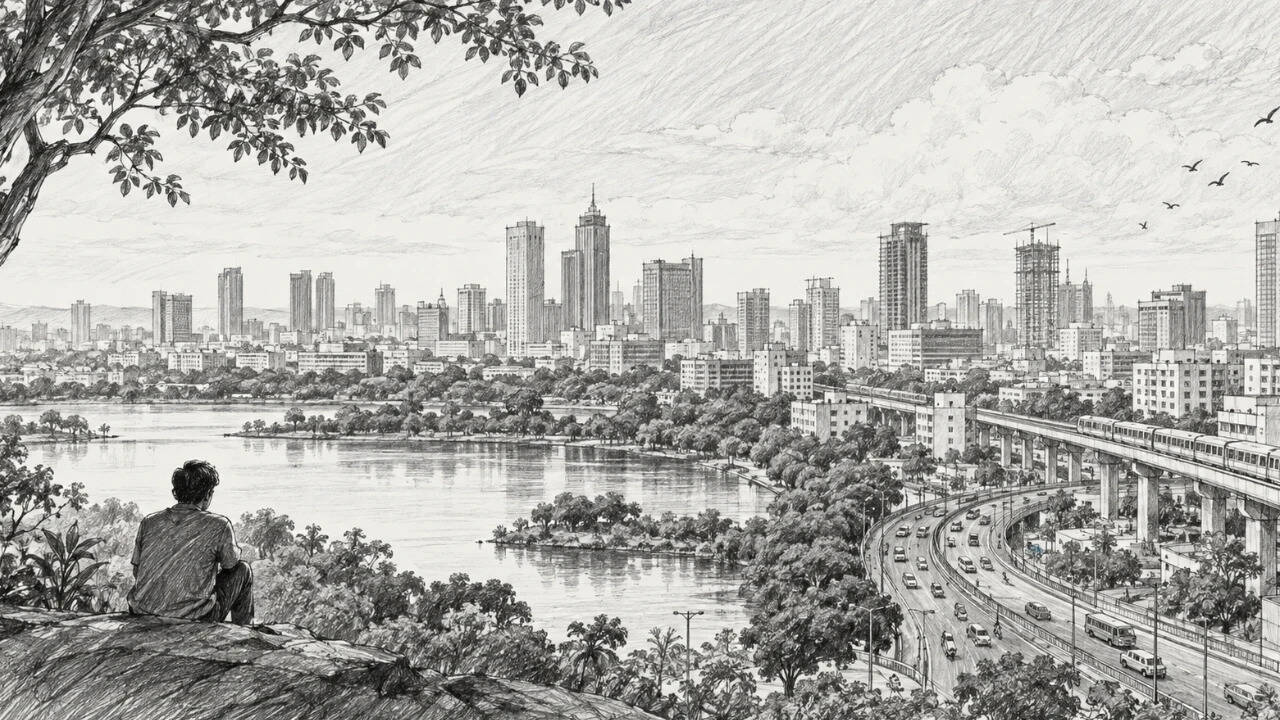
A city is a complex system in which mathematics, physics, ecology and human behaviour constantly interact.
Cities are usually discussed in the language of infrastructure, economics and politics. But I’ve often wondered whether we are looking at cities through too narrow a lens. Maybe it’s time to look at them through science.
Not because science has all the answers to urban problems, but because it can help us understand why cities behave the way they do, why seemingly sensible interventions sometimes fail, and why the consequences of building a city extend far beyond the structures we put up.A city is more than an assembly of buildings, roads and people. It is a complex system in which mathematics, physics, ecology and human behaviour constantly interact.
Looking at a city through these four disciplines might tell us something that conventional measures of development often miss: whether the city we are building is actually working.Consider what happens when a city doubles in population. It would be reasonable to expect that it would need twice as many roads, twice as much infrastructure and twice as many resources. But cities do not always follow such straightforward arithmetic.

Parallax
Research into urban scaling suggests otherwise: while many measures of economic and social activity, including wages and innovation, tend to increase faster than population, infrastructure, by contrast, often grows more slowly.In mathematical terms, these relationships are described using scaling exponents. A value greater than one indicates that an activity grows faster than population. A value below one indicates that it grows more slowly.
These are broad empirical patterns, not fixed rules that apply identically to every city.The explanation lies partly in the opportunities created by human interaction. A larger city brings more people into contact, creating opportunities for exchange, ideas and enterprise. But it also intensifies demands on housing, transport, water and public space.Growth is not merely about accommodating more people. It changes the relationships between them and the demands they place on urban systems.
The mathematics captures both the promise of density and the need to plan for its consequences.Physics makes those consequences visible. Roads, rooftops and concrete absorb and store solar energy, releasing much of it at night. Trees provide shade and cool the air through evapotranspiration, as water moves from soil and plants into the atmosphere. When green cover disappears and built surfaces multiply, the local heat balance changes.Bengaluru offers a measurable example. Multiple studies that examined satellite observations have found that the urbanised area had increased significantly, accompanied by a significant decline in vegetation greenness in areas undergoing urbanisation. Researchers also found that the urban heat island effect was particularly pronounced at night during the dry season, with increasing intensity during the wet season as well.The same thinking applies to water. When open ground is replaced by impermeable surfaces, rain has fewer places to seep into the soil. It runs off faster, placing pressure on drains and low-lying areas. Flooding is not only a question of how much rain fell; it is also about what the land beneath that rain has become.Traffic offers another lesson, though the mechanism is behavioural as much as mechanical. The intuitive response to congestion is to add road space.
Yet studies have found that more road space can encourage people to drive more, support travel-intensive activity and influence where people live. This is known as induced demand.The finding is not a universal formula for every road or city. But it challenges the idea that congestion can be solved simply by adding lanes. A road changes not only how people travel, but also the places they can reach and the development that follows.Ecology asks us to look at what cities have retained, and what they have lost. A lake is not simply a patch of water or a recreational amenity. It can hold stormwater, support wildlife, moderate local temperatures and connect habitats. Its value depends on the catchment that feeds it, the channels linking it to other lakes and the ecological life around it.This matters in a city like Bengaluru, where lakes were historically part of linked drainage networks.
Restoring one while ignoring its inlets, outlets or catchment risks treating a connected system as an isolated object. The same applies to trees. The number of saplings planted says little about how many survive, where they grow, whether they are native species or whether they form green corridors.A review of 850 peer-reviewed studies on urban green and blue infrastructure found that researchers often measured ecological properties more readily than the actual benefits experienced by people.
A green space is not successful only because it exists on a map. It must function as an ecosystem and be accessible to those who need it.Then there is psychology: the city as an experience, not just a physical arrangement. We know the difference between walking along a shaded street and negotiating a noisy road with broken footpaths, fumes and little room to pause. Neighbourhood design affects how people move, meet, rest, feel safe and experience everyday stress.Research has examined the effects of urban green spaces on mood, anxiety, stress and attention. A 2026 review of 56 controlled experiments found benefits across several mental-health measures, including self-reported stress, mood and feelings of restoration.This does not mean trees can substitute for mental-health care, or that every green space benefits everyone equally. It reinforces a point urban planning can overlook: access to nature and public space helps shape well-being.These lenses converge. A lake has a place in a drainage network, a physical role in storing water, an ecological function and psychological value as a place to pause. A road affects travel time, but also land use, air quality, neighbourhood connections and the space left for pedestrians. A tree is biological infrastructure, a cooling mechanism, a habitat and shade for someone waiting for a bus.Urban problems rarely stay within the boundaries in which we identify them.
A decision in one part of the system can produce effects elsewhere, sometimes years later. Cities behave less like machines with separate components and more like complex adaptive systems: their parts interact, respond and keep changing.The more I read across mathematics, physics, ecology and psychology, the harder it becomes to see them as separate disciplines. They are different ways of describing the same place, and the relationships that hold it together.
Understanding a city requires us to look beyond its skyline and see the systems beneath it.Some interesting research for you to consider:
- Luís M A Bettencourt, José Lobo, Dirk Helbing, Christian Kühnert and Geoffrey B West, “Growth, Innovation, Scaling, and the Pace of Life in Cities”, Proceedings of the National Academy of Sciences, 2007.
- “Impacts of Increased Urbanization on Surface Temperature, Vegetation, and Aerosols over Bengaluru, India”, Remote Sensing Applications: Society and Environment, 2019.
- Gilles Duranton and Matthew A Turner, “The Fundamental Law of Road Congestion: Evidence from US Cities”, American Economic Review, 2011.
- Clara J Veerkamp, Aafke M Schipper, Katarina Hedlund, Tanya Lazarova, Amanda Nordin and Helena I Hanson, “A Review of Studies Assessing Ecosystem Services Provided by Urban Green and Blue Infrastructure”, Ecosystem Services, 2021.
- “Mental Health Benefits of Urban Green: A Systematic Review and Meta-analysis of 56 Pre-post Control Experiments”, People and Nature, first published Feb 2026.
PostscriptA city looks different depending on where you stand. From a skyscraper, it is a skyline. From a flyover, a traffic network. From the edge of a lake, an ecosystem. And from a crowded footpath, a test of how well we have planned for people. Perhaps that is the essence of Parallax: the city doesn't reveal all its truths from a single vantage point. Sometimes, we just need to change the way we look.
KioskNews shows a cleaned-up reading view extracted from the publisher’s page — the original always lives on their site, not ours.