China Mobile triples capacity at mega Inner Mongolia computing hub amid nation’s AI push
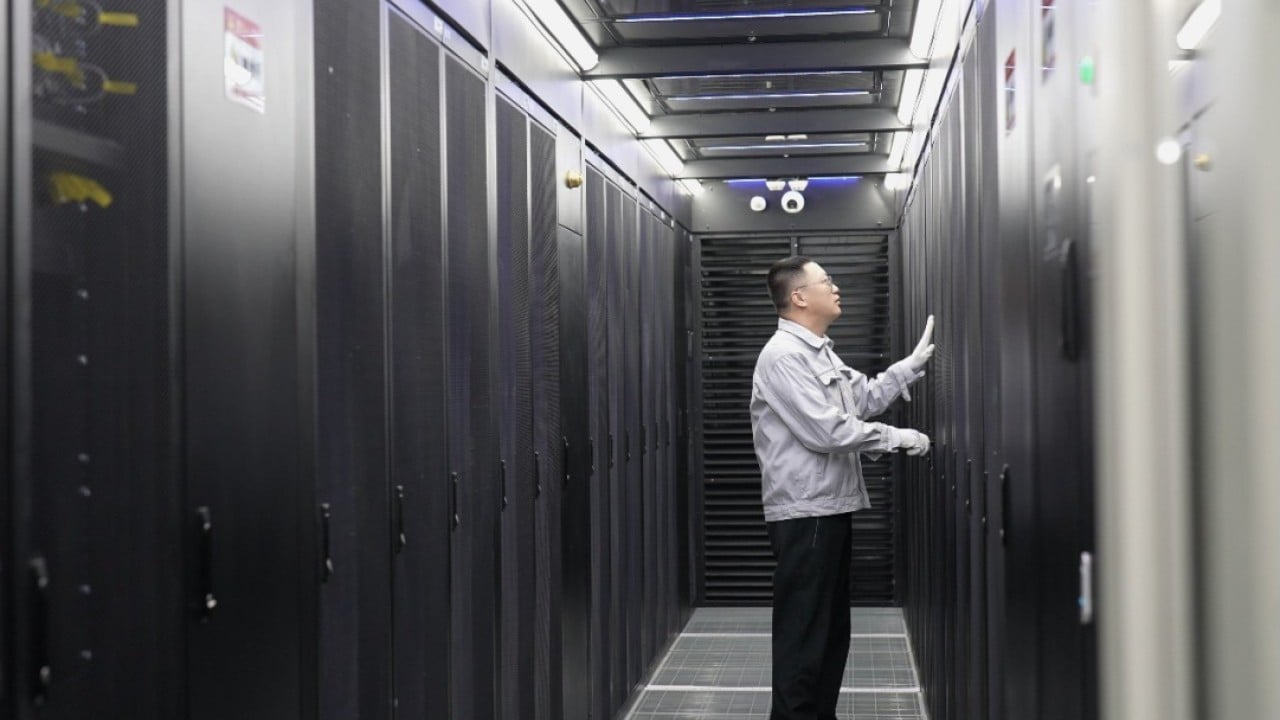
China Mobile, one of the country’s state-backed telecoms giants, has tripled the capacity of its largest intelligent computing hub in northern Inner Mongolia, amid Beijing’s push to boost digital infrastructure to power the country’s artificial intelligence ambitions.
The expansion of its data centre in Hohhot was recently completed, with total processing capacity increased to 20,100 petaflops, according to a report by Inner Mongolia Daily on Monday.
That was triple its previous capacity of 6,700 petaflops, according to data from a 2024 report by the state-run People’s Posts and Telecommunications News.
A petaflop is a measurement of a computer’s speed and is equal to a quadrillion operations per second. Of that total, 16,700 petaflops were dedicated to artificial intelligence and smart computing tasks, the Monday report said.
The project, the world’s largest single-site intelligent computing centre run by a telecoms operator, would funnel 90 per cent of the computing power to the Beijing-Tianjin-Hebei economic zone, according to the report.
The 2.7 billion yuan (US$403 million) expansion project covers roughly 44,500 square metres, equivalent to six soccer fields, and boasts a total power capacity of 120 megawatts.

The megaproject cements the role of the computing hub – which began operations in 2024 and deploys around 20,000 AI accelerator cards. It also underscores Beijing’s broader drive for tech self-reliance, with the northern Chinese region seen as a critical node in its “Eastern Data, Western Computing” strategy.
The National Development and Reform Commission, China’s top economic planner, said a total of 4 trillion yuan would be invested in national computing network buildout during the 15th five-year plan.
Launched in 2022, the Eastern Data, Western Computing initiative aims to move data processing from the country’s densely populated, power-hungry eastern seaboard to its energy-rich western provinces.
Hohhot, the capital of Inner Mongolia, and Ulanqab, another major city in the autonomous region, have emerged as a key link in this massive infrastructure network. Ulanqab, historically known for potato farming, is now dubbed “Grassland Silicon Valley” because it has attracted tech heavyweights like Huawei Technologies, ByteDance and DeepSeek, as well as some US tech giants.
In 2013, Huawei began working with the Ulanqab municipal government to expand its data centre presence there. Five years later, US tech giant Apple announced plans to host its iCloud service on data centres in the city, the same year Chinese cloud platform UCloud began building its own facility in Ulanqab.
ByteDance had been in preliminary talks with local data centre vendors to add between five and six gigawatts’ worth of compute in Ulanqab over the next two years, the South China Morning Post reported in September.
The China Mobile Hohhot intelligent computing project also touts a high percentage of green energy adoption, reflecting Beijing’s efforts to align the rapid expansion of AI with national carbon goals.
Green electricity powers 88 per cent of the facility, according to the Monday report.
KioskNews shows a cleaned-up reading view extracted from the publisher’s page — the original always lives on their site, not ours.