AI pulls up the civil service ladder to Southeast Asia’s middle class

Artificial intelligence promises to make government bureaucracies leaner across Asia, but its biggest effect on public-sector employment may not come from the widely feared wave of lay-offs.
Instead, analysts say the technology is more likely to reshape existing jobs and narrow opportunities for young graduates hoping to enter the civil service, even as governments seek to improve efficiency without sacrificing job security.
Unlike the Netherlands, which aims to cut an estimated 25,000 full-time equivalent civil service posts over the next decade in an efficiency drive that includes plans to harness AI, Southeast Asian governments face competing pressures to improve public services while protecting employment.
Analysts say those pressures, together with political considerations and employment protections, will determine whether productivity gains translate into better services, staff redeployment or fewer jobs.

Singapore offers a glimpse of the sensitivities surrounding public-sector restructuring, even when AI is not the cause of job cuts. GovTech, the public-sector technology agency, has announced two rounds of retrenchments affecting 131 officers, including 38 on October 22, but it insists the exercise is neither AI-driven nor a cost-cutting measure.
The first round, in July, came as a surprise to a public used to a secure public service. A commentary in the Business Times noted that some might interpret the cuts through the lens of wider fears about AI and jobs, but cautioned against drawing such a conclusion from GovTech’s case.
Augment vs displace
GovTech said the restructuring was aimed at changing its mix of skills so it could take greater ownership of government digital products and services, not to shrink its workforce to save money.
“Our overall demand for digital talent continues to grow,” the agency said in a written response to This Week in Asia’s questions. “We will continue to focus on retaining, retraining and redeploying officers, while providing support to those who will leave the organisation.”
In a written parliamentary answer on November 3, the Ministry of Digital Development and Information said 36 of the first 93 affected officers had left GovTech in August, while the remaining 57 were continuing on projects until their last day of service.
By October 30, 11 of those who left had found public- or private-sector jobs and 14 were receiving career coaching or applying and interviewing through support partners, it said. Another 11 had not used those services because they were pursuing personal plans, taking career breaks or exploring other options.
AI adoption must be undertaken in a way that augments, rather than displaces workers
Caryn Lim, assistant secretary general of the National Trades Union Congress (NTUC), said AI’s impact in Singapore had so far been more evident in job redesign and changing work processes than in job displacement.
Citing a Ministry of Manpower report issued in April, she said 18.9 per cent of firms adopting AI had redesigned job functions, while 6.2 per cent reported AI-related reductions in headcount or hiring.
“AI adoption must be undertaken in a way that augments, rather than displaces workers,” Lim said, adding that NTUC’s Company Training Committees involved workers and unions in identifying changes to jobs and the training needed for new roles.
Redundancies should remain a last resort, Lim said, with employers and unions first exploring job redesign, retraining and redeployment. Where cuts were unavoidable, early engagement with NTUC could help affected workers access job matching, career coaching and training advice, she added.

Lawrence Loh, director of the Centre for Governance and Sustainability at the National University of Singapore Business School, said businesses did not necessarily regard government AI adoption as a model to follow. Rather, they looked for “directions in the regulation or any necessity for compliance”.
But government job cuts could make similar corporate decisions easier to justify, he said. “If the government cut workforce, whether explicitly through AI or not AI … the act itself might legitimise private sector imitation.”
Reskilling was no quick fix, Loh said. Employees need time to develop AI skills and organisations face a mismatch between the skills available and those required to integrate the technology, which he called a “structural bottleneck”.
Employers must also weigh demand for new technical skills against the experience and institutional knowledge of existing staff, Loh said. “You cannot just let go of them because they don’t know AI, because actually they know a lot about business.”
Malaysia’s speed trap
In early 2024, Malaysia’s civil service union umbrella body, the Congress of Unions of Employees in the Public and Civil Services (CUEPACS), urged public officers to master AI.
Its president Adnan Mat said the technology could improve data processing, policy implementation and public-service delivery, calling on staff to complete the government’s introductory “AI Untuk Rakyat” (AI for Citizens) programme.
Last year, Adnan reiterated that workers needed to upgrade their skills to stay relevant as employers’ requirements changed. CUEPACS subsequently organised AI training.
Malaysian researcher Chan Xin Ying said the employment implications depended partly on where officers were needed, not just on which tasks could be automated. Her research focuses on civil servants and she previously drafted and implemented policies on care for the elderly, domestic violence and childcare for the Penang state government.

Drawing on that experience, Chan said AI-assisted case sorting and administrative processing could free up welfare officers for frontline work. Some services had too few caseworkers, she said, so faster processing could help meet unmet needs rather than justify “a mere reduction” in staff.
Still, Chan said she had mainly observed basic applications of AI such as data entry and online complaint filtering, rather than large-scale redeployment accompanying the technology’s adoption.
She also warned against equating faster processing with better outcomes. Automated categorisation could miss important details in cases involving children, elderly people and other vulnerable groups, she said.
Politics also influences staffing. Chan cautioned against assuming that preserving public-sector jobs would guarantee electoral loyalty. Malaysia’s many changes of government since 2018 had altered civil servants’ relationship with political parties, she said, making it less accurate to regard them as a single voting bloc than it was before that election.
Indonesia’s crowded ladder
For Indonesia, politics can determine whether AI-driven efficiency translates into fewer government jobs, according to Nicholas Kuipers, an assistant professor of politics at Princeton University who studies bureaucratic recruitment.
He said governments must weigh improvements in service delivery against the political importance of providing jobs. AI could improve services, Kuipers said, but handing out government jobs was also a way for politicians to build support.
“The motive of the government when it comes to … AI adoption is not necessarily only about efficiency,” he said.
Government jobs that offered stable incomes and a route into the middle class were “extremely sought after”, Kuipers said, noting that alternatives for graduates could be especially scarce outside Jakarta.
His published research recorded about 3.64 million applicants competing for 180,623 civil-service vacancies in the 2018-19 recruitment cycle, or about 20 applicants per post.
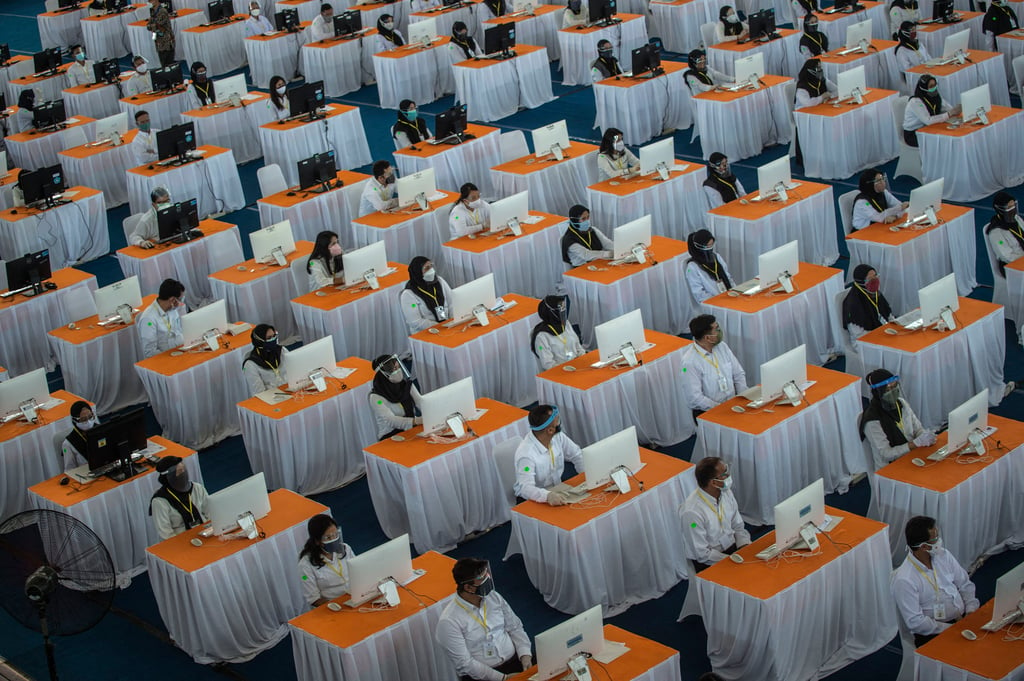
Given that level of demand, reducing recruitment would have an inevitable knock-on effect on young, college-educated applicants, Kuipers said.
“They’re going to see their opportunities for accessing a middle-class life … narrowing,” he said of would-be recruits, adding that he saw the job security of existing officers as a substantial constraint on dismissals.
“It is very hard for me to imagine current tenured civil servants being fired in Indonesia,” he said.
Indonesia is also assessing how ready its workforce is for digital government. A pilot assessment conducted in May covered civil servants’ digital literacy, proficiency, leadership and culture, with the aim of building a national picture of workforce capabilities.
Across the region, the main disruption from public-sector AI may not be immediate lay-offs but a restructuring of the civil service ladder, observers say.
The challenge for governments, according to Chan, is clearly communicating what technological adoption means for contract renewals, lateral transfers and day-to-day duties.
For existing tenured officers, employment remains relatively secure, but for the young graduates competing for a foothold in the bureaucracy, as in Indonesia, slower recruitment could close off one of the region’s main routes to the middle class.
KioskNews shows a cleaned-up reading view extracted from the publisher’s page — the original always lives on their site, not ours.