LOCAL RESILIENCE: How a Lenasia community garden helps unemployed families put food on the table
/file/attachments/2996/1HungerSeriesLogo_334602.jpg)
For unemployed father of three, Ramsenyane Lefenya, volunteering at a community garden in Lenasia South, close to Johannesburg, means there are fresh vegetables to take home to his family every day.
The 34-year-old father of three children, aged 7, 9 and 11, depends on the R370 Social Relief of Distress (SRD) grant to support his family.
“I am unemployed and I depend on the R370 social relief funds from Sassa (SA Social Security Agency). With the state of the economy the R370 was never enough to buy enough food to sustain my family till month-end,” he says.
/file/attachments/orphans/81veggarden_922050.jpg "Volunteers work in the community garden in Meriting, Lenasia South. (Photo: Lerato Kodisang)")
Lefenya is one of about 40 volunteers between the ages of 18 and 55 who work at the community garden in Meriting, Lenasia South, growing vegetables to feed their own families and support others in the community.
“Volunteering at this community garden has helped me a lot, I take vegetables home every day to eat with my family,” he says.
From unemployment to growing food
The garden was started by 42-year-old Mannini Ntlaba in 2022 after she was retrenched.
“I started this community garden in 2022 after I was retrenched at work. This garden started as a small garden but was keeping me busy,” says Ntlaba. “I was able to sustain my household with daily nutritious meals. The money I received from my retrenchment was depleting and becoming too little to meet all my needs.”
Other unemployed residents started joining Ntlaba and the small garden grew into a community initiative. Today, the garden covers about a hectare and produces spinach, cabbage, broccoli, kale, beetroot, carrots, onions, tomatoes, maize and bell peppers.
Ntlaba says that during harvest the team produces about 5,000 bunches of spinach and two pallets of tomatoes, alongside other seasonal crops.
/file/attachments/orphans/83Pigs_126927.jpg "The project currently keeps 18 pigs on site. (Photo: Lerato Kodisang)")
The project also raises pigs, which are slaughtered for meat and sold to the community.
Fresh vegetables from R5
/file/attachments/orphans/84Customer_620933.jpg "A local resident buys fresh produce from the Meriting community garden.( Photo: Lerato Kodisang)")
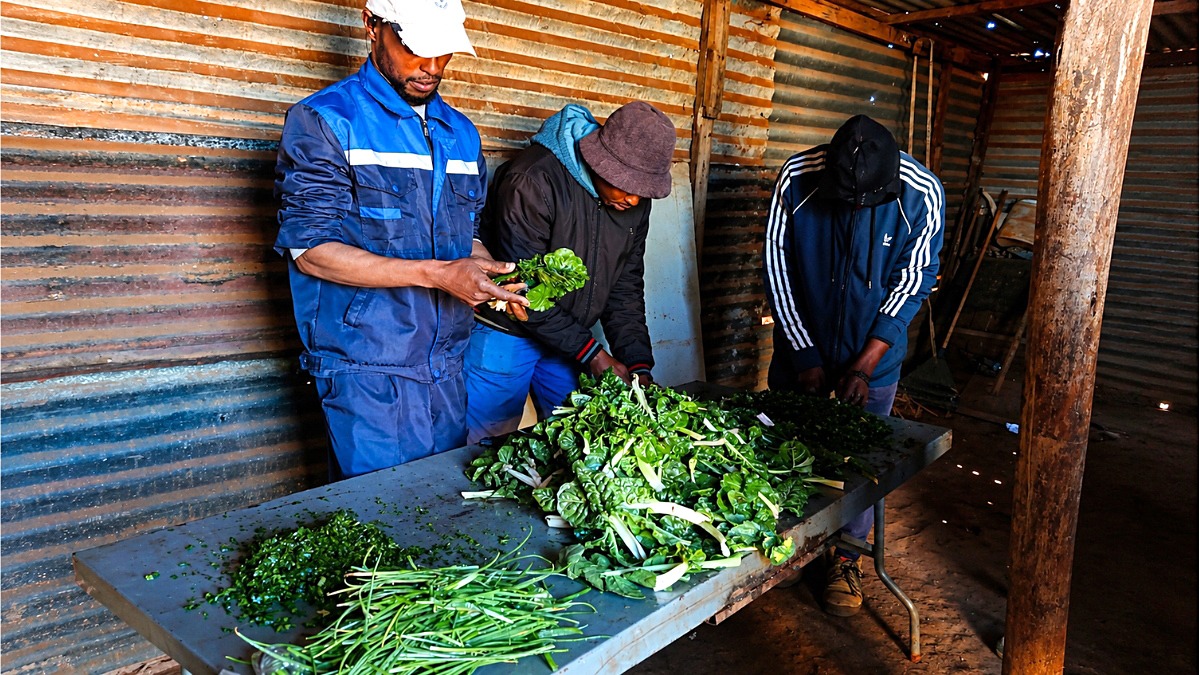
The vegetables grown at the garden are not only for its members. Ntlaba says produce is sold from a stall at the garden after being cleaned, prepared and sorted by volunteers.
“The crops are sold from R5 so that everyone in the community can afford fresh vegetables. In instances where the customers do not have money to buy, we give them crops that they need so they can go eat at home. Others will pay later when they have money just to boost the garden funds.”
She says elderly community members also come to the garden asking for spinach when they do not have enough food to feed their grandchildren.
Ntlaba says the project has adopted two preschools in the community, where it donates fresh produce every month and encourages healthy eating among children.
Taking food home every day
/file/attachments/orphans/85Vegbags_756336.jpg "Volunteers get to take vegetables home such as tomatoes, broccoli and bell peppers. (Photo: Lerato Kodisang)")
The volunteers also take vegetables home to their own families after working in the garden. Each member receives vegetables such as spinach, cabbage, carrots and tomatoes, depending on what is in season.
For Lefenya, having vegetables available every day means he can use his limited income to buy other household necessities.
“Relish is no longer a problem,” he says. “Now my R370 can buy more valuables at my house, like mealies and cooking oil, then I know that decent healthy relish is secured and available to my family.”
Working at the garden has also taught him how to grow food at home.
“With the education and training I received from working in this garden I was able to grow my backyard garden at home, and I can balance food at home,” he tells Health-e News.
“It helped me and others become providers to our families. I am grateful to be part of this initiative. I have also learnt from this community initiative, the crops in my backyard I share with my neighbours,” says Lefenya.
More than a vegetable garden
/file/attachments/orphans/86Sharedmeal_312940.jpg "Volunteers at the Meriting community garden share a meal together. (Photo: Lerato Kodisang)")
Ntlaba says the garden makes between R250 and R1,000 a month. The money is deposited into the community garden’s bank account. Lefenya says if there are no emergency expenses during the month, the money is shared among team members.
The garden also provides a space where members can eat together and support each other.
“On Friday we have a soup kitchen as a team. We cook our spinach or cabbage with pap and eat together and reflect on the week,” he says. “We support each other through open communication and see how we can help each other.” DM
Read Part 1, Part 2, Part 3, Part 4, Part 5, Part 6, Part 7
First published by Health-e News in an eight-part series about food insecurity in South Africa.
KioskNews shows a cleaned-up reading view extracted from the publisher’s page — the original always lives on their site, not ours.