Can the air-con remove PM2.5 particles? Will indoor plants and surgical masks help?
SINGAPORE – Singapore is currently experiencing its longest stretch of unhealthy air quality since September, with the Pollutant Standards Index (PSI) here recording readings above 101 since Oct 5.
The authorities also warned on Oct 9 that air quality may worsen and breach ‘very unhealthy’ levels if hot, hazy conditions continue.
The Straits Times talks to experts on what can bring reprieve.
Will turning on the air conditioner alone help to filter out haze particles?
Experts say that while air-conditioning helps to cool a room to make it more comfortable, its filters are designed to capture large dust particles, and not tiny haze pollutant particles.
The dominant pollutants during periods of transboundary haze are PM2.5 – tiny particles measuring 2.5 microns in diameter, 30 times smaller than the width of a strand of hair. These particles can get lodged deep in the lungs and enter the bloodstream.
Liu Zheng from NTU’s School of Materials Science and Engineering said a home air-conditioner mostly cools the same air that is already in the room. Its filter is only meant to catch dust, instead of haze particles which are far too small.
“So it makes the room cooler, but not much cleaner,” he said. Turning on the air conditioner, however, does help in an indirect way as the closed doors and windows help to keep much of the haze out, he added.
Rajasekhar Balasubramanian from the NUS College of Design and Engineering said that while air conditioning systems contain filters, those commonly used at homes are generally not efficient at removing fine particulate matter.
Upgrading air conditioners to include filters of Minimum Efficiency Reporting Values (MERVs) of 13 and above can also improve the removal of airborne fine particles, said Prof Balasubramanian. MERVs indicate the ability of an air filter to capture airborne particles.
Otherwise, experts said that using an air purifier with a High-Efficiency Particulate Air filter, or HEPA filter — which is designed to catch the tiny haze particles – in an enclosed room can help improve indoor air quality.
However, the air purifier must have enough capacity to match the size of the room and should not be confused with humidifiers and dehumidifiers, said Dr Philip Eng, a senior consultant respiratory physician at Mount Elizabeth Hospital.
Will indoor plants help to improve air quality?
Singapore Environment Council’s executive director Cheang Kok Chung said that while indoor plants can absorb small amounts of gaseous pollutants, such as volatile organic compounds which are toxic gaseous compounds, plants are unable to filter out fine particular matter, like the haze particles.
NUS’ Balasubramanian said plants can capture some airborne particles on their leaves.
But their limited leaf surface area and contact with indoor air mean that they are generally ineffective at removing fine particular matter at a meaningful level.
How are PSI and PM2.5 readings different?
The National Environment Agency provides two indicators of air quality: 24-hour PSI and one-hour PM2.5 readings. Both measures serve different functions.
The PSI, which is Singapore’s official national reporting system for air quality, is a measure of air quality in Singapore, and readings of over 100 reflect unhealthy air quality.
It is calculated based on six different pollutants – small particulate matter PM10 and PM2.5, sulphur dioxide, nitrogen dioxide, ozone and carbon monoxide.
PSI readings are averaged out over a 24-hour period, which is why they may not always be reflective of current conditions. For instance, it sometimes appear hazier than what the PSI readings indicate.
Meanwhile, PM2.5 readings refer to concentrations of the dominant pollutant particle during haze episodes. It provides a more reflective indicator of current air quality.
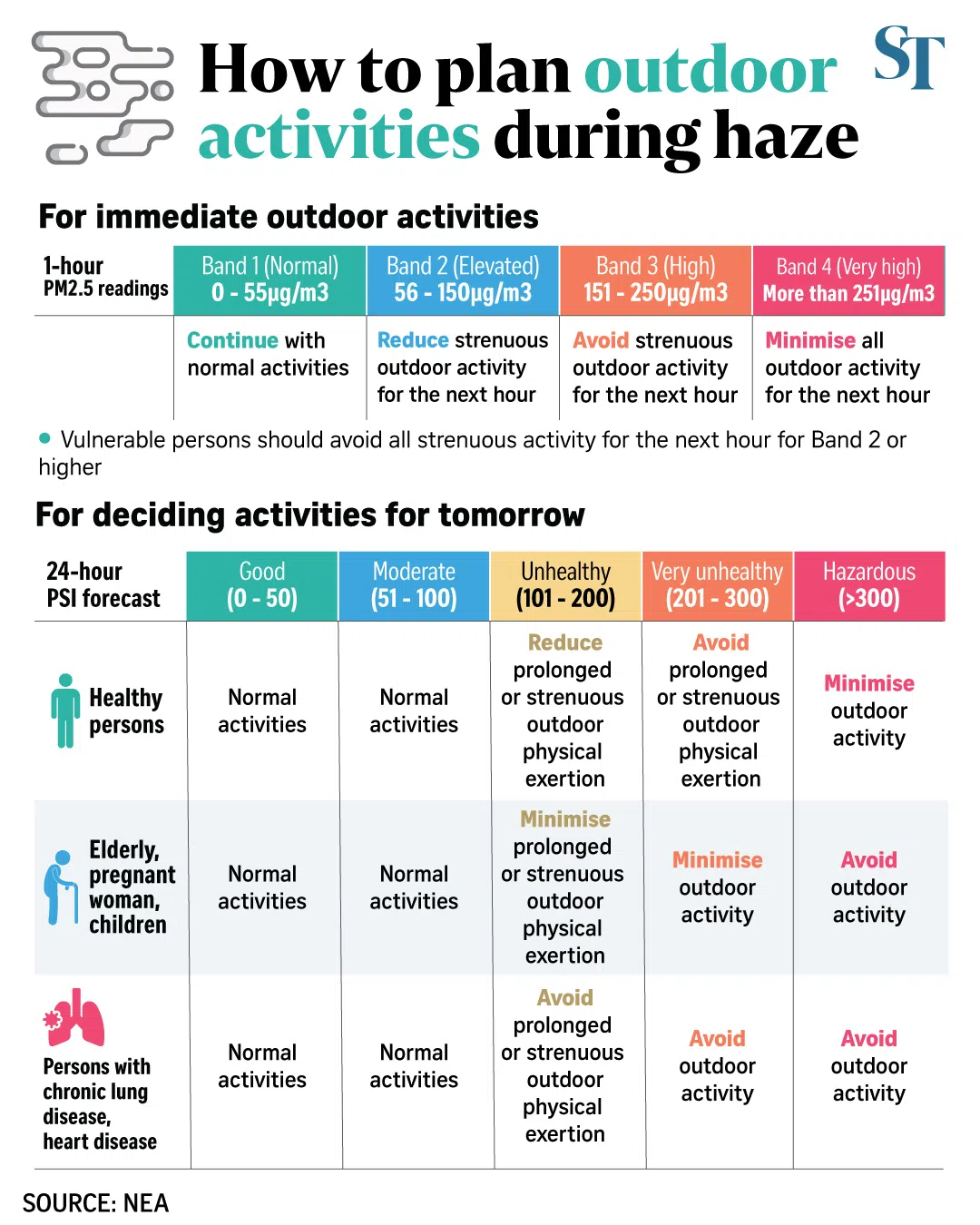
There are four bands on the PM2.5 concentration scale: zero to 55 for normal, 56 to 150 for elevated, 151 to 250 for high, and very high for any higher reading.
When these readings are at elevated levels, vulnerable individuals – including the elderly, pregnant women and those with chronic lung or heart disease – should avoid all outdoor activities for the next hour.
The public can view a personal guide for planning outdoor activities using these readings at this website.
In a nutshell, people should refer to the PM2.5 values for planning their immediate activities, and refer to the PSI forecast if they are planning an outdoor activity the next day.
Can I wear a surgical mask instead of an N95 mask to filter out haze pollutants?
N95 masks are designed to filter out at least 95% of the fine airborne particles when worn correctly, Parkway Shenton’s acting medical director Dr Sharon Ngoh. For effective protection, the mask must fit snugly around the nose and mouth, without gaps that allow polluted air to enter, she said.
Surgical masks, on the other hand, are mainly designed to prevent the spread of respiratory droplets, she said.
“As they do not fit tightly around the face, fine haze particles can still enter through the gaps,” she added. “While they may offer some protection against larger particles, they are not reliable for protection against PM2.5.”
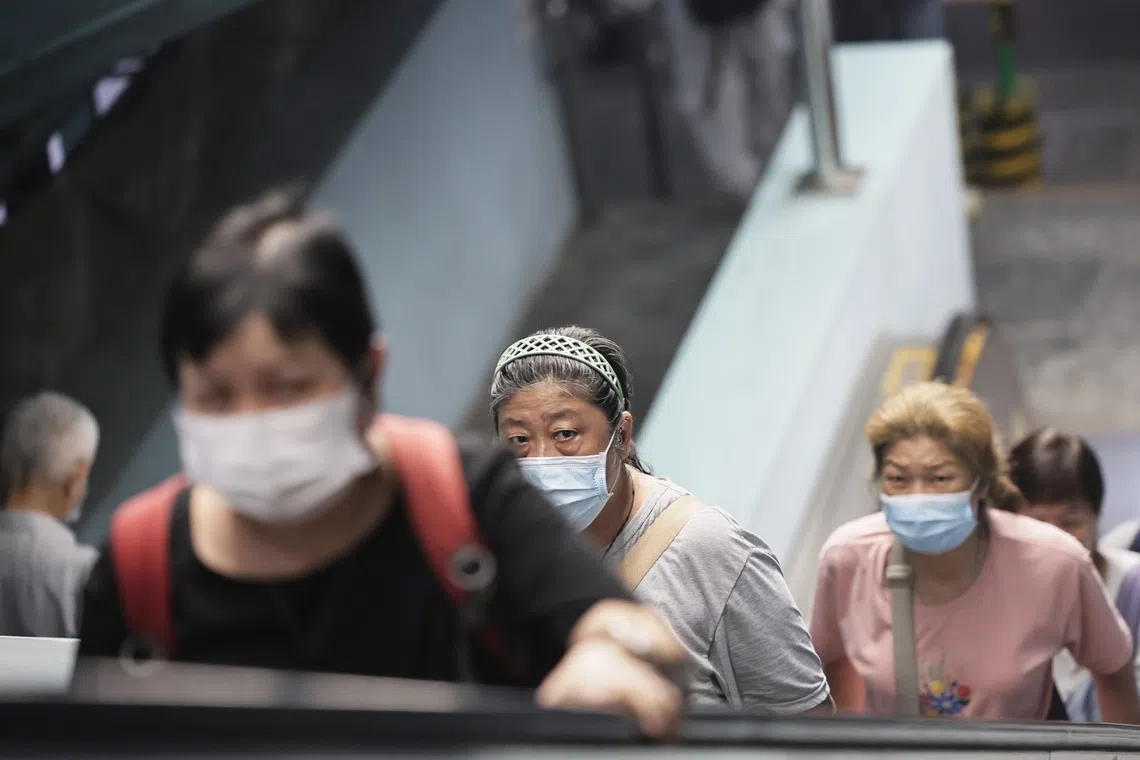
Surgical masks are mainly designed to prevent the spread of respiratory droplets.
ST PHOTO: KELVIN CHNG
Ngoh also cautioned that N95 masks can make breathing more difficult, especially during physical activity. “If you experience breathing discomfort, slow down, take a break and move indoors to an area with cleaner air,” she said.
Older adults, pregnant women and individuals with severe heart or lung conditions should also consult their doctors before using N95 masks, she added.
NTU’s Liu said that some N95 masks have a small valve that makes breathing out easier and trying another size or brand may help.
Mount Elizabeth Hospital’s Eng added that any form of face cover is better than none.
According to the haze task force, N95 masks are generally not required for short outdoor exposure, like commuting from home to school or work, or when indoors.
A healthy individual who has to be outdoors for several hours may wear an N95 mask to reduce exposure when the air quality forecast is in the “hazardous range”, where PSI exceeds 300.
Vulnerable people such as the elderly, pregnant women and individuals with chronic heart or lung disease may wear an N95 mask to reduce exposure when the air quality forecast is in the “very unhealthy” range where the PSI exceeds 200 and if they have to be outdoors for several hours.
Any person who feels discomfort when using an N95 mask should take a break from using the mask, according to the haze task force.
KioskNews shows a cleaned-up reading view extracted from the publisher’s page — the original always lives on their site, not ours.