Marc-Olivier Fortin: The CAQ’s desperate attempt to link the Parti Québécois to Trump
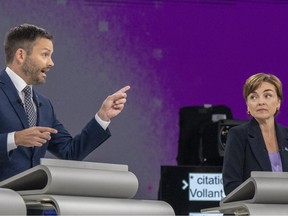
The latest seat projection from poll aggregator QC125 on Sunday puts the incumbent Coalition Avenir Québec at a mere six seats, with the possibility of being shut out of the national assembly altogether. According to the last Synopsis poll, also published Sunday, the CAQ is sitting at 17 per cent and the Parti Québécois is comfortably in majority territory at 30 per cent. Not long ago, thanks in part to U.S. trade tensions, the CAQ was just four points behind the PQ. But the early success of CAQ Leader Christine Fréchette’s strategy of campaigning against U.S. President Donald Trump was short-lived, and the party has been struggling ever since, suffering from, among other things, a disastrous debate performance last week.
Sign In or Create an Account
As election day approaches next Monday, we may have just witnessed what a campaign looks like when it is running out of options: a desperate political Hail Mary. On Friday, the Journal de Montréal reported on concerns about possible foreign interference, regarding an American think-tank called Defense Analyses and Research Corporation, which has argued that the U.S. government should support the PQ and favour the sovereigntist movement. The federal government apparently informed the CAQ of the potential threat at the beginning of September, and according to the Journal, the governing party had been made aware of the possibility of election interference on two other occasions: early 2026, and within the previous week.

Columnist Jesse Kline keeps you up to date with what’s happening in Israel and the effects of antisemitism on life here in Canada. Friday mornings.
By signing up you consent to receive the above newsletter from Postmedia Network Inc.
A welcome email is on its way. If you don't see it, please check your junk folder.
The next issue of Channel Israel will soon be in your inbox.
We encountered an issue signing you up. Please try again
Curiously enough, it turns out, these allegations of interference have been public for months, but it was only two days before advance polling began that they became part of the election campaign.
In a news conference on Friday, Fréchette claimed to only have been told about the think-tank’s online writings last Saturday. “I only learned of this recently,” she said. She also used the occasion to request a meeting with Prime Minister Mark Carney, claiming the federal government had the tools to deal with the matter. When pressed on why the prime minister needed to get involved, Fréchette struggled to provide a clear answer. (The Prime Minister’s Office told the Journal de Montréal that allegations of foreign interference are taken seriously.)
Fréchette also confirmed that the United States tried to bypass Ottawa in trade negotiations, in an attempt to negotiate directly with Quebec on certain sectors, suggesting that the province is viewed as vulnerable to foreign pressure in the current political environment.
Things got more interesting on Sunday when it was revealed that the CAQ campaign team obtained copies of the documents from the pro-Trump group calling for the U.S. to support the PQ in order to destabilize the country at least 10 days before informing the Canadian Security Intelligence Service, and at least a week before Fréchette said she was informed. What we know is that instead of going to CSIS right away, which would have been appropriate if the threat was genuine, the party has tried since Sept. 12 to persuade reporters to write a story about it in the hope that it would link the PQ to Trump.
The CAQ did contact CSIS on Sept. 22 and met with officials the following day. CSIS responded that the information was already known to the public. The think-tank’s articles are all easily accessed on the web and other newspapers, including Le Devoir, had already referred to them months earlier, in March.
But now that an official complaint was made to CSIS and the Journal de Montréal reported on the possibility of interference, Fréchette had the opportunity to address the matter — and, of course, to attempt to bring Trump back to the centre of the campaign.
There’s no way this was a coincidence. It’s hard to believe that nobody on the premier’s campaign team thought the article posed a serious national-security concern until days before the advanced polls opened. The CAQ built its identity fighting political cynicism, but it is the same party that saw no contradictions in defending a candidate accused of stuffing $20 bills into gifts for seniors.
Was this simply a case of desperate times calling for desperate measures? Why did a months-old document suddenly become of national interest in the closing days of the campaign? The chronology matters more than the allegations themselves.
This story tells us more about the state of the CAQ campaign than any possibility of American influence. When a campaign gets desperate enough, even a stale think-tank report can suddenly become a matter of national security.
But at some point, it becomes so obvious that it discredits the leader and the party. Rather than facing the music and staying true to their convictions, the CAQ and Fréchette seemed content to recycle Ottawa’s anti-Trump playbook. By the end, it felt less like a national-security issue and more like a low-budget cartoon spy caper whose plot twists fool no one.
National Post
Join the Conversation
This website uses cookies to personalize your content (including ads), and allows us to analyze our traffic. Read more about cookies here. By continuing to use our site, you agree to our Terms of Use and Privacy Policy.
KioskNews shows a cleaned-up reading view extracted from the publisher’s page — the original always lives on their site, not ours.