The Balfour Declaration: Historical revisionism cannot erase Jewish claims to Israel - opinion

On November 2, 1917, Britain’s foreign secretary, Arthur James Balfour, signed a letter that would help change the course of Jewish history.
Just 67 words long, the declaration expressed British support for the establishment of a Jewish national home in the Land of Israel, helping to lay the diplomatic groundwork for the eventual rebirth of Jewish sovereignty.
Yet 109 years later, the Balfour Declaration’s significance is being obscured by an increasingly familiar accusation: that Zionism was a European colonial enterprise imposed on the Middle East.
But that is patently false.
The fact is that Britain’s declaration did not invent the Jewish people’s connection to the Land of Israel. It simply recognized that connection, which had already existed for thousands of years.
In his letter to Lord Lionel Walter Rothschild, a prominent leader of British Jewry, Balfour stated that His Majesty’s Government viewed “with favour the establishment in Palestine of a national home for the Jewish people” and would use its “best endeavours” to facilitate its achievement.
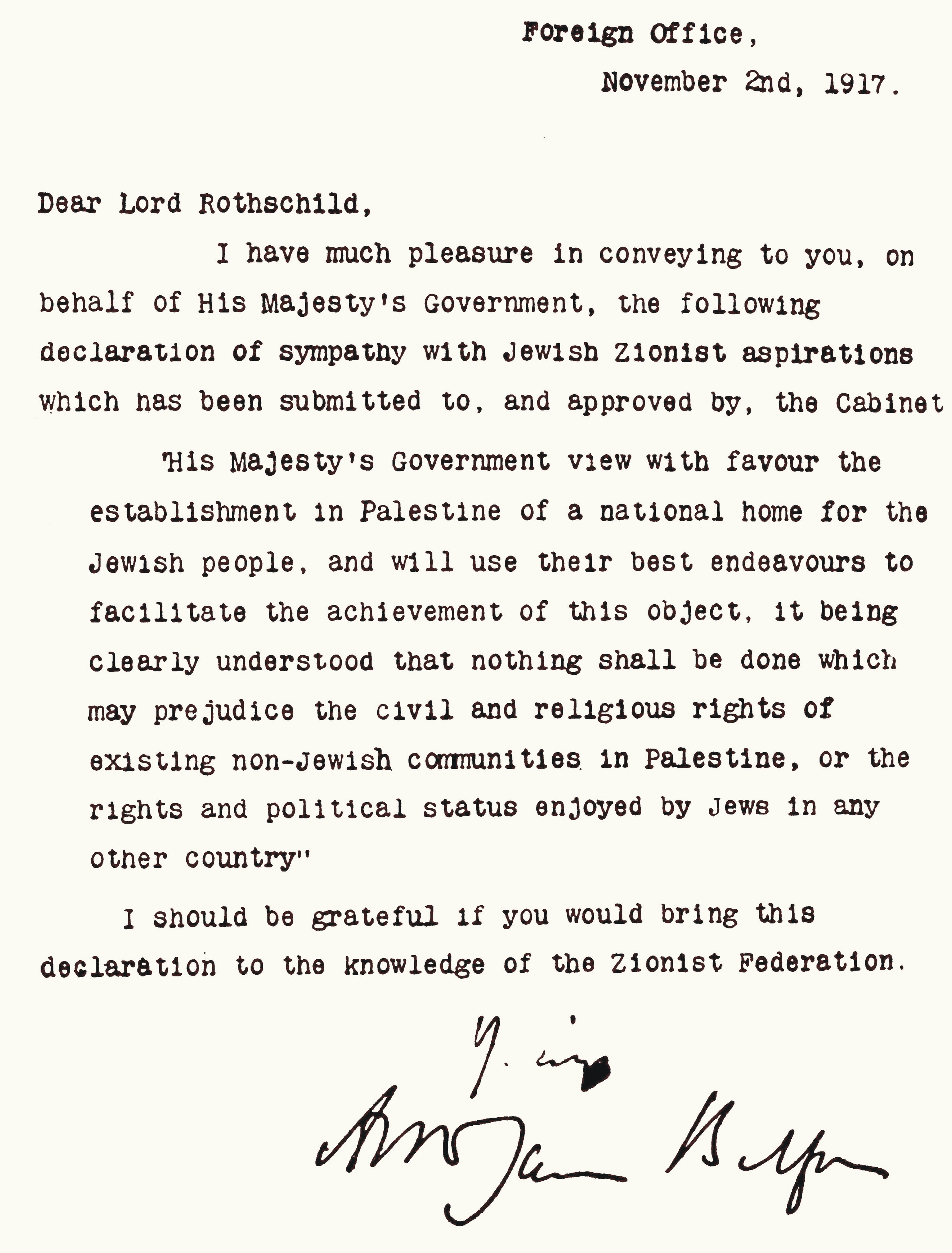
Balfour was acknowledging something far older than the modern Zionist movement
For a people that had endured centuries of persecution, expulsions, and discrimination, the declaration represented an extraordinary diplomatic breakthrough. A major world power had publicly endorsed the Jewish people’s national aspirations, lending support to the dream of returning to Zion.
But Balfour was acknowledging something far older than the modern Zionist movement.
The Jewish people’s connection to the Land of Israel dates back to biblical times, when it established its kingdoms, built its Temples in Jerusalem, and developed the religious and national traditions that continue to define Jewish identity today.
Even after the Roman destruction of the Second Temple in 70 CE and the subsequent dispersion of much of the Jewish population, a Jewish presence in the land endured.
And for nearly two millennia, Jews throughout the Diaspora prayed toward Jerusalem, mourned the destruction of the Temple, and expressed their longing to return to Zion.
Modern Zionism gave political expression to that ancient aspiration.
Beginning with the First Aliyah in 1882, thousands of Jewish pioneers arrived in the land, establishing agricultural settlements and laying the foundations for a renewed Jewish society.
In 1897, Theodor Herzl convened the First Zionist Congress in Basel, Switzerland, providing the movement with an organized political framework.
This history is difficult to reconcile with the claim that Zionism was merely another form of European settler colonialism.
After all, European colonial powers sought to extend their influence over distant territories in pursuit of strategic, economic, or political interests. The Jews who returned to the Land of Israel, however, were seeking to rebuild their national life in the place where their civilization had originated.
They were not representatives of a foreign empire sent to exploit a distant possession. They were members of an ancient people returning to the land from which their ancestors had been exiled.
The declaration’s importance extended well beyond the words of a British foreign secretary.
In April 1920, the Allied powers convened at San Remo and decided to entrust Britain with the Mandate for Palestine and incorporate the Balfour Declaration into its responsibilities.
Two years later, the League of Nations approved the Mandate, whose preamble formally recognized “the historical connection of the Jewish people with Palestine” and the grounds for “reconstituting their national home in that country.”
A bitter betrayal of the promise made in 1917
Britain’s subsequent behavior, however, hardly reflected consistent devotion to the Zionist cause.
Its 1939 White Paper limited Jewish immigration to 75,000 over five years and made further immigration dependent on Arab consent, just as European Jews were desperately seeking refuge from Nazi persecution.
It was a bitter betrayal of the promise made in 1917, with tragic consequences for countless thousands of European Jews who might otherwise have been saved from the Nazi inferno.
Yet the Jewish national movement persevered, and on May 14, 1948, the State of Israel declared its independence. With Divine assistance, the Jewish people had restored its sovereignty through determination, sacrifice, and nation-building rather than British generosity.
Nearly eight decades later, however, Israel’s legitimacy is once again being challenged.
Since the Hamas-led massacre of October 7, 2023, anti-Israel demonstrations on university campuses and in Western cities have featured accusations that Zionism is inherently colonialist, and Israel an illegitimate settler state.
Yet those who portray Zionism as a foreign intrusion into the Middle East must contend with an inconvenient historical reality: Jewish nationhood originated in the very land where Israel stands today.
Nor was the State of Israel created merely as compensation for the Holocaust, as another common misconception would have it. The Zionist movement emerged decades before the Nazis came to power, while the Balfour Declaration and the League of Nations Mandate had already secured international recognition for Jewish national aspirations prior to Hitler’s ascent to chancellor.
ULTIMATELY, THE debate over the Balfour Declaration is about far more than a letter written in London in 1917. It is about whether the Jewish people’s history in the Land of Israel can be dismissed or rewritten to suit the political fashions of the day.
Balfour’s declaration was an important diplomatic milestone, but it was not the beginning of Jewish nationhood, nor was it the source of the Jewish people’s rights to their ancestral homeland.
The British Empire that issued the declaration has long since disappeared. Yet the Jewish people, whose national aspirations it recognized, has returned to sovereignty in its ancient homeland.
And no amount of historical revisionism can turn us into foreigners in our own land.■
The writer served as deputy communications director under Prime Minister Benjamin Netanyahu.
KioskNews shows a cleaned-up reading view extracted from the publisher’s page — the original always lives on their site, not ours.