Uric acid is 7.5 mg/dL: Should you worry about gout?
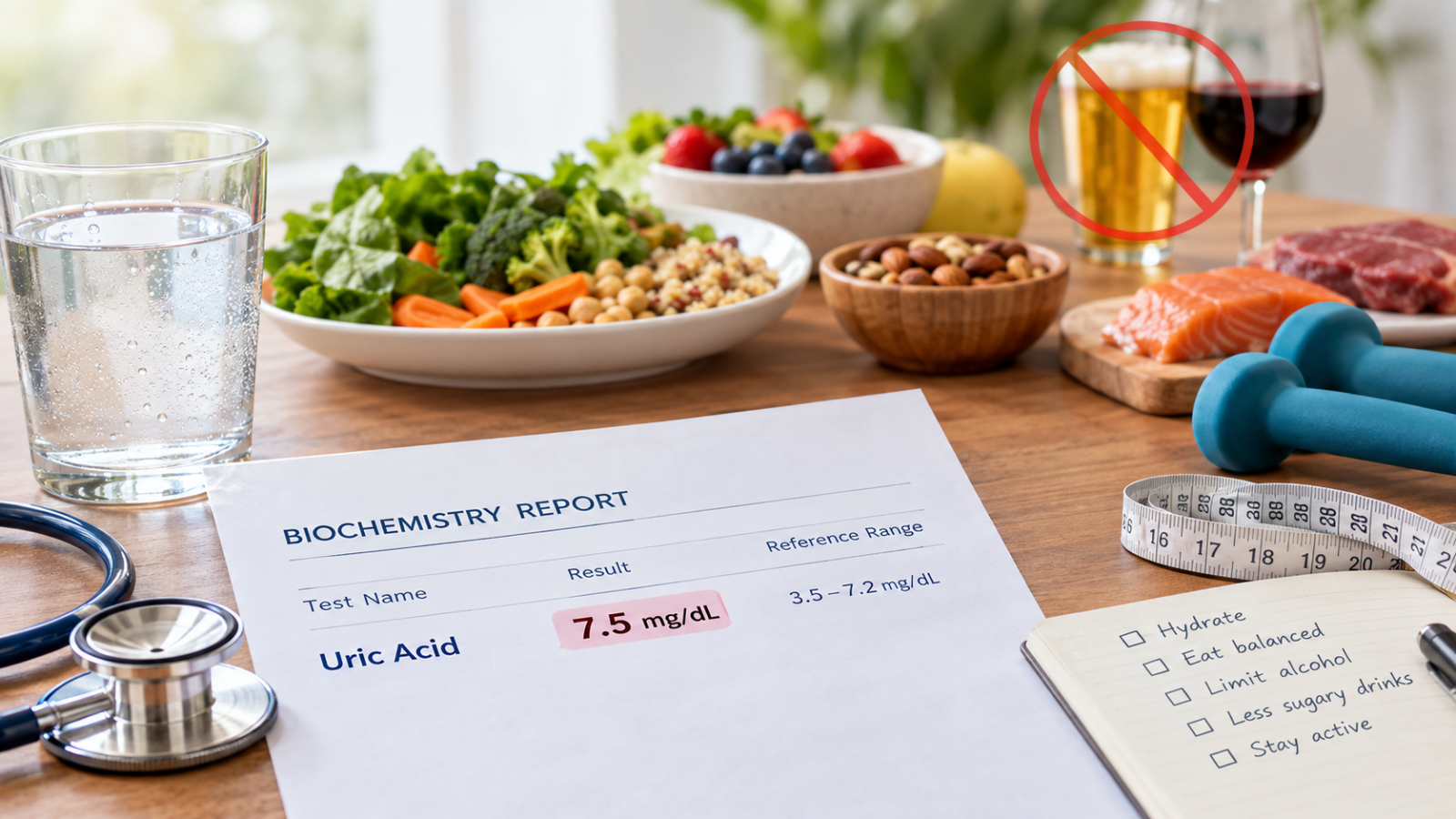
A uric acid reading of 7.5 mg/dL can make you wonder whether something is wrong, especially if you have no symptoms. Should you change your diet? Do you need medicines? Or can you simply monitor the number?
We reached out to Dr Udit Gupta, Consultant, Nephrology, Renal Sciences, ISIC Multispeciality Hospital, seeking answers.
DISCLAIMER: This article is based on information from the public domain and/or the experts we spoke to. Always consult your health practitioner before starting any routine.
As per the nephrologist, the first thing to know is that 7.5 mg/dL is above the usual blood urate range used by many laboratories, although the reference range can vary slightly. But the number by itself does not tell you whether you have gout or need treatment.
“A single mildly elevated result should therefore be viewed as a finding that needs context, rather than as a diagnosis by itself,” he tells indianexpress.com.
He further clarifies that the reading does not confirm gout.
“Gout develops when urate crystals accumulate in and around joints, causing inflammation. Some people can have elevated uric acid for years without developing gout, while uric acid can sometimes be lower during an acute gout attack”
Story continues below this ad
If you have sudden pain, swelling, redness or warmth in a joint, particularly the big toe, it is better to get assessed by a doctor rather than assuming that the blood test confirms gout. Interestingly, uric acid can sometimes be lower during an acute gout attack.
What should you do after seeing 7.5 mg/dL on your report?
“If the person feels completely well, there is usually no need to panic or start medication based only on a 7.5 mg/dL result. I would first review the report, hydration status, kidney function, medicines and dietary habits,” says Dr Gupta. He adds that your doctor may decide whether to repeat the test based on your individual situation.
The result deserves more attention if you have recurrent joint pain or swelling, kidney stones, known kidney disease or other relevant medical problems. In such cases, discuss it with a doctor instead of monitoring it entirely on your own.
Do you need medicine?
 In people without gout symptoms, urate-lowering medicines are generally not started simply because the level is mildly elevated (Pexels)
There is no universal uric acid level at which everyone needs treatment. For people who have elevated uric acid but no gout symptoms, Dr Gupta notes that urate-lowering medicines are generally not started simply because the level is mildly high.
Story continues below this ad
For someone with confirmed gout, however, the decision is different. Repeated gout attacks, tophi, joint damage and kidney disease can influence whether treatment is recommended. The usual treatment target in people being treated for gout is below 6 mg/dL.
Dr Gupta also notes that certain factors can affect treatment decisions after a first gout attack, including uric acid levels above 9 mg/dL, kidney stones and certain forms of kidney disease.
So, if your report says 7.5 mg/dL and you have never had gout, that does not automatically put you on medication. And uric acid-lowering medicines should not be started or stopped without medical advice.
What can you change in the meantime?
You do not need to eliminate every food that contains purines. Instead, focus on changes you can realistically maintain.
Story continues below this ad
Dr Gupta recommends staying adequately hydrated, maintaining a healthy weight and limiting alcohol, particularly beer and spirits. Sugary drinks and foods high in fructose should also be reduced. Red meat and organ meats should be kept in moderation, as should excessive portions of certain seafood.
At the same time, nutritious foods such as vegetables and legumes do not necessarily need to be completely eliminated just because they contain some purines.
“A balanced diet is more practical than an unnecessarily restrictive one,” says Dr Gupta.
If your uric acid is 7.5 mg/dL and you have no symptoms, the next few weeks can focus on the bigger picture rather than chasing a single number. Stay hydrated, eat a balanced diet, limit alcohol and sugary drinks, avoid crash diets, and work towards a healthy weight if needed. Your doctor can also review your kidney function and medicines and decide whether follow-up testing is appropriate.
Story continues below this ad
DISCLAIMER: This article is based on information from the public domain and/or the experts we spoke to. Always consult your health practitioner before starting any routine.
KioskNews shows a cleaned-up reading view extracted from the publisher’s page — the original always lives on their site, not ours.