Israel's opposition weighs minority coalition as Bennett, Liberman reject Arab support

Israel's anti-Netanyahu bloc is preparing for the possibility of forming a minority government after the upcoming elections, despite opposition from Avigdor Liberman and Naftali Bennett, while a broad agreement is emerging among the parties to replace Knesset Speaker Amir Ohana even before a coalition deal is reached.
In most polls, the anti-Netanyahu camp holds an advantage over the outgoing coalition bloc, but the Zionist parties seeking political change fall short of the majority needed to form a government based on their current agreements.
Prime Minister Benjamin Netanyahu and his allies are far from securing a majority in many polls, although some surveys give the right-wing bloc enough seats to form a government. The electoral threshold could change the distribution of Knesset seats, and a relatively small number of votes could determine whether Israel forms a new government or enters another round of political turmoil.
There is broad agreement within the camp seeking to replace Netanyahu on the need for a change of government. The disagreement begins over how to form that government if the Zionist parties in the bloc fail to win a combined 61 seats.
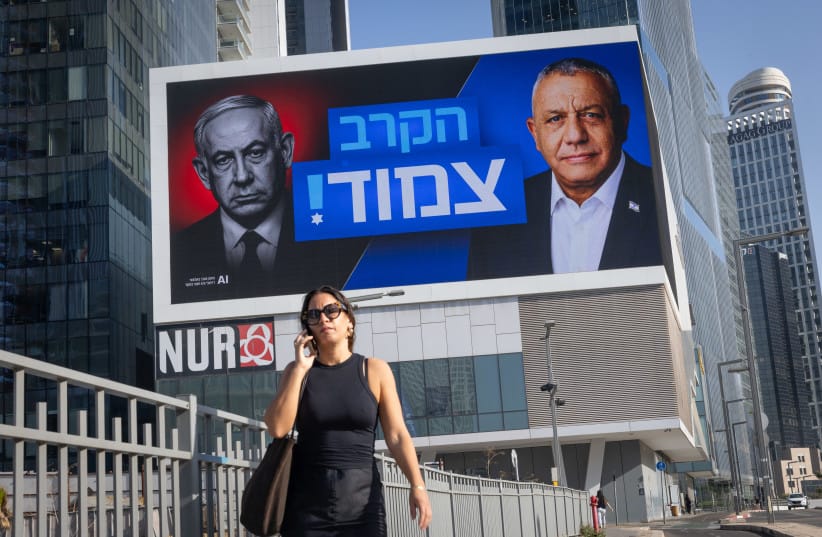
Gadi Eisenkot wants to lead the bloc and become its main candidate for forming the next government. He firmly rejects the possibility of serving under Netanyahu, even in a rotation government, and has raised the possibility of establishing a minority government if the parties seeking political change secure 58 or 59 seats.
The idea is to swear in a government that wins a majority in a confidence vote, even without the permanent support of 61 MKs, and subsequently attempt to broaden its parliamentary base.
Eisenkot has made no secret of his ambition to achieve a much stronger electoral result, one that would allow him to form a Zionist government without relying on political actors outside his camp.
Relying on 58 or 59 seats, however, would require detailed agreements with his partners, particularly Bennett and Liberman, who oppose establishing a government dependent on the support or abstention of the Arab parties.
Eisenkot himself has not ruled out the possibility of outside support from Ra'am. In recent discussions and interviews, he has sought to project confidence that progress could be made in stages, but no agreed formula has yet been presented that would allow the plan to be implemented.
From a legal standpoint, swearing in a government does not require 61 votes in favor, but rather a majority in the confidence vote. Abstentions by MKs could allow a government to take office without an absolute majority.
By contrast, a constructive vote of no confidence, intended to replace an incumbent government, requires the support of 61 MKs for an alternative government.
Eisenkot's minority-government scenario could therefore be relevant during the process of forming a government, but it would not allow the anti-Netanyahu bloc to remove an incumbent Netanyahu government through a simple majority vote.
The political difficulty remains: Who would agree to serve in such a government, who would abstain in the vote, and how would the government survive after being sworn in?

Liberman rejects minority government, insists on Zionist majority
Avigdor Liberman categorically rejects this possibility. He has made clear that he would not support a minority government, even for a transitional period, and insists on a government backed by a Zionist majority.
A unity government with Netanyahu is also unacceptable to him. From his perspective, if a suitable majority cannot be found, another election would be preferable to establishing a government that fails to meet the conditions he has set.
Liberman has raised another possibility: bringing Likud MKs into a government without Netanyahu, or creating a Zionist majority through a change in the composition of the political blocs after the elections.
He has even claimed that some Likud MKs would be willing to take such a step. Liberman has not named them, and at this stage there are no public negotiations with Likud MKs about joining such a government.
Eisenkot wants to establish a government even with a partial majority and attempt to expand it later. Liberman is unwilling to join such a government and demands a Zionist majority from the moment it is formed.
Bennett and Yair Lapid, who head the Beyachad list, are also demanding a Zionist government and are unwilling to base its formation on the votes or abstentions of the Arab parties.

By contrast, Democrats chairman Yair Golan has not ruled out cooperation with Ra'am.
The disagreement among the party leaders could intensify when they are required to decide whether to support the swearing-in of a government that lacks a Zionist majority in the Knesset.
The meeting between Eisenkot and Liberman this week ended with a joint statement emphasizing the need to increase voter turnout. It did not resolve their disagreement over a minority government.
Internal competition for leadership also continues. Eisenkot wants to emerge from the elections as the leader of the largest party, believing such a result would strengthen his position during consultations at the President's Residence.
Bennett sees himself as a natural candidate to lead the anti-Netanyahu camp because of his experience as prime minister, while Liberman insists on withholding any commitment that could enable the formation of a government contrary to his positions.
Each party leader is seeking to increase his political strength, even though the transfer of Knesset seats between parties in the same camp does not necessarily increase the bloc's overall representation.
After the elections, they will also need to agree on the identity of the next prime minister, the composition of the coalition, and the conditions for establishing it.
Anti-Netanyahu parties seek agreement on replacing Knesset speaker
Within the anti-Netanyahu bloc, broad agreement is emerging on a step that could be attempted even before the question of forming a government is settled: replacing Knesset Speaker Amir Ohana.
The move is intended to give the camp opposing Netanyahu control over the parliamentary agenda, even if Netanyahu remains in office as head of a caretaker government.
Electing the Knesset speaker is among the first steps taken by a newly elected Knesset, and the vote is public.
To replace Ohana, the bloc would need to assemble a majority around an agreed candidate. It could also rely on votes from MKs representing the Arab parties.
The move would not require a prior agreement on the composition of the next government.
Among the names raised as possible candidates are Chili Tropper, Matan Kahana, and Elazar Stern from Eisenkot's list; Meirav Ben-Ari and Eitan Ginzburg from the Bennett-Lapid list; Efrat Rayten from the Democrats; and attorney Oded Forer from Yisrael Beytenu.
No consensus candidate has yet been announced.
Liberman estimated this week that MKs from the outgoing coalition would also support replacing Ohana, suggesting that as many as one-third of them could vote against him.
If such MKs are indeed prepared to take that step, they would have to do so publicly.
Opposition parties prepare legislative agenda for new Knesset
The anti-Netanyahu bloc is seeking to advance a state commission of inquiry into the events of October 7, changes to military conscription legislation, limits on the prime minister's tenure, and the repeal of some of the changes promoted by the outgoing government to the judicial system.
Liberman also wants to advance legislation that would prevent a person facing criminal charges from serving as prime minister.
The parties have not yet reached a binding agreement on all the details of the proposed legislation or the order in which it would be advanced.
Teams representing the parties have already held meetings to coordinate their first steps in the new Knesset.
The idea is to use the first weeks after the elections to advance legislation before coalition negotiations deepen the disagreements between the parties.
The experience of the Bennett-Lapid government also looms in the background. Laws promised when that government was formed were not completed before it collapsed.
This time, the anti-Netanyahu bloc wants to move quickly, but there are concerns that MKs with differing political views will not support every item on the shared agenda.
Replacing the Knesset speaker would not automatically provide a legislative majority, and not all members of the bloc agree on every proposed judicial change.
Legislation effectively targeting Netanyahu would likely encounter constitutional and legal difficulties, including questions of applicability and legislation directed at a specific individual.
Nor would a state commission of inquiry be established automatically simply because the Knesset elected a new speaker.
If the move succeeds, Netanyahu could remain in office as head of a caretaker government while a newly elected Knesset, in which his opponents hold a majority, works to advance an agenda contrary to that of his government.
KioskNews shows a cleaned-up reading view extracted from the publisher’s page — the original always lives on their site, not ours.