As US votes in midterm elections, 6 themes to watch

For the last two months, US President Donald Trump has offered a consistent plea: Pretend he’s on the ballot. The midterm elections on Tuesday will give voters an opportunity to do just that. They are set to render the first national referendum on a second-term Trump agenda characterised by far-reaching tariffs, an unpopular war with Iran and an aggressive immigration crackdown.
Republican officials are bracing for a harsh judgment and potentially significant defeats. They widely expect to lose control of the House. They have grown increasingly worried about losing the Senate, too.
Democrats have sought to define their campaigns through anger over high prices driven by tariffs and the war, focusing heavily on the idea of making life cost less. Led by Trump, Republicans have struggled to articulate an affirmative counterargument, with the president dismissing concerns about the economy and sending an often scattered message.
American politics is of course full of surprises. While Republicans have underperformed in both midterm elections of the Trump era, the president has demonstrated his ability to turn out his most loyal supporters. He has also stepped up his baseless attacks on the U.S. election system, raising fears of federal interference in the results.
Democrats need a net gain of just three House seats to win a majority. The Senate is a heavier lift: Democrats must hold all of their seats and flip at least four Republican-held ones. They are competing in states like Texas, which has not elected a Democratic senator since 1988, and Kansas, which has not done so since 1932.
And if Democrats flip at least two Republican-held governorships, they will hold a majority of them for the first time since 2010, when a backlash to President Barack Obama fueled a Republican wave that has shaped American politics ever since.
Polls will close starting at 6 p.m. ET (4:30 am in India). The results that follow will shape the country for at least the next two years, and perhaps much longer. Here are six themes to watch as voting ends:
Story continues below this ad
How deep into Republican territory can Democrats reach?
Look at where the competitive races were in the final days of the campaign.
Solidly red Kansas and Ohio have toss-up Senate races. Democrats are seriously contending in House districts like the one in northern New York being vacated by Rep. Elise Stefanik — where Trump won by 21 percentage points two years ago.
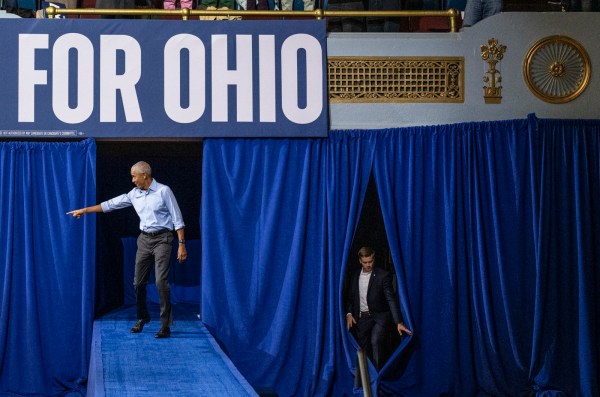 Former President Barack Obama, left, arrives on stage at a campaign rally in Cleveland, Ohio, Oct. 24, 2026. (Victor J. Blue/The New York Times)
Governor’s races are tight in conservative states like Florida, Nebraska and Oklahoma, where Gov. Andy Beshear of Kentucky, the chair of the Democratic Governors Association, spent Monday night stumping for the party’s nominee. The last Democratic presidential candidate to win even a single county in Oklahoma was Al Gore in 2000.
Over the weekend, Republicans rushed money into Louisiana’s Senate race, which had not been considered a competitive contest before then. Both parties have also directed late money to the Senate races in Mississippi and South Carolina, states that have been out of reach for Democrats for a generation.
Story continues below this ad
With Democrats widely expected to win races in at least some red House districts and threatening to flip Senate seats in deep-red states, the question is how far into Republican terrain they can prevail.
How angry are voters about Trump’s handling of the economy?
Voters care most about whether they can afford their everyday needs, and polls suggest that they are angered about the high prices brought on by tariffs and a war ordered by Trump.
The president spent the day before the election talking about his alterations to the Reflecting Pool in Washington. Over the past few weeks, some of his most memorable rally lines have been about the anatomies of Republican Senate candidates.
Trump’s approval ratings have sunk to record lows. Republican candidates who have recast their political identities in his image are struggling to convince voters that they can be independent.
Story continues below this ad
In many cases, Republicans have not even tried to make a case that the economy is in good shape. Instead, they have tried to change the subject.
In Michigan’s Senate race, former Rep. Mike Rogers has sought to push the Muslim faith and family background of his Democratic opponent, Abdul El-Sayed, to the center of the campaign. In Texas, voters have seen an onslaught of Republican ads about how James Talarico, the Democratic Senate nominee, talked about transgender rights in the past. And in Maine, Sen. Susan Collins is selling voters on the idea that her seniority after four terms is best for her state.
If Democrats win the House, how big will their majority be?
We could know fairly early in the evening what kind of night it will be for the House.
In Indiana and the eastern half of Kentucky, polls close at 6 p.m. ET. There are tight races in Kentucky’s 6th Congressional District, which Trump carried by 15 points in 2024, and Indiana’s 5th District, which he won by 17 points.
Story continues below this ad
Both are competitive races that will reveal some of the first clues about the rest of the electoral map. They are districts that combine rural and suburban voters and are usually safe for Republicans.
There are dozens of similar House districts across the country.
What’s the fallout from the national redistricting fight?
Starting with Texas in the summer of 2025, Republican-led states began redrawing their congressional district lines to try to secure more House seats for their party.
The new maps were based on the idea that the electorate in 2026 would look somewhat like the one that carried Trump to victory in 2024.
That does not seem to be the case.
Story continues below this ad
Latino voters have turned against Trump, shifting the politics of South Texas and South Florida, where Republicans tried to lock in advantages. Rural voters are furious about the price of diesel fuel. Black voters, early voting data suggests, are turning out in huge numbers.
The result is that House districts drawn with the express intent of putting them in Republican hands instead have competitive races. In Texas, Florida, Tennessee and North Carolina, there are increasingly tight races in districts Trump would have carried by double digits had they existed in 2024.
Meantime in California, voters approved a plan aimed at delivering five House seats for Democrats, and redistricting does not seem to have placed any of the party’s seats at risk.
What about all the Republican money?
Elon Musk spent at least $474 million to back Republicans in the midterm elections. The next four biggest donors are also Republicans. And Trump had an unmatched war chest.
Story continues below this ad
If Republicans defy expectations, it will be at least in part because of a financial advantage built long before races became tight in the campaign’s final weeks.
At the same time, Democratic officials involved in House and Senate races have lamented that they do not have the money to compete in as many districts and states as they would like.
Will Democrats be hurt by their Senate-race dramas?
The red-state Senate races in Iowa, Kansas, Mississippi, Ohio, Texas and South Carolina are competitive in part because Democrats have nominated a generally strong slate of candidates who have mostly avoided major problems on the campaign trail.
That’s not the case for their blue-state brethren.
Maine Democrats switched out their candidate in July after the primary winner, Graham Platner, was forced out of the race after a rape allegation, which he denied.
Story continues below this ad
Michigan was convulsed this weekend by a late endorsement flip, with Rep. Haley Stevens, who lost the Senate primary to El-Sayed, defecting and backing the Republican in the race, Rogers.
And in light-blue Minnesota, Lt. Gov. Peggy Flanagan has led in polling in her Senate race despite being trailed by the state’s major fraud scandal and being viewed as running one of the party’s weakest campaigns.
There’s also Alaska, where a New York Times report last week about Democratic chicanery to help Mary Peltola, the party’s nominee for Senate, by recruiting a second Dan Sullivan into the race set off a wave of Republican anger.
Polls show the Democratic nominees leading or with an edge in all four races, but some of these contests — especially in Michigan and Maine, where Collins, the incumbent Republican, is a formidable opponent — have required more resources and attention than party leaders would have preferred.
KioskNews shows a cleaned-up reading view extracted from the publisher’s page — the original always lives on their site, not ours.