Full patch member of the Outlaws Motorcycle Club allowed to keep alcohol delivery licence in Ontario
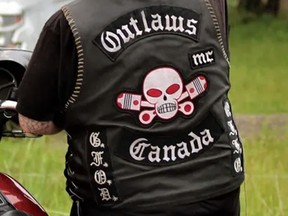
A full patch member of the Outlaws Motorcycle Club (OMC) can keep his Trenton, Ont., liquor delivery service licence, despite three recent run-ins with police.
Sign In or Create an Account
The registrar of Ontario’s Alcohol and Gaming Commission issued a notice of proposal in March revoking Adam Bridge’s liquor delivery service licence for Big Deal Delivery because he “is a full patch member of the OMC,” according to a recent decision from the Ontario Licence Appeal Tribunal.
“The registrar argues that the appellant’s membership, influence and participation in the OMC constitutes reasonable grounds for belief that he will not carry on business in accordance with law and with integrity and honesty.”

Get a dash of perspective along with the trending news of the day in a very readable format.
By signing up you consent to receive the above newsletter from Postmedia Network Inc.
A welcome email is on its way. If you don't see it, please check your junk folder.
The next issue of NP Posted will soon be in your inbox.
We encountered an issue signing you up. Please try again
The registrar argued that Bridge’s “affiliation with the OMC, which it considers to be a criminal organization and whose members are required to uphold a code of non-cooperation with police and law enforcement, is incompatible with holding a licence in Ontario’s regulated liquor industry, and three recent interactions the appellant had with police further demonstrates his disentitlement to a licence.”
The registrar argued unsuccessfully “that revocation is the only appropriate remedy under the circumstances.”
That didn’t fly with tribunal member Bruce Stanton, who directed the registrar not to carry out the proposal.
“The registrar has not met its burden in establishing that the appellant’s conduct, in the form of his full patch membership in the OMC and the three interactions with police should disentitle him to a licence,” Stanton wrote in a Sept. 22 decision.
Bridge told the tribunal that “licensing should be based on actual conduct, not assumptions based on association,” said the decision.
“He argues that his activities as a licensee are unimpeachable and he has always acted in accordance with the law and with integrity and honesty.”
Bridge told the tribunal “that he provides lawful regulated services to customers including pharmacies, restaurants and other regulated premises,” said the decision.
“He submits that he has never wavered in upholding the obligations of his licence including never selling alcohol illegally or acting dishonestly, and his customers rely on him and are confident in his services.”
Bridge pointed out that his three recent interactions with police did not result in any charges “and did not implicate him in any unlawful activity.”
The tribunal heard Bridge was at a restaurant in Picton, Ont., on Sept. 2, 2024, when police were called.
“The owner of a restaurant there called police because they thought ‘a couple of bikers are getting into it’ and ‘it looks like it will be physical,’” said the decision.
Police responded to the scene and separated the club members to “figure things out,” in this case two Red Devils and Bridge, who was then a probationary member of the OMC, accompanied by a friend.
OPP Det. Laura Empey, a biker expert, testified “that the situation was ‘not good’ because Picton is an area controlled by Hells Angels. She testified that the Red Devils are a support club of the Hells Angels.”
Bridge, who was wearing his OMC colours, and his friend “were initially obstructing police and refusing to identify themselves while video recording the officers,” said the decision.
Bridge told the tribunal he didn’t identify himself to police because the law does not require him to do so.”
Empey “described the incident as a provocation because the OMC members were in an area known to be controlled by the Hells Angels and Red Devils,” said the decision.
Bridge testified that “he was just having lunch with a friend when two Red Devils approached and started yelling at him. He stated that the situation had calmed down by the time the police arrived. He submits that no charges were laid, there was no altercation and he was simply standing up for his rights.”
On Sept. 4, 2024, police were called to the Trenton Downtown Business Improvement Agency after its executive director, who had previously complained about Big Deal Delivery overcharging her son for a food order, dialled 911 when Bridge showed up in her office.
Bridge testified that he was there “to clear up the misunderstanding and ‘things did not go well.’”
He argues that his activities as a licensee are unimpeachable and he has always acted in accordance with the law and with integrity and honesty
Bridge returned to the same office later that day “and proceeded to video-record elements of the interior,” said the decision, noting that prompted the executive director to dial 911 again.
When police arrived, Bridge told them “that he was uploading video to YouTube, he would not identify himself and that he would not answer any questions of police.”
Police had to use Bridge’s licence plate to identify him.
Bridge “said he posed no threat” to the executive director, who “refused to speak with him and told him to leave.”
Then on Feb. 27, 2026, police pulled Bridge over in Quinte West after he turned onto a side street to avoid a police checkpoint looking for impaired drivers.
When a cop asked Bridge why he avoided the checkpoint, “he said he did not feel like stopping to talk to them,” said the decision, which notes his breath sample showed he had not been drinking and no charges were laid.
Stanton found Bridge’s three police encounters demonstrated he was “following the OMC’s unwritten rule requiring that he avoid talking to law enforcement officers,” said the decision.
“Each of the encounters were resolved peacefully and seemingly without violence or risk to public safety. Accordingly, I find there is insufficient compelling and credible information to find that the appellant’s conduct in these three interactions reaches the level of reasonable grounds for belief that he will not carry on business in accordance with the law and with integrity and honesty.”
Our website is the place for the latest breaking news, exclusive scoops, longreads and provocative commentary. Please bookmark nationalpost.com and sign up for our daily newsletter, Posted, here.
Join the Conversation
This website uses cookies to personalize your content (including ads), and allows us to analyze our traffic. Read more about cookies here. By continuing to use our site, you agree to our Terms of Use and Privacy Policy.
KioskNews shows a cleaned-up reading view extracted from the publisher’s page — the original always lives on their site, not ours.