Construction robots on trial in Jurong could be deployed as early as 2028
SINGAPORE – What if the next machine at Singapore’s new construction sites had nobody sitting behind its controls?
A pilot, launched by JTC Corporation and Kajima, is putting autonomous excavators and compactors to the test at Bulim autonomous yard in Jurong Innovation District, with the machines performing tasks under real site conditions. They can carry out assigned tasks independently, while operators monitor and oversee them remotely from a nearby control room.
The project will explore how autonomous heavy construction equipment can help address manpower constraints and improve workplace safety.
Calvin Chung, assistant chief executive of engineering and operations at JTC, said: “If the pilot succeeds, we will deploy autonomous heavy construction equipment across suitable projects in our pipeline and support wider industry adoption.”
The first phase of the project started in January and includes four machines: two excavators and two compactors. It is set to end in early 2027.
The second pilot will then begin, introducing autonomous bulldozers and dump trucks to create a coordinated fleet. Once the trials are complete, the machines may be pushed out to JTC’s sites, specifically within the Jurong Innovation District, by 2028.
This is the first project at JTC’s new 1ha sandbox, announced by National Development Minister Chee Hong Tat at ConTech@PDD in July. It is being conducted in partnership with the Public Sector Science & Technology Policy & Plans Office, and Housing Board.
Improving productivity with fewer workers
Productivity is crucial as JTC is looking at a pipeline of at least 800ha of earthworks projects over the next five years.
According to the Building and Construction Authority, Singapore’s total construction demand is projected to reach $53 billion in 2026, while industry reports show the sector faces a persistent manpower shortfall of nearly 15 per cent across various roles.
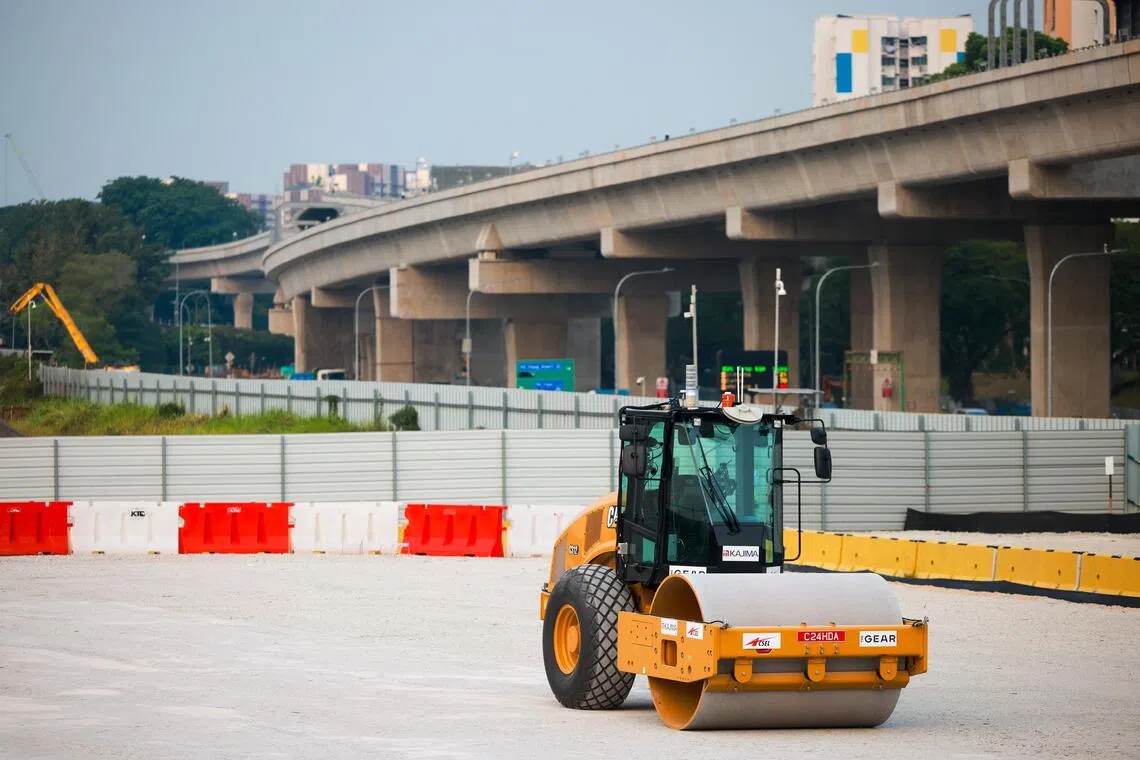
Besides excavators, compactors are also being tested at JTC’s sandbox for validating autonomous construction equipment under real site conditions.
ST PHOTO: JASON QUAH
“Adding more manpower is not a sustainable way to meet Singapore’s future construction needs,” Chung said.
JTC is targeting a reduction in operator manpower by half, with one operator overseeing two machines from a control room away from the construction zone.
Under the trial, an operator assigns tasks and sets virtual boundaries for each machine from an operating room situated 20m from the sandbox.
Using sensors and artificial intelligence, the machines then perform the tasks without an operator seated inside or near the cabin. The activities are monitored remotely by staff who have a line of sight to the machines and will intervene whenever an issue occurs.
For this trial, two operators from local contractor Kok Tong Construction (KTC) travelled to Japan to be trained by Kajima’s operators on how to use the robots. Lessons from this pilot are also being documented for the rest of the industry.
Project engineer Tosh Chin Kah Woo, who oversees activities from the control room, underwent training in Japan for one week, where he learnt how to operate and supervise the robots. In the past, he had to physically cordon off the work area for the excavator, but now, the commands and boundaries are built into the system, he said.
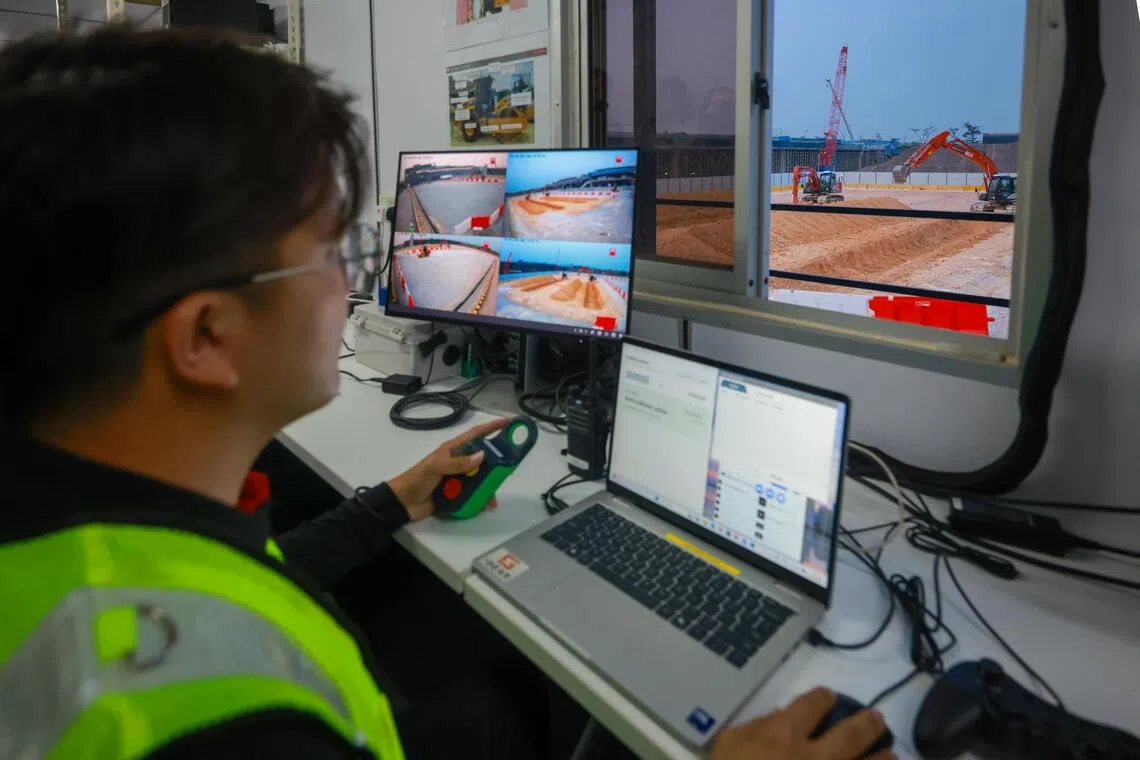
KTC project engineer Tosh Chin Kah Woo managing autonomous construction equipment from a control room during a trial on Sept 16.
ST PHOTO: JASON QUAH
If these machines are deployed, foreign workers, who make up nearly 90 per cent of the manual semi-skilled workforce in Singapore’s construction industry, may get the chance to upskill and become more productive.
Many migrant workers have already been trained to use robotics at construction sites, including robots that are used for painting, JTC said in response to queries. It added that workers’ suitability for this training will depend on their skill level and aptitude.
For this trial, JTC is aiming for a 20 per cent to 30 per cent increase in construction speed compared with traditional machines, said Cheong Jiawen, director of JTC’s future of building and infrastructure. He added that the trial looks very promising so far, and JTC is looking to further improve productivity.
Additionally, construction robots reduce workers’ exposure to some on-site safety hazards by decreasing the need for personnel to operate machinery or work closely with moving equipment.
JTC is also working with the Manpower Ministry to develop operating guidelines and safeguards for the deployment of these machines. These include virtual fences to contain the machines, sensors to detect people and obstacles, and emergency-stop controls on site and in the control room.
Retrofitting traditional machines
To create construction robots, traditional machines are retrofitted with technology from multiple partners. Retrofitting existing machines with new technology allows for easier and more cost-effective adoption as contractors can upgrade machines they already own, rather than replace entire fleets.
To automate digging, the excavator uses technology from Gravis Robotics, a Zurich-based start-up developing autonomous software and hardware for earth-moving equipment. The compactor, which presses down construction material, runs on Kajima’s automated construction system, A4CSEL. This is the first deployment of the system outside Japan.
Kajima is working with KTC and equipment provider Tractors Singapore on the retrofitting process.
Luke Wu, managing director of The GEAR by Kajima, said the system is suited to large-area operations, based on its use in Japan. For example, during the construction of Naruse Dam in Akita prefecture, three operators based 400km away managed a total of 14 robots, which ran continuously for up to 70 hours at one point.
Yoshihiko Riho, senior executive officer of Kajima, said: “We believe the combination of Kajima’s technologies and Singapore’s innovation-driven environment will help realise the next generation of construction.”
Beyond the pilot, JTC will be collaborating with public agencies, contractors, equipment providers, research institutions and technology companies to conduct more autonomous construction trials at its Bulim sandbox.
KioskNews shows a cleaned-up reading view extracted from the publisher’s page — the original always lives on their site, not ours.