Perspective: Simon Winchester was here to tell a story
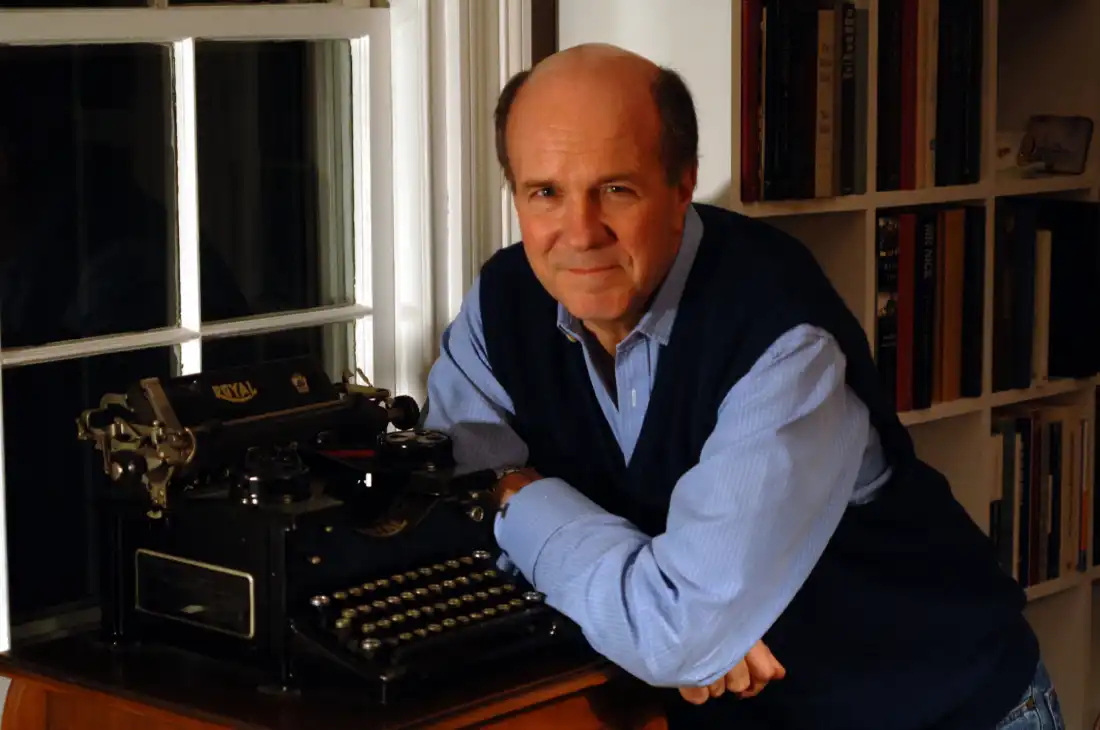
Author and journalist Simon Winchester with his 1914 Royal typewriter at his home in Sandisfield, Massachusetts in 2006. Stephen Rose/Getty Images hide caption
Stephen Rose/Getty Images
I met Simon Winchester decades ago, covering a big story in a small town. The Menominee Warrior Society had seized an abandoned Catholic monastery in Gresham, Wisconsin, and other indigenous rights activists - including the actor Marlon Brando - came to join them.
I was a young reporter who had traveled up from Chicago. Simon Winchester was there for The Guardian newspaper, wearing a Sherlock Holmes-style hat and a tweed cape. We wound up in the same local rooming house, and I would creep onto the stairs at midnight to hear Simon, on a payphone, read his elegant copy to an editor in London between quaffs of brandy.
"Analysis is just so much gabble," I remember him remonstrating to an editor one night. "I'm here to tell a story."
Simon Winchester, who died this week at the age of 82, told so many stories. He covered Bloody Sunday in Derry, Northern Ireland; the Watergate scandal in Washington DC; and the Falklands war - during which Argentine authorities accused him of spying for the British government and threw him in jail for three months.
"Who on earth would make me a spy?," he used to ask in re-telling the story. "As if I could keep a secret!"
Simon Winchester went on to author dozens of bestsellers that ranged around the world, and humanity. He wrote about earthquakes and cities, explorers on open seas, mountains, and in laboratories, the English language, and the human mind and soul.
"It was a brave man," Simon wrote in his book about the Atlantic Ocean, "who ate the first oyster."
This week, as exit polls show so much human anxiety over Artificial Intelligence, I wondered if Simon Winchester might want people to hear some of the final, surprisingly buoyant thoughts from his 2024 book, Knowing What We Know.
"An existential intellectual crisis looms," he wrote. "If machines will acquire all our knowledge for us and do our thinking for us, then what, pray, is the need for us to be?...
"But what if the opposite is true?" asked Simon Winchester. "What if mental leisure gives us the time and space to suppose, ponder, ruminate, consider, assess, wonder, contemplate, imagine, dream?...
"And by doing so perhaps come to know not simply what we do know, but what we should know, in order to be fully human."
KioskNews shows a cleaned-up reading view extracted from the publisher’s page — the original always lives on their site, not ours.