Audience members fell asleep six times on my last book tour. I still feel grateful to be an author
“Do you want the bad news, or … the worse news?” the head of a local community association is asking me. “The bad news first,” I reply, my heart sinking. “I’m sorry but we don’t have a microphone for your talk tonight.” I feel a momentary rush of relief. That isn’t so bad. I smile back, encouragingly. “Don’t worry, I can just talk louder.”
I see a nerve in his jaw twitch, his face still grim. “That’s nice,” he says, “but the worse news is the room next door has been booked by a Chinese drum troupe.”
Many people imagine an author’s life to be a dream-like existence, spending hours floating in your imagination only to come up for air from time to time to head off for a creative confab with a grateful publisher or a signing session with adoring fans.
But for a large number of writers, with so many independent publishing houses closed down, bigger companies slimmed, advances slashed and book sales tumbling, it’s less an exquisitely rewarding reverie and far more a brutal battle for survival.
Once, we simply banked the advance, signed a few books, tried our best to charm interviewers and then (with any luck) watched the royalties roll in. Now, it’s about putting yourself incessantly out there to sell as many books as you possibly can.
You pay for your own launches, beg media for coverage, give talks, hold workshops, get grilled at festivals, spend hours on your socials, and sacrifice any last vestiges of pride to ask bookshops if you can sign your latest titles in the hope they’ll be displayed more prominently.
“No, thanks,” one bookstore assistant once told me. “It spoils the book for the reader.”
Of course, I’m not complaining. Well, not too much. It is a tremendous privilege to be able to write for a living, and I love it. But it can still be pretty tough at times, and in such humbling ways readers might never imagine. That evening with the drum troupe, for instance. I shouted at the top of my lungs for 45 minutes, trying to make myself heard to my small but eager audience over the deafening boom of the dagu (bass drum), the clash of cymbals and the tinkling of the chime bells. Every so often there’d be a pause in the wall of sound, and I’d hear myself screeching into the void. I lost my voice for two days.
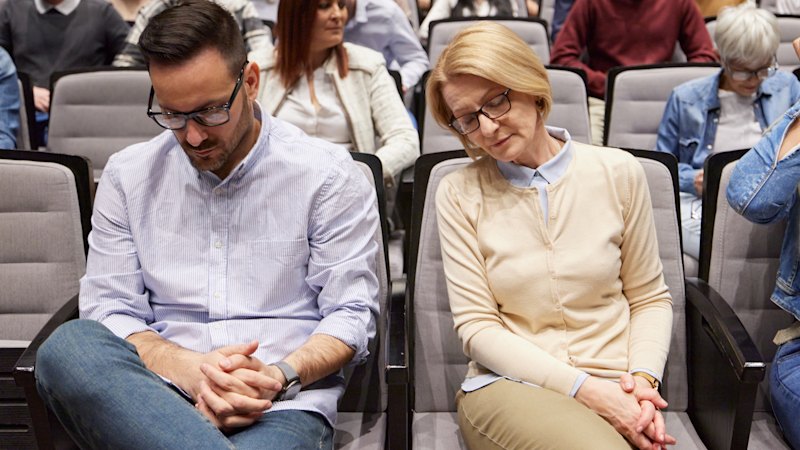
You spend much time, these days, travelling around the country to talk to clubs and associations, library groups, book groups, and at bookshops and festivals. It’s usually a treat to connect with readers, but sometimes it can be a trial. It’s hard, for example, when an older audience member falls asleep, especially when they’re in the front row (six times). It can be enormously distracting watching their head loll, their mouth fall open and then waiting for the snore.
Of course, it’s wonderful to be invited to give talks on books but very rarely are you offered travel expenses. “But we thought your publisher would pay you to come here,” is a familiar refrain. If only! Publishers’ budgets are tighter than the deadlines on hot new true crime books.
The sole income from most engagements is when people buy books that you’ve bought at a discount and you’re selling for a bit less of a discount. Again, it can tear your heart out when just one person comes up at the end to buy, but suggests you sell them three books for the price of one, and gets huffy when you won’t agree.
I suggested they pay me a token $100 for expenses. I never heard from them again.
Of course, it can be lovely when people tell you how much they like your books, but there’s never any chance of that going to your head. I was invited by one company in an outer suburb of Greater Sydney once to come and give a talk to 200 of their employees. I happily agreed – and was surrounded afterwards by fans – but incredibly, not one person bought a book.
The next year, they asked me back, saying it had been a splendid morning. But remembering how much it had cost me in time and travel, not to mention emotional wear and tear, I suggested they pay me a token $100 for expenses. I never heard from them again.
And then there’s always the risk that few people – or even no one – turns up. A writer friend of mine did a talk in a bookshop to just one person, who looked absolutely hunted. “Have you read many of my books?” my friend asked her. “No, none,” the woman replied. “I just saw the sign outside and it looked warm inside.”
For most of us writers, the reality checks and wake-up calls are louder than the cacophony of Chinese drums.
Sue Williams’ latest book is The Duke’s Secret (Allen & Unwin).

KioskNews shows a cleaned-up reading view extracted from the publisher’s page — the original always lives on their site, not ours.