Adamus: From regulatory deadlock to a roadmap for recovery—Kay Codjoe writes
The Adamus Resources dispute did not arise in isolation. It sits inside a mining sector under severe regulatory and environmental pressure.
During a strategic policy dialogue with IMANI, Lands and Natural Resources Minister Emmanuel Armah Kofi Buah disclosed that about 8,900 hectares of forest reserves had been completely degraded. He reported 258 arrests, 200 excavators seized and more than 4,000 excavators awaiting clearance at Ghana’s ports under a tighter documentation system. Government is also proposing to reduce the maximum initial duration of large scale mining leases from 30 years to 20 years and give mining communities a greater voice in licensing.
Against that broader enforcement campaign, Adamus emerged as a critical test of whether Ghana can enforce its mining laws firmly, fairly and intelligently.
IMANI had formally requested the engagement to examine the Ministry’s inherited baseline, performance, challenges and reforms. Its delegation comprised Founding President and CEO Franklin Cudjoe, Vice President for Strategy Selorm Branttie, writer and IMANI Associate Kay Codjoe, and Associate Ransford Brobbey. They met Minister Kofi Buah, senior Ministry officials and representatives of the Minerals Commission, Forestry Commission, Lands Commission and Ghana Geological Survey Authority.
On Adamus, the Minister said a report by a regional Chief Inspector of Mines prompted a further investigation by a team from Accra. He alleged breaches involving permits, unauthorised mining activity, inadequate cooperation with regulators, and outstanding taxes, royalties and statutory fees.
“We have a country. We have institutions,” Kofi Buah said, insisting that the Minerals Commission must be allowed to police the industry.
He was right about the principle. No company can operate above Ghana’s laws.
But the detailed supporting records were not fully presented during the dialogue. The allegations therefore require documentary proof and a substantive response from Adamus.
IMANI did not ask government to abandon enforcement or pronounce Adamus innocent. Franklin Cudjoe proposed a structured pathway through which the company could address the concerns, settle its liabilities, secure fresh capital and work towards restoring lawful operations.
Correction is not immunity. Recovery is not regulatory surrender.
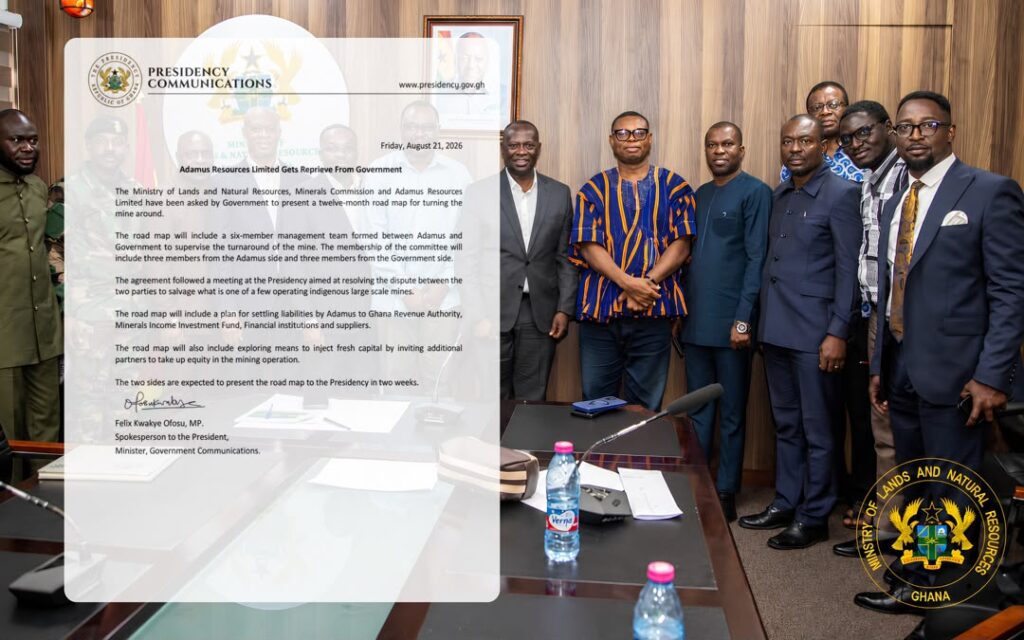
The Minister received the proposal constructively. The subsequent decision announced by President John Dramani Mahama’s government on Friday, 21 August 2026, to establish a 12 month turnaround roadmap reflects that practical middle course.
A six member team, divided equally between government and Adamus, will supervise the process. It will address liabilities to the Ghana Revenue Authority, the Minerals Income Investment Fund, banks and suppliers, while exploring new equity investment.
IMANI’s contribution was limited but useful. The dialogue helped place a workable alternative before government. The decision and its implementation now belong to the State, its regulators and Adamus.
The roadmap must contain public milestones, quarterly reports, verified liabilities, environmental obligations and consequences for default.
No company is above the State. No regulator is above due process.
The dialogue opened a door. Results must now walk through it.
By: Kay Codjoe
DISCLAIMER: The Views, Comments, Opinions, Contributions and Statements made by Readers and Contributors on this platform do not necessarily represent the views or policy of Multimedia Group Limited.
Tags:
DISCLAIMER: The Views, Comments, Opinions, Contributions and Statements made by Readers and Contributors on this platform do not necessarily represent the views or policy of Multimedia Group Limited.
KioskNews shows a cleaned-up reading view extracted from the publisher’s page — the original always lives on their site, not ours.