Hamed Shafia, who helped in ‘honour killing’ of sisters and stepmother, allowed to tour lower security prison
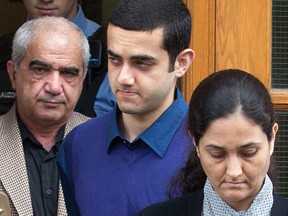
Hamed Shafia, at the age 18, helped his father kill three of his sisters and his stepmother by drowning them in the Rideau Canal in a so-called “honour killing” because his “cultural upbringing outweighed any moral obligation,” but now, 17 years later, he says his views have softened.
Sign In or Create an Account
Shafia’s account of his development since the four horrifying murders in 2009 and details of his prison life since his arrest in Kingston, Ont., are revealed in a written decision released Tuesday by the Parole Board of Canada on his request for a series of visits outside his prison.
Shafia, now 35, was given a life sentence for four counts of first-degree murder in January 2012.

Get a dash of perspective along with the trending news of the day in a very readable format.
By signing up you consent to receive the above newsletter from Postmedia Network Inc.
A welcome email is on its way. If you don't see it, please check your junk folder.
The next issue of NP Posted will soon be in your inbox.
We encountered an issue signing you up. Please try again
He asked the parole board to approve two escorted temporary absences for personal development. One was to visit a minimum-security prison, the other to attend a mosque to speak with an imam. The prison visit was approved at Friday’s hearing, but the mosque visit was denied.
The board members said at the hearing their reasons would be released in writing. Their decision reveals much about a deeply shocking crime and the family behind it.
On the morning of June 30, 2009, a Nissan Sentra was spotted submerged in the water of a lock on the Rideau Canal near Kingston, Ont. The bodies of four females were found inside, identified as Hamed Shafia’s three sisters — Zainab Shafia, 19, Sahar Shafia, 17, and 13-year-old Geeti Shafia — and his stepmother, Rona Amir Mohammad, 52, who was his father’s first wife.
Police investigators found the car was registered to Hamed Shafia’s father, Montreal businessman Mohammad Shafia.
Three hours later, Hamed Shafia went with his father and mother, Tooba Mohammad Yahya, to the Kingston police station to report the Nissan missing. The father told police three of his daughters and his “cousin” were also missing. He said the family, who had immigrated to Canada from Afghanistan, was returning from a trip to Niagara Falls, travelling in two cars.
The police investigation, however, disclosed that neither the missing Nissan nor the missing women were really a mystery to the father. Nor was the oldest victim his cousin, but one of Mohammad Shafia’s two wives.
Both of the family’s cars were at the lock when the Nissan, with the four passengers inside, was pushed into the water. Police deemed the deaths planned and deliberate murders and all three of the Shafias were charged with four counts of first-degree murder.
The killings were deemed a so-called “honour killings” in the context of the family’s “strict Afghan culture.” The case caused shock and alarm and caused headlines around the world.
Hamed Shafia and his parents were found guilty at trial. Their parole eligibility was automatically set at 25 years.
“It is difficult to conceive of a more heinous, more despicable and more honourless crime,” the trial judge, Robert Maranger, said at the time. “The apparent reason behind these cold-blooded, shameful murders was that the four completely innocent victims offended your twisted notion of honour — a notion of honour that is founded upon the domination and control of women, a sick notion of honour that has absolutely no place in any civilized society.”
In the parole board’s 11-page decision on his leave requests, the panel addressed their comments directly to Hamed Shafia.
“Following the dismissal of your appeal, you eventually admitted the murders were planned and deliberate, that you and your parents tried to disguise the murders as an accident, and confirmed the victims were conscious when the vehicle entered the water. You admitted to being in the vehicle with your mother and father while your father drove the vehicle to push the other vehicle into the water,” the board wrote.
“You acknowledged that months prior to the murders, three of your sisters started to push back against following the extremely strict Afghan culture where women were subservient, that you and your father did not like the western values your sisters were expressing, and you felt embarrassed and ashamed of their actions, believing it brought shame to your family.”
Hamed Shafia was born in Afghanistan but raised in Dubai from the age of five until he was 16, when the Shafia family moved to Canada. He never became a Canadian citizen and now has a deportation order issued against him and an arrest warrant from Canada Border Services Agency on file with the prison to be activated upon his release.
“You described your childhood as stable, denying any form of abuse. You acknowledged being raised with problematic beliefs that were cultural and not part of the Islamic culture,” the board said.
“At the time of offending, you were living with your mother, father, stepmother, and six siblings. You maintain regular contact with your mother and three living siblings and have little contact with your father. You have never been married and do not have children. You reported dating before and during your incarceration, but you are currently single.
“You did not complete your high school education prior to your arrest. You have no employment history, other than collecting the rent on your father’s commercial properties. You denied ever using alcohol or drugs,” the board said.
He was in involuntary protective custody until July 2012 because of the nature of his crimes. He was transferred to a medium-security prison in 2015.

He has several in-prison incidents in his prison record, the board heard. In 2013, he was involved in an altercation with another prisoner; in 2014, he refused to remove his window coverings on his cell, and he and other prisoners refused lock-up. In 2017, after a private family visit with his brother he was found with 10 items of unauthorized clothing; and he and other prisoners entered the school area when not permitted.
Since 2016 he has been living in the most sought-after living unit at the institution, where offenders have single cells and are responsible for ordering their own groceries, managing a budget and cooking for themselves.
While he has had family visits with a brother and sister and video visits with his mother, he has had little contact with his father.
“Your father has reached out to you through a letter, and you asked your sister to pass on a response to him that you are well, and this is the extent of your contact with him,” the board said.
Hamed Shafia was denied a request for a compassionate escorted absence to visit family in 2019 to honour his maternal grandmother.
He speaks regularly with the prison’s imam, was described by prison officials as treating all prison staff (male and female) with respect and has continuously taken in-prison employment.
While incarcerated, he completed his high school diploma and taken in-cell post-secondary courses. He has completed prison programs, including a violence prevention course.
His escorted absence request to visit a minimum-security prison is part of a plan to help his transfer to a lower security facility. The prison he wants to be transferred to didn’t support his transfer without him showing compliance with escorted absences. The visit would include a tour of the facility and a question period with staff.
His requested private visit to a mosque was to give him an opportunity to discuss “the beliefs you held at the time of the index offences, including honour, the role of women in a family, and your responsibility to restore honour to the family, with another authority from the Muslim faith, outside of just the Imam who you see at the institution.” The prison’s plan was to escort him to the mosque in a prison vehicle while he wore restraints.
Psychological risk assessments deemed him at low risk for general recidivism, and low to low-moderate range of risk for violent recidivism.

At his parole hearing, Sharif was questioned about his crimes.
“You were able to discuss what was going on in your life at the time of the index offences. You spoke about being young and to the influence that your parents had over you, which you did not question. You were new to Canada, and you had not had the chance to grow and mature,” the board summarized his answers.
“Your lifestyle was predominately focused on being with your family and you stated that you had not yet adjusted to Western culture. You spoke about the views and beliefs that were held by your culture regarding women and control, that were not questioned or challenged.
“The option of choosing murder as a consequence for your family member’s behaviour was questioned (by board members), which you explained was an accepted and common result of dishonourable behaviour.
“You noted that while you struggled with the actions that your family took towards the victims, you felt that your cultural upbringing outweighed any moral obligation you may have had and followed through with the plan. Your loyalty and closeness with your father also influenced your behaviour, in comparison to the relationship you had with the victims. You wanted to live up to expectations of your father and did not want to disappoint him.”
He said his views have since changed.
“You noted that your siblings are not religious. You also shared how your views have changed over time with respect to your culture and now align more with your siblings’ views. It was clarified that you are not religious, but you are/were influenced by culture. You do not think about religion much in your life,” the board said.
The board said the “horrific nature” of his crime could not be overlooked: “The fear and panic that the victims would have experienced at the time of their deaths has not been lost on the Board and the profound harm and trauma caused to other members of the family will be lifelong.”
The board said prison visits would help his rehabilitation but took a different view of a trip to the mosque.
“You currently attend mosque consistently within the institution and work with the Imam. Further exploring this work in the community is not assessed as offering a different form or benefit of rehabilitation from what you are currently doing now. You noted that getting a different perspective from a different Imam is one of your goals, however the Board was unable to determine how this would be of benefit in any significant way in your change process.”
Our website is the place for the latest breaking news, exclusive scoops, longreads and provocative commentary. Please bookmark nationalpost.com and sign up for our newsletters here.
Join the Conversation
This website uses cookies to personalize your content (including ads), and allows us to analyze our traffic. Read more about cookies here. By continuing to use our site, you agree to our Terms of Use and Privacy Policy.
KioskNews shows a cleaned-up reading view extracted from the publisher’s page — the original always lives on their site, not ours.