Indonesia calls for fair cross-border digital royalty governance
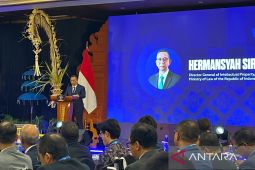
Bali (ANTARA) - The Indonesian government called for a fundamental overhaul of global digital economy practices, arguing that rapid innovation in streaming and digital platforms must be matched by structural fairness for content creators worldwide.
Speaking at the "Global Dialogue on Cross-Border Copyright Royalty Governance in the Digital Era" in Bali on Wednesday, the Indonesian Law Ministry highlighted a stark geographical imbalance in global royalty distribution despite the borderless nature of digital music consumption.
"Europe and North America account for nearly 80 percent of global royalties. Meanwhile, the Asia-Pacific region contributes 14 percent, Latin America six percent, and Africa less than one percent,” the ministry’s Director General of Intellectual Property Hermansyah Siregar revealed.
The disparity comes as digital royalties reach record highs. According to figures presented by Hermansyah, global royalties totaled nearly €14 billion (approximately US$15.3 billion) in 2024, driven heavily by music—which accounted for 90 percent (€12.59 billion) of all payouts.
Digital royalties alone have surged sevenfold since 2015 to exceed €5 billion, making streaming platforms the primary source of income for music creators globally.
According to him, cross-border royalty bottlenecks rarely stem from legal copyright disputes. Instead, the primary challenges lie in information exchange across the data value chain—starting from incomplete ownership records and fragmented global licensing to the processing of massive usage reports.
He identified the matching stage—linking usage reports to copyright holders—as a critical vulnerability.
"If the identifiers are lost, the chain is broken," Hermansyah warned, adding that subsequent calculation, distribution, and reconciliation steps are often hindered by administrative deductions and limited visibility for foreign copyright holders.
To resolve these complexities, the forum is centering discussions around three key pillars: transparency, accountability, and system interoperability.
Running until Friday (October 9), the dialogue brings together member states of the World Intellectual Property Organization (WIPO) across various regional groups, alongside intergovernmental organizations, Collective Management Organizations (CMOs) from Singapore, Japan, and China, as well as academics and technical experts.
The forum is non-binding and does not aim to produce international legal commitments. Instead, it will conclude with a “Bali Chair’s Summary" detailing key consensus areas and a framework titled "Possible Pathways for Future Cooperation" to guide voluntary initiatives in capacity building, research, and technical interoperability.
Related news: Indonesia seeks global markets for creative products via ION
Related news: WCCE 2026 opens global market access for Indonesian brands: Ministry
Translator: Agatha Olivia Victoria, Yashinta Difa
Editor: Rahmad Nasution
Copyright © ANTARA 2026
KioskNews shows a cleaned-up reading view extracted from the publisher’s page — the original always lives on their site, not ours.