Antarctic winter sea ice falls to third-lowest level on record as scientists warn of ‘now problem’
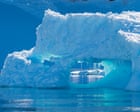
Antarctica’s winter sea ice has peaked at its third-lowest level on record, falling a million square kilometres – or almost 400,000 square miles – short of the long-term average, scientists have confirmed.
Confirmation of the peak meant the four lowest years on record for the continent’s sea ice – a vital component of the planet’s climate and critical for marine life – had all occurred in the past four years.
Satellites have been watching the continent’s sea ice since 1979, and this year data showed the sea ice peaked on 14 September at 17.59m square kilometres, about a million square kilometres short of the average maximum or an area roughly twice the size of Spain.
Dr Walt Meier, a senior scientist at the National Snow and Ice Data Center at the University of Colorado, said the centre had held off in declaring the maximum because there was a “lot of potential variability” at this stage in the continent’s sea ice cycle.
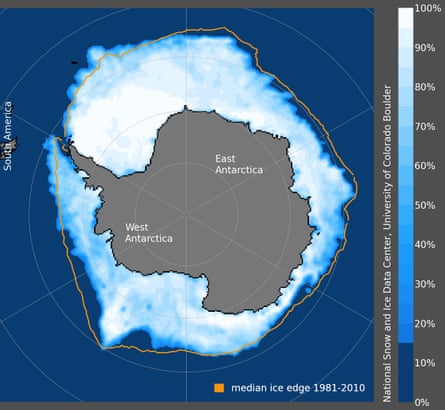
But the levels of sea ice had been falling since 14 September and he now thought “the maximum has been reached”.
Antarctica’s sea ice goes through an enormous annual swing, melting through summer to below 2m sq km in recent Februaries and then growing through winter reaching above 17m sq km in September.
But recent years have seen records broken for low sea ice in both winter and summer, raising concerns that global heating could be driving the losses.
“The past four winters have had the lowest sea ice maximum on record – that’s a very clear indication of a system that has changed,” said Dr Ariaan Purich, a Southern Ocean expert at Monash University in Melbourne.
“This is not a one-off event any more. The sea ice is no longer covering the same extent of ocean that it used to. We are seeing low winter after low winter and that suggests the sea ice is behaving differently because we have warmed our climate.
“This is not a future problem. It’s a now problem.”
In June, the Antarctic peninsular saw a heatwave with temperatures 20C above normal while scientists pointed to a France-sized area of open ocean where ice should have been.
In early August when sea ice should be steadily expanding, a large area of the Amundsen Sea to the south of the Pacific lost ice.
Purich said changes in winds associated with the El Niño climate pattern in the tropical Pacific had likely played a role in reducing the sea ice in that region.
Dr Phil Reid, who monitors Antarctic conditions at Australia’s Bureau of Meteorology, said El Niño tended to change the movement of storm systems around Antarctica leading some to be held in the same place, churning up the sea ice below.
after newsletter promotion
But he said even without an El Niño, “I think we would still be in a similar position … and that is a bit disconcerting”.
“The atmosphere will play around a bit, but in the end thermodynamics wins. If the water is too warm, you won’t have as much sea ice.”
Purich said as Antarctica now emerged from its “polar night”, sea ice reflects the sun’s energy during the day. But less sea ice meant the Southern Ocean could take up more heat.
Loss of sea ice does not directly affect sea levels as it was already floating, but it can expose ice shelves to buffeting ocean extremes and weaken them.
Ice shelves slow down the advance of glaciers and the continent’s vast ice sheet that has the potential to push up global sea levels by many metres if it reaches the ocean.
As well as providing habitats for algae and krill – critical elements of the continent’s food web – unstable sea ice has raised concerns for other species, including emperor penguins, that use the ice to breed and raise young.
Dr Will Hobbs, Antarctic sea ice expert at the University of Tasmania, said since reaching its peak earlier this month, Antarctic sea ice had been dropping “faster than usual”.
“We could be looking at another low summer and that’s when things get really worrying,” he said, pointing to concerns about impacts on ice shelves.
“How sensitive is the global climate system to this loss of sea ice? We are still working to put numbers on that. But the system is changing faster than we are understanding it.”
KioskNews shows a cleaned-up reading view extracted from the publisher’s page — the original always lives on their site, not ours.