Adam Zivo: Olivia Chow’s election victory is nothing to be proud of
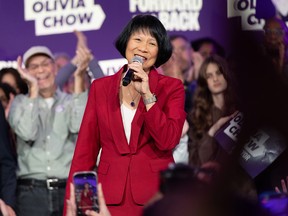
Olivia Chow may have defeated Brad Bradford in Toronto’s mayoral race, but her unusually narrow margin of victory suggests that many Torontonians remain frustrated with her lacklustre performance.
Sign In or Create an Account
Although pre-election polls conducted over the past week suggested a tight race, Chow beat Bradford by what would be considered, in most contexts, a large lead: 54 versus 41 per cent, or 13 points.
However, since Toronto was amalgamated in 1998, no incumbent mayor has ever lost a re-election bid. All of them, except Chow, have won by enormous margins: John Tory crushed his opponents in 2018 and 2022, winning by 40 and 44 points respectively; David Miller beat his opponent by 25 points in 2006; and Mel Lastman dominated by 72 points in 2000.

Columnist Jesse Kline keeps you up to date with what’s happening in Israel and the effects of antisemitism on life here in Canada. Friday mornings.
By signing up you consent to receive the above newsletter from Postmedia Network Inc.
A welcome email is on its way. If you don't see it, please check your junk folder.
The next issue of Channel Israel will soon be in your inbox.
We encountered an issue signing you up. Please try again
Rob Ford was on track to become an exception in 2014, as he was polling in second place behind Tory, but an unexpected cancer diagnosis forced him to drop out of that year’s race at the last minute. We will never know how well Rob Ford would have performed at the ballot box, but the final results would’ve presumably been underwhelming, given that his brother Doug, who stepped in as his replacement, lost to Tory by seven points.
So, putting things into perspective, when you exclude Rob Ford — the controversial mayor who was stripped of some of his powers after being caught smoking crack — then Chow’s win was the weakest among all of Toronto’s incumbent mayors. Her victory may have been clear, but it was not resounding.
It isn’t hard to see why Chow, despite her name recognition, had to fight for another mandate while her predecessors enjoyed a cakewalk: polling data consistently shows that Torontonians believe that the city, along with their quality of life, is deteriorating.
A survey conducted this month by Canada Pulse Insights found that 64 per cent of Torontonians think the city is on the wrong track, with affordability, crime and homelessness all being top issues. Another poll conducted by Build Canada similarly found that 61 per cent of respondents believe Toronto is a worse place to live than it was four years ago, and 60 per cent think that city hall needs a major change in direction.
Anecdotally, this is consistent with how many Torontonians speak about the city in everyday life — their rhetoric seems suffused with disappointment, resignation and malaise. “The city ain’t what it used to be” has become a popular cliche.
Chow failed to effectively address Toronto’s myriad of problems during her first term. Granted, many of them were outside her control, and are either symptoms of wider macroeconomic dysfunction or policies set by higher orders of government. Chow could not lower food prices any more than she could conjure thousands of doctors out of thin air.
Yet in areas where she had the agency to make change, she often acted meekly or ineffectively. For example, while she has the power to ram through pro-density housing reforms, something that’s urgently needed to address the city’s housing shortage, she allowed uncooperative councillors to exempt their own wards from change.
She also did little to curb public disorder and failed to co-ordinate any significant response to the violent antisemitism that’s been festering on city streets. This created an opportunity for Toronto’s centrists and conservatives to coalesce around Brad Bradford, whose message revolved around public safety, affordability and fiscal discipline.
Although Bradford was criticized for being too intense, his underlying political message obviously resonated with a large subset of frustrated voters. His vote share skyrocketed from 1.28 per cent in the 2023 mayoral election to almost half the city — an impressive feat, even if it culminated in a loss.
Despite his weak starting position, Bradford gave Chow and her political machine a serious fight, preventing what could have otherwise been a de facto coronation. In the end, though, his policy platform could not overcome her baked-in incumbent advantage. There is no shame in that. He still did well, given the circumstances.
At Bradford’s election event, as the energy in the room darkened into quiet disappointment amid Chow’s victory, I interviewed his campaign manager and chief spokesperson, Laryssa Waler.
“The reality is that it is very hard to beat somebody with huge name recognition, with an established machine, in a municipal race without a party system,” she said, deflated. “I think there is a huge percentage of Torontonians who don’t feel like the city’s working for them. I’m hopeful that the mayor sees fit to pay attention to them over the next four years.”
Shortly after, surrounded by supporters elsewhere in the city, Chow made a victory speech promising to represent all Torontonians, “whatever your background, whatever you believe.” If she honestly believes this, then her next term must speak to the sizable chunk of her constituents who did not feel heard the first time around.
National Post
Join the Conversation
This website uses cookies to personalize your content (including ads), and allows us to analyze our traffic. Read more about cookies here. By continuing to use our site, you agree to our Terms of Use and Privacy Policy.
KioskNews shows a cleaned-up reading view extracted from the publisher’s page — the original always lives on their site, not ours.