Isolated by flood, Zambales village builds its way back

SAN MARCELINO, Zambales — For the first time in what seemed like a very long while, the sky above this remote community was finally bright.
On Sept. 13, there was no steady curtain of rain, no dark clouds threatening another downpour and no river swollen by another night of heavy rains.
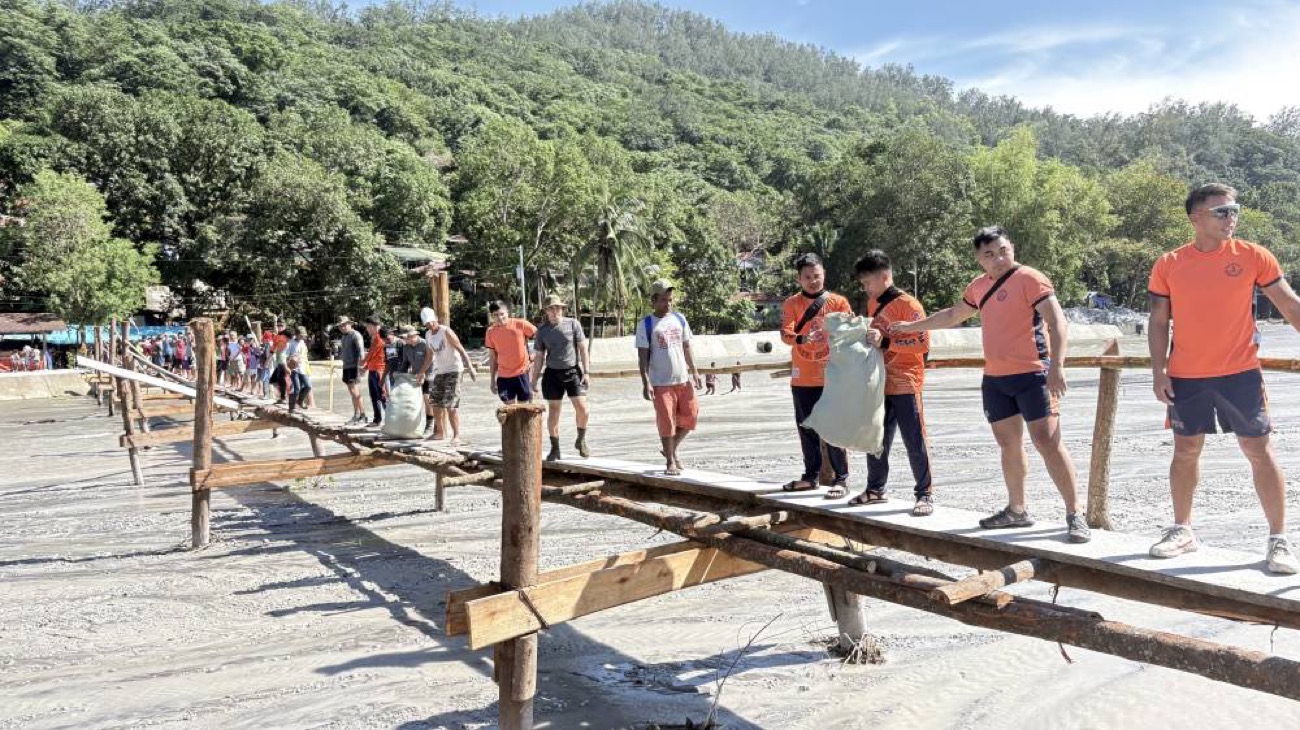
Under the morning sun, residents crossed a temporary wooden bridge, carrying food and other supplies.
Article continues after this advertisement
READ: Sea inches closer as dredging worries Zambales folk
FEATURED STORIES
NEWSINFO
NEWSINFO
NEWSINFO
Because vehicles could not pass through the narrow structure, they formed a human chain, passing sacks and boxes from one person to another until the goods reached the other side.
It was a simple but necessary arrangement in a community that had spent weeks finding ways to move people and supplies after its main connection to the rest of the town was cut off.
The scene also reflected how residents had been getting through the crisis from the beginning: by helping one another.
The bridge was built by residents after the river swept away the community’s main bridge on Aug. 9 amid the heavy rains spawned by the southwest monsoon, leaving the northern portion of Sta. Fe village cut off from the rest of the municipality for nearly a month.
Article continues after this advertisement

Reminder
For Joel Morales Soler, 50, one of the residents who helped build the bridge, seeing people cross it was a reminder of how much they had struggled simply to remain connected.
For about 800 families living north of the river, even ordinary purchases from town became difficult to bring home. The bridge was gone. The dike had been breached. Roads had become difficult to pass.
Article continues after this advertisement
And the river residents had to cross for their daily needs was the same river that had taken away homes, crops and infrastructure.
Aeta resident Melissa Cabalic Hugatan, 43, said food became particularly difficult to bring into the community after the bridge disappeared.
READ: Flood control projects fail Central Luzon folk
“It’s difficult to get food across. There are stores, but they’ve also run out of supplies,” she told the Inquirer in an interview.
For Hugatan, whose only known livelihood is farming, the disaster also meant losing part of her source of income. Floodwaters entered her home and destroyed her crops.
“I told the others living here, ‘Why is it like this? It seems like we’re struggling even more now,’” she said.
Starting over

There are many like Hugatan whose livelihoods were ruined, and for some families, rebuilding will mean starting almost from nothing.
Dominador Garcia, 61, had lived in the village for 20 years and was among those whose homes were destroyed. His house, located south of the river, was swept away by floodwaters.
“Our house is gone,” Garcia said, looking toward the area where his home once stood.
He and his family spent three days at the village covered court before moving in with his wife’s relatives.
Garcia appealed for assistance so his family could have a place to stay while they recovered from the loss. He also called for the dike to be repaired and strengthened, saying it had already been damaged three times.
“If it had been sturdy, our house would have survived,” he said.
Earlier damage assessments showed that 10 houses in the village were damaged, with estimated losses of P8.5 million.
Two houses were buried in lahar, while other homes were damaged by fallen trees. Schools and government buildings were also affected.
For weeks, the local government had to find other ways to reach the village, including using four-wheel-drive vehicles and heavy equipment through lahar-affected areas. An improvised zip line was also used to transport supplies across the river.
Soler, who has lived in the village for 12 years and works as a barangay “tanod” (watchman) and a security guard in town, missed 15 days of work after heavy rains damaged the bridge and surrounding access routes.
Even after the water receded, residents still had to cross waist-deep water to get in and out.
The bridge was their connection to work, food, school, medicine and the rest of the municipality. That was why residents did not simply wait. They built another one.
Village officials, residents and volunteers gathered timber for posts and worked together even as rain continued to fall.

“Even when it’s raining, we practice ‘bayanihan’ and build it together. We cut the wood,” Soler shared.
It took three days. But before they could even consider the bridge finished, another heavy rain came. Some of the posts they had painstakingly installed were swept away, forcing them to start over.
They kept working until they had at least a structure that residents could use on foot.
Ahead of President Marcos’ visit to Sta. Fe last week, they pushed to finish it.
“Before he arrived, we really worked hard to get it finished so we would have something to cross on,” Soler remarked.
The makeshift bridge restored a pedestrian connection for the community.
Something to last
The government provided food packs and financial assistance to families whose livelihoods were disrupted.
In recent days, several private groups and individuals have also traveled along muddy roads to bring assistance to residents.
But for residents, immediate relief was only part of what was needed. They wanted to know what would keep Sta. Fe connected the next time the river rose.
For Soler, that means replacing the wooden crossing with a permanent bridge, preferably one made of steel and strong enough to accommodate vehicles.
Residents also want the dike and access road rebuilt or reinforced to better protect homes and farms along the river.

Soler said a bridge would still not be enough if the road leading to the community became impassable during heavy rains.
The local government has been exploring an alternative route linking Sta. Fe to Barangay Omaya in neighboring San Narciso, which could give residents another way in and out when flooding affects the usual route.
These are the solutions residents say would make the community less dependent on emergency measures. The wooden bridge, meanwhile, remains a product of what they could do immediately.
Residents also continue to work together to clear mud and debris from schools and other community facilities after the flooding. That same spirit was visible in how they moved supplies across the river.
For now, the village is far from recovered, but the bridge is enough to keep it moving.
“The crossing is important to us because it is difficult to cross while carrying the things we buy for our daily needs, especially when they are heavy. For now, we’ll carry them across. At least we have a bridge to cross,” Soler said.
They are asking for something beyond the temporary structure they built themselves.
Your subscription could not be saved. Please try again.
Your subscription has been successful.
They want a bridge that will stay, a dike that will hold and a road that will remain open when the rains return—so they will not have to build their own way across the river again. /das
KioskNews shows a cleaned-up reading view extracted from the publisher’s page — the original always lives on their site, not ours.