European Commission head revives ‘associate membership’ for Canada on eve of meeting
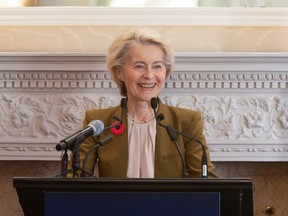
MONTREAL — European Commission President Ursula von der Leyen said Thursday the EU and Canada can work together on “everything” as she renewed her call for the country to join the bloc as an “associate member.”
Sign In or Create an Account
In a speech right before the start of a two-day Canada-European Union meeting in Montreal, von der Leyen extolled the current partnership between allies while calling for even more integration with Canada.
She notably began her speech reiterating her call for Canada to become the first ever “associate member” of the EU, pushing for “association without accession”.
Her doubling down on associate membership for Canada raised eyebrows because the term has become controversial in Europe, with some countries — notably Germany and half-dozen other countries — dismissing such a move.
A reference for “associate member” for Canada was removed from a draft joint statement between Canada and the EU circulated Wednesday ahead of the summit.
Instead, the Oct. 28 draft document (which could still be changed) referred to an “ever-closer association” between the EU and Canada that will be fully defined by next year’s bilateral summit.
Thursday, von der Leyen told attendees of a C.D. Howe Institute event that Canada and the EU “can build a partnership that comes closer to membership than anything we’ve done before.”
She summarized associate membership as better alignment on policies like AI, climate, energy and security, shared governance work between both parliaments and courts, and more integration in certain EU ventures like student-mobility program Erasmus+ or its supercomputing infrastructure for AI.
“We are once again called upon to work on new frontiers together, because the current moment in history calls for it. We are witnessing a deeper decay in international order,” she said. “We can no longer let ourselves be shackled by the limits of the old world order.”
At a separate press conference, Prime Minister Mark Carney dismissed concerns about the nomenclature used to describe the new budding relationship between Canada and the EU.
“This new alliance is not a marketing exercise. The name doesn’t matter. What matters is that the complementarities of our two jurisdictions strengthen our sovereignty,” he said.
In the past, he has emphasized a joint interest in developing AI and data-storage solutions outside of the U.S. and China as well as joint ventures in space technology and telecommunications.
Carney has repeatedly pointed to Elon Musk’s satellite telecommunications company Starlink as a technology he wants Canada to move away from.
Carney, von der Leyen and European Council President Antonio Costa on Friday are expected to sign a final joint statement at the end of their trilateral summit on Friday.
According to the Oct. 28 draft statement viewed by National Post, Canada and the EU have concluded “substantive negotiations” on a new Digital Trade Agreement (DTA) that will supplement the existing free-trade deal between Canada and the EU. The DTA “will improve legal certainty and predictability, facilitate cross-border data flows, and enhance confidence in the digital economy for businesses and consumers.”
During a background briefing with reporters, senior European officials explained that the deal would harmonize rules on digital commerce and specifics like e-contracts and duties on electronic transmissions.
The Oct. 28 document also promises to look into faster money transfer solutions between Europe and Canada.
“We will also support work toward connecting instant payment systems to facilitate faster, lower cost and more seamless cross-border transactions, making it easier for Canadians and Europeans to conduct business, invest and transfer funds across the two economies.”
Our website is the place for the latest breaking news, exclusive scoops, longreads and provocative commentary. Please bookmark nationalpost.com and sign up for our newsletters here.
Join the Conversation
This website uses cookies to personalize your content (including ads), and allows us to analyze our traffic. Read more about cookies here. By continuing to use our site, you agree to our Terms of Use and Privacy Policy.
KioskNews shows a cleaned-up reading view extracted from the publisher’s page — the original always lives on their site, not ours.