NP View: Vancouver must vote to end disorder on its streets
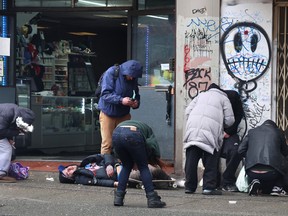
Vancouver’s Downtown Eastside is the worst example of the disorder that has been allowed to go on too long in Canada. The human misery that has plagued that corner of the city for decades has many triggers, including the long tail consequence of the deinstitutionalization trend to empty psychiatric hospitals across the country. However, things have become much worse in the last decade, as worsening homelessness and the fentanyl crisis emerged alongside permissive drug use policies at the provincial and federal levels.
Sign In or Create an Account
Other communities in Canada — Winnipeg’s Point Douglas or Toronto’s Dundas-Sherbourne neighbourhood — experience similar dysfunction of open drug use, street encampments, the drug addled sleeping on sidewalks, public defecation, violent assaults and gang infestations. But the Downtown Eastside is Ground Zero for hell.

Columnist Jesse Kline keeps you up to date with what’s happening in Israel and the effects of antisemitism on life here in Canada. Friday mornings.
By signing up you consent to receive the above newsletter from Postmedia Network Inc.
A welcome email is on its way. If you don't see it, please check your junk folder.
The next issue of Channel Israel will soon be in your inbox.
We encountered an issue signing you up. Please try again
Public drug use is currently prohibited under federal, provincial and municipal rules, but those rules often go unenforced. One telling anecdote from reporter Allen Abel in his in depth story for the Post on the Downtown Eastside helps to explain the dysfunction. When he asked police why they weren’t ticketing for open use and confiscating their drugs, one officer told him: “We can’t arrest our way out of this.”
The progressive mantra for over a decade has been that enforcement of basic rules is unnecessary, even authoritarian, because, the argument goes, drug addicts are a vulnerable group suffering from stigma. Therefore, enforcing drug laws criminalizes a health problem, or, according to some progressives, criminalizes a legitimate lifestyle choice.
The B.C. government has accepted many of the arguments from activists who seem determined to remove any consequences associated with drug addiction, ultimately discouraging treatment.
The province asked for, and was granted, an exemption from the federal government’s controlled substances laws, in order to decriminalize the possession and open use of hard drugs, though it is a policy the NDP was forced to walk back after the drug crisis and general street disorder worsened, instead of improving, as was, bizarrely, assumed would happen.
To illustrate how broken drug policy is in this country, both the provincial and federal levels of government have engaged in “safer supply” programs, where addicts are prescribed hydropmorphone, a drug similar in strength to heroin, to give them an alternative to toxic street fentanyl. Those pills are then frequently resold on the street to fund the much harder drugs they actually want, driving up demand for fentanyl, the exact opposite of what was intended. Government sanctioned drug-injection sites have also contributed to disorder.
Signals coming from the province are clear as day to police: Drug addicts are a vulnerable class and should be left alone. While in 2024 the province asked Ottawa to recriminalize public drug use, clearly more and stronger signals are needed.
Enter Vancouver Mayor Ken Sim’s decision to add two plebiscite questions on the ballot for Vancouver’s Oct. 19 municipal vote, where he is also seeking re-election. The first asks, “Are you in favour of the City of Vancouver strengthening its laws to forbid open-air hard drug (heroin, meth, fentanyl, and crack) use in public spaces?” And the second question asks if voters support the city asking the province to convert a hospital into a treatment centre that includes 100 involuntary beds.
Getting the public to explicitly express its opinion on these questions will strengthen the mayor’s hand when giving direction to police that they are expected to enforce the law, confiscate drugs, move users out of public spaces, issue tickets, and, if necessary, arrest anyone who refuses to listen.
Clear public support for involuntary treatment is something that will be much harder for the province to ignore. Better yet, B.C. Conservatives stand a good chance of toppling the NDP in the provincial election that is also being fought, which we hope would make Mayor Sim’s job all that much easier.
We encourage Vancouverites to vote yes on both questions in the plebiscite, and let that vote amplify attempts to take back Canadian streets from failed left wing policies that have done away with the notion of responsibility, of shame, and of true collective good.
National Post
Join the Conversation
This website uses cookies to personalize your content (including ads), and allows us to analyze our traffic. Read more about cookies here. By continuing to use our site, you agree to our Terms of Use and Privacy Policy.
KioskNews shows a cleaned-up reading view extracted from the publisher’s page — the original always lives on their site, not ours.