Donna Kennedy-Glans: Paternalistic Indian Act should have been abolished long ago
I’m a lawyer. And I’ve been watching Canadian governments talk about ending the Indian Act for most of my adult life.
Sign In or Create an Account
In 1969, Trudeau and Chrétien actually tried it. Their white paper proposed scrapping the statute, ending separate legal status and treating First Nations people as ordinary Canadians. Indigenous leaders called it assimilation and killed it; the paternalistic act stayed.
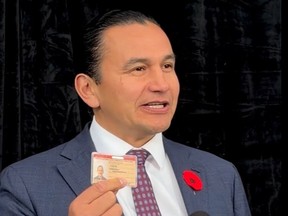
Last week in Ottawa, Manitoba Premier Wab Kinew held up his own status card and said the same thing. The Indian Act is a race-based form of identification that has no place in a modern country. Abolishing it is overdue; keep the treaties and Section 35 rights, but drop the paternalism. Prime Minister Mark Carney called the act racist, anachronistic and said he is open to reforming or abolishing it — with First Nations, of course.

Columnist Jesse Kline keeps you up to date with what’s happening in Israel and the effects of antisemitism on life here in Canada. Friday mornings.
By signing up you consent to receive the above newsletter from Postmedia Network Inc.
A welcome email is on its way. If you don't see it, please check your junk folder.
The next issue of Channel Israel will soon be in your inbox.
We encountered an issue signing you up. Please try again
That sounds like progress. Then you look at what actually happened in British Columbia.
In September 2025, the Eby government, the federal government and the Haida Nation went to B.C. Supreme Court and asked Justice Christopher Giaschi to declare that the Haida hold Aboriginal title to the terrestrial areas of Haida Gwaii under Section 35(1) of the Constitution. This was not the end of a long trial; it was a consent order. The NDP had already recognized title by agreement and legislation; they wanted the court to lock it in so a future government could not undo it.
B.C.’s lawyer, Brent Olthuis, put it plainly: “If the legislature makes a law, it can unmake a law.”
The Haida lawyer, David Paterson, was more direct: “There are agreements in place, but agreements can be revoked. There is provincial legislation in place, but legislation can be repealed.”
“There are people,” — he nodded at the politics — “who would like to repeal this legislation. There are people who would like to see this arrangement not succeed.”
The Haida Nation needed the court to “tie a ribbon” around the deal so nobody would still be arguing about title in twenty years. Justice Giaschi tied the ribbon. The declaration is constitutional; ordinary politics cannot touch it.
Veteran B.C. journalist Vaughn Palmer has detailed how little the public was told. The provincial and federal governments issued no announcement. Indigenous Relations Minister Spencer Chandra Herbert said he learned about his own government’s intervention after the fact. Attorney General Niki Sharma called a press release a “waste” because it was merely “tying up loose ends.” As Palmer suggests, entrenching title against a possible Conservative government is some loose end.
This fits a pattern of secrecy that has become the NDP’s default on land. Documents unearthed by Northern Beat and reported by Adam Pankratz show the government planning to hand over roughly 400 parcels of public Crown land to First Nations. Briefing notes labelled confidential were dated just before Eby called the snap election; anyone who wanted to see them had to sign a non-disclosure agreement and stay quiet. The Haida arrangement itself only became public because the nation announced it. Over and over, major transfers of public land happen first and the public is told later — if at all.
Now the Conservatives have won a majority in B.C. under premier-designate Lorne Doerkson, who has already reaffirmed the pledge to repeal the Declaration on the Rights of Indigenous Peoples Act (DRIPA), the 2019 statute that courts have treated as binding provincial law. Conservatives argue it has produced uncertainty, litigation and barriers to development rather than workable reconciliation. Whether they succeed or not, the Haida declaration sits outside their reach. One government can be replaced; a Section 35 consent order cannot.
The mixed messages are not accidental.
Politicians talk about ending race-based statutory distinctions and modernizing relationships. At the same time, governments engineer constitutional permanence for specific title claims through consent orders that bypass full trials and public scrutiny, and quietly prepare to give away hundreds of parcels of Crown land.
First Nations are told they will have a meaningful role in nation-building. Investors and residents are told projects will proceed with certainty. Both cannot be true when the legal ground keeps shifting or when major decisions are locked in against future democratic choices.
What gives me hope is the younger generation of Indigenous leaders who are not waiting to be treated as tokens. They are driving the practical conversation themselves.
Chief Aaron Pete of Chawathil First Nation — a lawyer, podcaster and blunt pragmatist in his early thirties — recently noted that politicians don’t deserve credit merely for saying the Indian Act should go; the real test is whether they follow through and what replaces it.
Á’a:líya Warbus, the Sto:lo MLA for Chilliwack-Cultus Lake, came into politics as a filmmaker and mother and has focused on economic participation and accountable governance.
These are not the faces invited to a press conference to nod along; they are the ones asking harder questions about what actually works for the people they represent.
Kinew is right that the Indian Act is a relic. Ending it carefully, with the people it governs, makes sense. What does not make sense is treating constitutional lock-in via a quiet court appearance, or confidential land transfers signed under non-disclosure agreement, as the model for the rest of the country. Canadians can support self-determination and negotiated partnerships; they cannot support a process in which governments and First Nations agree among themselves, then ask a judge to put the result beyond the reach of the voters who will live with the consequences — or simply hand over public land and tell the public afterward.
Clarity requires distinguishing removable statutes from constitutionally protected rights, protecting existing private interests in plain language and subjecting major territorial arrangements to the ordinary tests of evidence and public accountability. The current approach — talk of abolition here, secret constitutional entrenchment and Crown-land giveaways there — produces neither. It produces cynicism. And cynicism is expensive. The younger leaders who refuse to play along with that game are the ones worth watching.
National Post
Join the Conversation
This website uses cookies to personalize your content (including ads), and allows us to analyze our traffic. Read more about cookies here. By continuing to use our site, you agree to our Terms of Use and Privacy Policy.
KioskNews shows a cleaned-up reading view extracted from the publisher’s page — the original always lives on their site, not ours.