‘Spend time going down rabbit holes’: how the Avalanches created their wildest album yet

Last December, Robbie Chater and Tony Di Blasi, the core members of the Aussie disco-pop collagists the Avalanches, found themselves winding through the frosty, mountainous region of Minakami, Japan, with Haley Joel Osment. The pair’s lauded debut album, 2000’s Since I Left You, has become a touchstone in plunderphonics – a genre known for its innovative use of samples – and in the years since its release, the group have amassed an ardent cult following. Osment, the former child star of The Sixth Sense and Forrest Gump, seemed to count himself among their devotees, frequently liking their posts on Instagram, so they decided to reach out and ask him to board their latest project: a 35-minute movie that would accompany their new LP, No Bad Memories.
“We’d never made a film before, so it was like, ‘This could be a complete disaster for him,’” recalls Di Blasi, who is dressed in a black tee and purple cap with the logo for the cult electronic label трип when we meet in Manhattan in mid-September. “We were like, ‘We don’t really have anyone yet … We don’t even know what we’re doing.’” To their surprise, Osment signed on.
Joined by their co-director Jonathan Zawada, cinematographer Andrés Arochi and a crew that flew in from Mexico, they would eventually spend three weeks braving the elements, often shooting on the fly on little sleep. “It was fucking freezing and we’re driving around in the snow to this crazy isolated location,” says Chater, seated next to his longtime bandmate at their label’s New York office. Osment, whom he describes as “one of the most knowledgeable music fans ever”, was game for it all. “He was the glue that kept the whole production together, because he’s naturally very funny and was so calm.”
Named after an old slogan for a 5in floppy disc, No Bad Memories was inspired by the ways that advertising and technology shape us – specifically how jingles, audio logos and the drones, chimes and twinkling arpeggios of outdated devices can trigger and distort our recollection of events from our past. Chater and Di Blasi’s fondness for vintage pop and soul clips remains, but here they have broadened their palette to include chipmunk chirps, gurgling hard drives and video game bleeps and bloops. Listening to the record feels like feverishly flipping through an 1980s Saturday morning cartoon lineup – or getting sucked into the TV and thrust into the cartoons themselves. Loony and tuneful, it is the Avalanches’ wildest ride yet.
In the forthcoming short film of the same title – a mix of live action, collage and animation – Osment plays Ken, a man who works for the fictional company Takumi, a digital archives service that allows clients to upload and preserve their cherished possessions (or as Di Blasi calls them, “tangible memories”). Its tagline: “At Takumi, your memories are safe with us.” Sporting a uniform emblazoned with the brand’s flashy logo, he travels to people’s homes in his Takumi van, gathering their belongings and taking them to a mysterious storage facility.-
“You’re not sure if they’re deceased or what the story is, but it’s quite melancholy because he’s going in and boxing up these memories – VHS tapes, CDs, cassettes and photo albums,” Chater explains.
“Ken is in the middle of packing up one abandoned place when things get weird. As the tale unfolds, he starts struggling to distinguish his own memories from the imagery in commercials he’s consumed over the years. He eventually seeks refuge inside an enormous iPod that materializes in his apartment. “You don’t know whether he’s losing his mind,” Di Blasi says.
Chater and Di Blasi have been blurring that line between reality and fantasy, actual reminiscence and the illusion of it, for nearly three decades. They met in the mid-90s in high school. As a teenager, Di Blasi used to sleep with his guitar and cried when he first heard the Beatles’ Strawberry Fields Forever. Coming of age in the Australian countryside, Chater was blown away by the ingenious sampling on David Byrne and Brian Eno’s My Life in the Bush of Ghosts and early De La Soul tracks. He began experimenting with tape loops using a Tascam cassette Portastudio, and by the time Di Blasi moved to his town for his last year of school, he was laying demos with it. The two bonded immediately, relocated to Melbourne and, along with Darren Seltmann, formed the Avalanches in 1997.
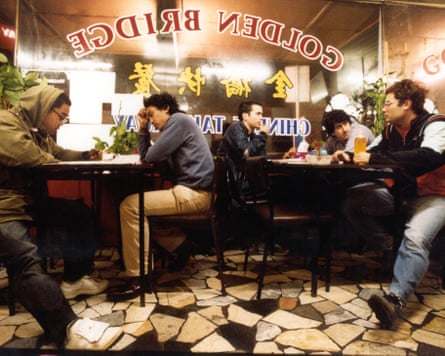
Influenced by the dense, cavernous arrangements of the Beach Boys and Phil Spector as well as the sample-heavy ragers the Chemical Brothers were churning out at the time, the band set out to conjure a hazy, psychedelic blast of sonic deja vu. Since I Left You put them on the map and changed Chater and Di Blasi’s lives forever. A meticulously crafted, stunningly cohesive patchwork of upwards of 3,500 samples – everything from neighing horses and Madonna’s Holiday to snippets from 1960s comedy sketches and Arnold Palmer’s golf instructions album – it dazzled critics and vinyl hounds and was hailed a masterpiece by outlets such as Pitchfork, Paste and the Guardian, who named it among the best albums of the 21st century.
“There was a real excitement and buzz around it,” Chater recalls. “It was the turn of the century. Dance music was having a moment. It was really fortuitous timing, and the beautiful sentiment behind the music connected with people.” He pauses. “And the fact that we didn’t do anything for 16 years added to this myth.”
The gap between Since I Left You and its successor became legendary. When their sophomore LP, Wildflower, finally did come out, in 2016, Chater said that the process of making it was plagued by “seven shades of shit”: Seltmann left the group, their label dissolved, Chater had to contend with two autoimmune diseases and a drinking problem (he is now healthy and sober) and they hit countless hurdles clearing its myriad samples. Also at play was a crippling perfectionism as they strove to meet the insanely high expectations for their long-awaited second outing.
“With Since I Left You, we were so young and free, and I remember thinking afterwards, I didn’t even try that hard,” Chater says. “We just had fun and made this thing spontaneously, and people loved it. So I thought if I tried really, really hard, imagine how good it could be.”
“Living up to that, it’s almost like people who have really famous parents,” adds Di Blasi. “They’re in their shadow. It felt like as time developed, the shadow of Since I Left You got quite large, and then you’re sitting there going, Oh, wow, it’s got to be as good as this.”
Wildflower was well received and a step forward for them. To bolster all of its blissed-out sampling, they enlisted guests including Danny Brown, MF Doom, Biz Markie, Father John Misty, Tame Impala’s Kevin Parker and David Berman. Their third full-length, We Will Always Love You, arrived a reasonable four years later and continued their winning formula: heaps of dusty samples and a murderer’s row of modern voices, including Blood Orange, Johnny Marr and Neneh Cherry. A meditation on death, the cosmos and the great beyond, it was a more subdued, wistful affair. Despite its quiet release in late 2020, during the height of Covid, it still earned raves. Delivering a follow-up that was brighter and more euphoric was “definitely a conscious decision”, Di Blasi says. “We were like, ‘Let’s do something that’s a bit more of a party and fun and more in the spirit of Since I Left You.’”
“We were really excited to make up-tempo, really joyous music,” Chater adds.
after newsletter promotion
What, they wondered, could be more joyous than a jingle?
Their first record with new member Andy Szekeres, No Bad Memories is both joyous and delightfully unhinged. That’s partly due to the abundance of whimsical ear candy on display – chanting children, whirring computers, the crack and hiss of a soda can – and partly because of how frenetic and kinetic it is. “It’s just about energy,” Chater says. “Sometimes we’d try to figure out the song order and structure, and I’d get bored and want to go to the next song, like skipping through a playlist. I thought, ‘Why can’t the album do that? The song doesn’t have to finish properly.’”
“We’d just cut it off mid-cycle,” adds Di Blasi, “not even on the beat. You think it’s going somewhere and then all of a sudden we’re cutting to somewhere else. And that’s just exciting.”
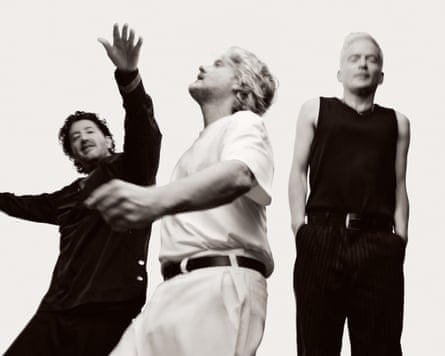
They also cast a wide net when selecting their featured artists. Newcomers including the British rapper John Glacier and Tunisian footwork producer Khadija Al Hanafi rub elbows with Panda Bear and Haruomi Hosono, as well as previous collaborators Karen O, Rivers Cuomo and Jamie xx. Pioneering electronic composer Suzanne Ciani, who invented Coca-Cola’s classic “pop and pour” sound effect in the 1970s, also makes a cameo. The fittingly fizzy track Our Love Is Alive samples a 1980 episode of the PBS Kids’ science show 3-2-1 Contact, in which she breaks down how her signature Buchla synthesizer works.
As if all that recruiting, knob twiddling and movie-making weren’t enough, Chater and Di Blasi also created two other fictional products, the Superfun console and a soft drink called El Dorado, whipping up original jingles, logos and ads for them. After Osment’s impressive performance in the No Bad Memories short film, they tapped him to record spots for them for interludes on the album.
The lofty ambition of it all, including the increasingly difficult task of trying to clear all their samples – “Now you’re dealing with companies who’ve bought up all these catalogs and just want the maximum amount of money they can get,” Chater says – nearly broke them. “We literally just handed in the album and said, ‘Sincerely, never again are we going to do this. Like, we have to find another way.’”
That’s a promise they’ve failed to keep. When we speak, it is less than two months after they’ve finished the record, but they are already sampling again. “We don’t know any other way,” Di Blasi says with a laugh.
Besides, isn’t the pain and pleasure of discovery the point? “What’s beautiful about what we do is the memories and the humanness in the sounds that we sample,” Chater says. “What’s beautiful is that there’s no shortcut. You’ve got to just put the hours in, spend the time looking and digging and listening and going down rabbit holes.”
KioskNews shows a cleaned-up reading view extracted from the publisher’s page — the original always lives on their site, not ours.