Collin May: Ottawa is betting on a Europe that no longer exists
On Oct. 5, Quebec voters returned the separatist Parti Québécois to power after more than a decade in the wilderness. Its leader, Paul St-Pierre Plamondon, has promised a third referendum on sovereignty during his first mandate. On Monday, Albertans voted on whether to take the first step toward a referendum on separation.
Sign In or Create an Account
St-Pierre Plamondon will lead a minority government, five seats short of a majority, and has promised to wait until Donald Trump leaves the White House in January 2029 before holding a sovereignty referendum. Quebec voters also wiped out the governing Coalition Avenir Quebec, which lost every seat it held, and sent 19 Conservatives to the National Assembly, the first elected to the Quebec legislature since 1935. The Alberta vote would not itself authorize separation, but it could set in motion the legal process toward a second, binding referendum.
That one of Canada’s major provinces has just formed a separatist government, while another considers taking the first step toward separation, should cause all Canadians to wonder whether we have some serious unresolved constitutional issues. Rather than brandishing our elbows at the American president and daydreaming about a yet-to-be-defined association with Europe, Canada may want to put its own house in order.

Columnist Jesse Kline keeps you up to date with what’s happening in Israel and the effects of antisemitism on life here in Canada. Friday mornings.
By signing up you consent to receive the above newsletter from Postmedia Network Inc.
A welcome email is on its way. If you don't see it, please check your junk folder.
The next issue of Channel Israel will soon be in your inbox.
We encountered an issue signing you up. Please try again
We are not the only ones busy with elections. In Spain, Socialist Prime Minister Pedro Sánchez has dissolved the Spanish Parliament, triggering early elections. The vote, to be held on Nov. 29, follows a series of blunders and missteps by the leftist leader.
With his wife facing trial on corruption charges and his government unable to deal with the influx of Moroccan migrants into Ceuta earlier this summer, Sánchez was already under pressure. The rejection of his housing proposals by Parliament was the final straw, forcing him to call an early election.
The outlook for Sánchez going into this election is not bright. Polls consistently show that his socialist government is in trouble as both the centre-right People’s Party and the right-wing Vox surge. Unfortunately for Sánchez and his left-leaning allies, Spain is not the only country ditching the left for a more nationalist right.
In Italy, Prime Minister Giorgia Meloni and her right-wing government remain at the top of the opinion polls as she lauds Italy’s historic heritage of Christianity, Roman law and Greek rationality. In France, “far-right” presidential candidate Marine Le Pen leads polling in both rounds for the French presidential election next year. And in Germany, the Alternative für Deutschland, an even further-right party, is going from success to success in state elections while challenging the country’s traditional centrist parties. That all of these parties entertain, to some extent, Eurosceptic views is making Brussels very uneasy.
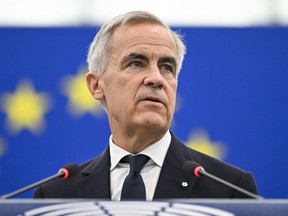
When it comes to Europe, the European Union of Carney’s dreams is on the ropes, and his preferred partners are going down in rapid succession. However, it’s doubtful that any of this will change Carney’s mind as he pursues his idealized vision of Europe.
Carney has long mused about a rupture with the United States, well before his celebrated Davos speech earlier this year. In part, this is likely because he seems to favour government control of capital spending rather than allowing private interests to manage their own investments. In this, he, no doubt, believes himself to be in step with the European Union.
The difficulty is that the Europe of Carney’s imagination is largely a figment. If it ever did exist, it has long since passed, with the Eurosceptic right coming to dominate the continent. The days of bankers and bureaucrats managing a pacified population are coming to an end.
Looking south, we come across a similar phenomenon in Latin America. The day before the Quebec vote, Brazil held its national elections, including a presidential election in which right-wing candidate Flávio Bolsonaro outpaced leftist President Luiz Inácio Lula da Silva. While Bolsonaro did not secure the majority needed to win outright in the first round, he is the front-runner in the runoff against Lula on Oct. 25.
Bolsonaro’s upset follows a series of Latin American elections that have seen the region shift from left-wing domination to predominantly right-wing governments. Just as important, several of these governments are cozying up to the U.S., creating a de facto hemispheric alliance. While Carney looks across the Atlantic, much of the hemisphere is moving in precisely the opposite direction.
Unlike many of the Western Hemisphere’s nations, Canada has decided to poke the American hegemon in the eye, fumble a trade deal negotiation and sidle up to an imaginary Europe. As Canada has its hissy fit, even Greenland has managed to strike a security deal with Washington. Trump’s updated version of the Monroe Doctrine may be finding more willing partners than Ottawa cares to admit.
Sadly, for Canada, as we mindlessly follow Carney off the international cliff like lemmings, we refuse to address the constitutional dysfunction in our own country that fuels not one but two separatist movements.
Perhaps the best we can say about it all is that Quebec’s premier-designate has promised to wait out Donald Trump. That buys Ottawa at least two years to take the Constitution seriously. Judging by its priorities, it will spend them courting Brussels.
National Post
Collin May, a Harvard graduate and lawyer, is a senior fellow with the Frontier Centre for Public Policy, an adjunct lecturer with the Cumming School of Medicine at the University of Calgary, and the former chief of the Alberta Human Rights Commission.
Join the Conversation
This website uses cookies to personalize your content (including ads), and allows us to analyze our traffic. Read more about cookies here. By continuing to use our site, you agree to our Terms of Use and Privacy Policy.
KioskNews shows a cleaned-up reading view extracted from the publisher’s page — the original always lives on their site, not ours.